2026-07-03 · Public Affairs Podcast
First Friday, July 2026: AI Search, Agency Growth and the Trends Shaping Public Affairs
with Neil Hughes, Host — Public Affairs Podcast
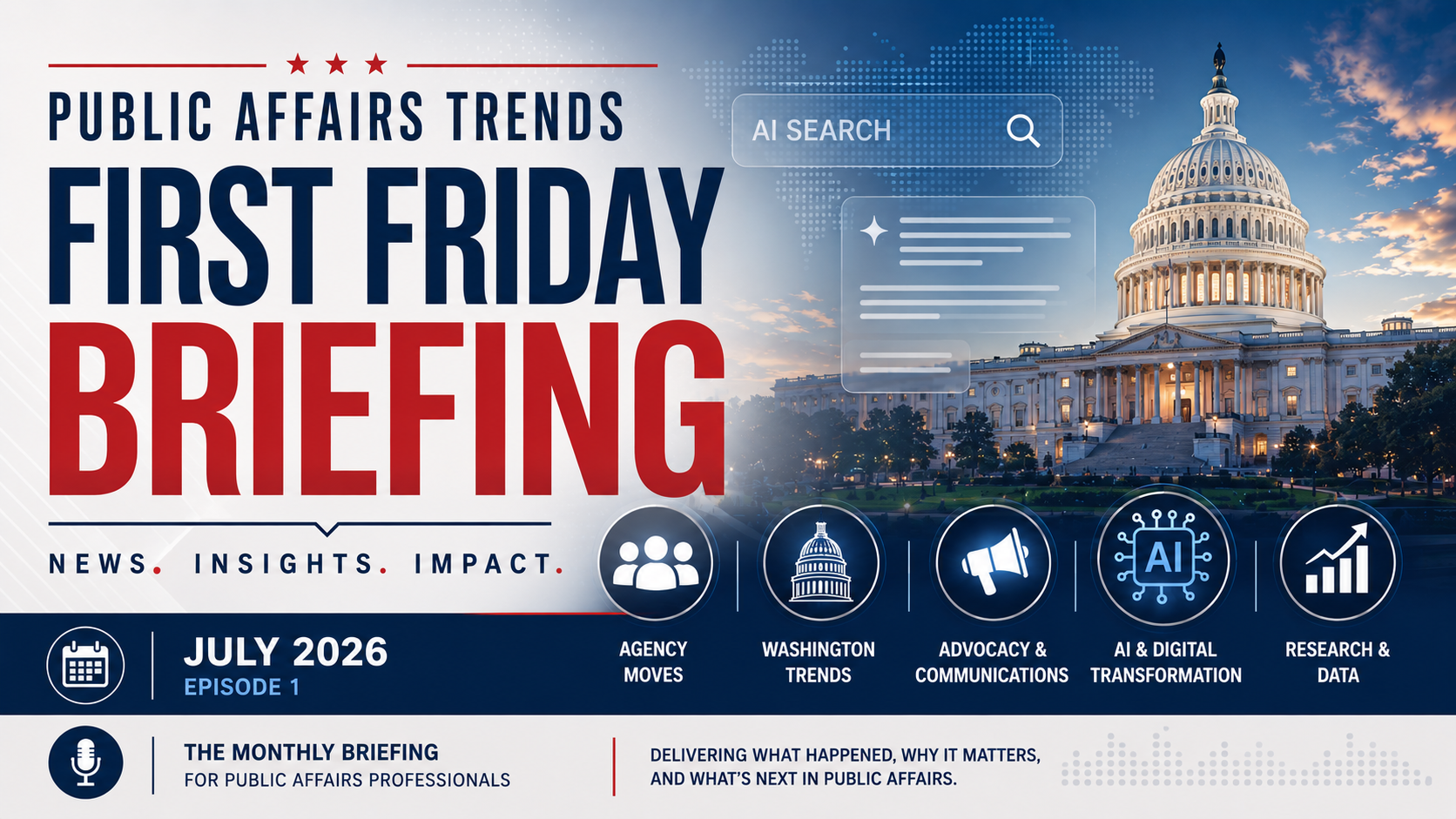
In the inaugural Public Affairs Trends First Friday Briefing, host Neil Hughes rounds up the month’s most important developments affecting public affairs, government relations, advocacy, and strategic communications. This episode covers DCI Group’s expansion of its public affairs team, Trident’s top industry recognition for crisis and litigation communications, how Google’s AI-powered search is changing digital advocacy, new research on AI visibility and media consumption in Washington, and what these developments mean for communications professionals navigating an increasingly complex policy landscape.
First Friday, July 2026: AI Search, Agency Growth and the Trends Shaping Public Affairs
Public Affairs Trends: July 2026 Briefing Highlights Industry Changes and AI Impact
Washington, D.C. — In the July 2026 episode of the Public Affairs Trends podcast, host Neil Hughes discussed significant developments in public affairs, including personnel changes at DCI Group, advancements in crisis communications, and the growing influence of artificial intelligence on advocacy strategies.
DCI Group, a prominent public affairs firm, announced the hiring of seven new employees and three promotions, as reported by DC Newsline. The firm added three senior hires: Dan Savickas, formerly with the Taxpayers Protection Alliance; Isabella Chambers, who previously worked in the UK Parliament; and Maggie Clemmons, a former press secretary at the U.S. Small Business Administration. The firm also promoted three account associates to account manager positions.
Hughes noted that these personnel changes reflect a broader trend within the industry, indicating a sustained demand for public affairs and strategic communications expertise. “Personnel announcements are not just inside-baseball,” he said. “They show where firms are investing.”
Trident, another key player in the public affairs arena, received Band 1 rankings from Chambers and Partners for both Litigation PR & Communications and Crisis PR & Risk Management. This recognition marks Trident's ninth consecutive year ranked in Litigation PR and its sixth year in Crisis PR. Founding partners Josh Galper and Adam Goldberg were also individually recognized.
Hughes emphasized the growing importance of crisis communications in public affairs. Organizations are increasingly focused on how their legal strategies will be perceived by policymakers, stakeholders, and the public. “Public affairs professionals need to understand reputation risk before, during, and after high-stakes disputes,” he said.
The episode also highlighted the transformative impact of Google’s AI search overhaul on advocacy efforts. According to Eric Wilson’s article in Campaign Trend, Google’s AI Mode is changing how users access information online. Instead of traditional search results, users are now receiving synthesized answers directly from Google, which could alter the first impression of candidates and organizations.
Hughes pointed out that this shift necessitates a reevaluation of how public affairs teams approach content creation and visibility. “Organizations need to understand what AI tools are saying about them and whether outdated or hostile framing is shaping the first impression,” he said.
Research from 5WPR further underscores this trend, revealing that citation share is becoming a new metric of visibility across AI engines. The firm’s State of AI Search 2026 report indicates that earned media remains a crucial factor influencing whether a brand is cited in AI-generated responses.
Avoq’s 2026 Media Habits Report revealed that 96 percent of Washington, D.C., policy insiders now use AI tools, with three in four expecting to increase their usage in the coming year. Hughes noted that this trend highlights the need for public affairs professionals to develop AI literacy and adapt their audience targeting strategies.
The episode concluded with a discussion of the ongoing convergence of public affairs and reputation management, as outlined in PRWeek’s recent coverage. Organizations are increasingly integrating public affairs, corporate reputation, crisis communications, and issue advocacy into cohesive strategies.
Hughes summarized the key takeaways from the month’s developments, emphasizing the importance of talent acquisition, crisis communications, and the implications of AI on public affairs. He urged professionals to watch for how organizations respond to the evolving landscape shaped by AI and to pay attention to hiring trends within major public affairs firms.
In closing, Hughes reiterated that the public affairs profession is becoming more integrated and technologically complex. “The work now sits at the intersection of policy, reputation, digital visibility, AI, and audience trust,” he said.
The Public Affairs Trends podcast will return next week with guest Jordan Lieberman, CEO at Powers Interactive.
Interview Q&A
Q&A: First Friday, July 2026: AI Search, Agency Growth and the Trends Shaping Public Affairs
Public Affairs Trends Q&A
Q: What is the focus of the Public Affairs Trends podcast?
A: The podcast provides a monthly roundup of stories, reports, agency moves, and technology trends shaping public affairs, advocacy, government relations, and strategic communications.
Q: What recent move did DCI Group make in the public affairs sector?
A: DCI Group announced seven new hires and three promotions, expanding its public affairs and strategic communications practice.
Q: Who are some of the new senior hires at DCI Group?
A: The new senior hires include Dan Savickas, Isabella Chambers, and Maggie Clemmons.
Q: Why are personnel announcements significant in public affairs?
A: They indicate where firms are investing and reflect the demand for public affairs, strategic communications, grassroots, and rapid-response capacity.
Q: What recognition did Trident receive in 2026?
A: Trident received Band 1 rankings from Chambers and Partners for both Litigation PR & Communications and Crisis PR & Risk Management.
Q: How does crisis communications relate to public affairs?
A: Organizations are increasingly concerned about how legal strategies will be perceived by various stakeholders, making reputation risk a critical consideration in public affairs.
Q: What impact is Google's AI search having on advocacy?
A: Google's AI Mode is changing how users encounter information, meaning the first impression may now be an AI-generated summary rather than the organization's website.
Q: What is the significance of AI visibility in communications?
A: AI visibility is becoming a new metric, with citation share indicating how often an organization is mentioned in AI-generated answers, impacting advocacy and public affairs strategies.
Q: What did Avoq's 2026 Media Habits Report reveal about AI usage among policy insiders?
A: The report found that 96 percent of D.C. policy insiders use AI tools, with three in four expecting to increase their usage in the coming year.
Q: How is audience targeting evolving in public affairs?
A: Different ideological groups are turning to various platforms for news, complicating the effectiveness of a single communications strategy.
Q: What trend is emerging in the integration of public affairs and reputation management?
A: There is a blending of public affairs, corporate reputation, crisis communications, and issue advocacy, requiring integrated teams to manage these areas effectively.
Q: What should public affairs professionals watch for in the near future?
A: They should monitor responses to Google's AI search changes, the marketing of AI visibility services, hiring announcements, and developments in crisis communications.
Q: What is the overarching theme of this month's briefing?
A: Public affairs is becoming more integrated and technologically complex, sitting at the intersection of policy, reputation, digital visibility, AI, and audience trust.
Key takeaways
- “DCI’s expansion points to continued demand for public affairs, strategic communications, grassroots, and rapid-response capacity.”
- “Crisis communications and litigation PR are becoming increasingly central to public affairs work.”
- “AI-generated answers create a new challenge.”
- “For years, organizations measured visibility through impressions, search rank, media mentions, web traffic, and social engagement.”
- “AI literacy is becoming a basic professional skill.”
About the guest
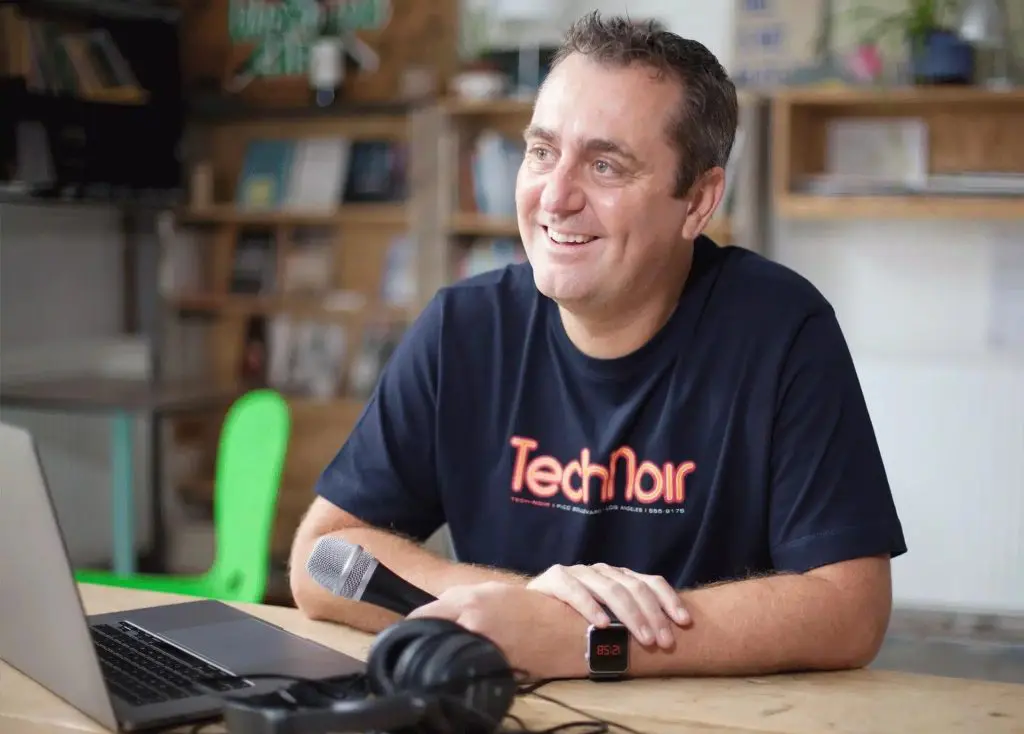
Host — Public Affairs Podcast
Full transcript
Show full transcriptHide transcript
Filed under
Related episodes
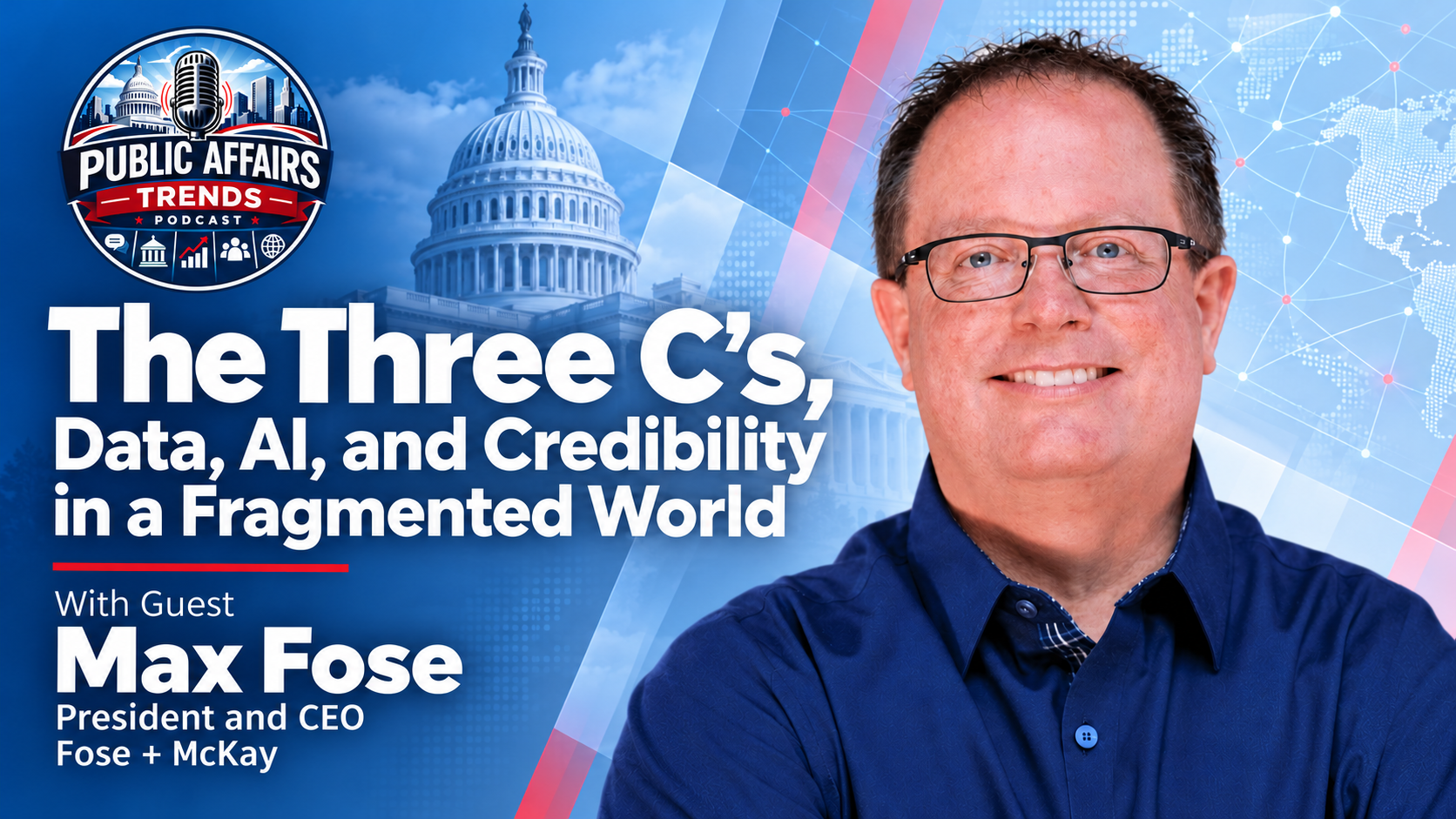
Max Fose on Public Affairs: The Three C's, Data, AI, and Credibility in a Fragmented World
with Max Fose
Beyond the Old Playbook: Why Human Conversations Win in Public Affairs
with Nicole Schlinger
First Friday, October 2026: AI, Trust, and What Makes Public Affairs Effective
with Neil Hughes
Disrupting Politics: Katie Harbath on Tech, Democracy and AI’s Impact
with Katie Harbath