2026-07-10 · Powers Interactive
AI, Data, and Trust: Reshaping Political Campaigns and Public Affairs with Jordan Lieberman
with Jordan Lieberman, Co-Founder — Powers Interactive
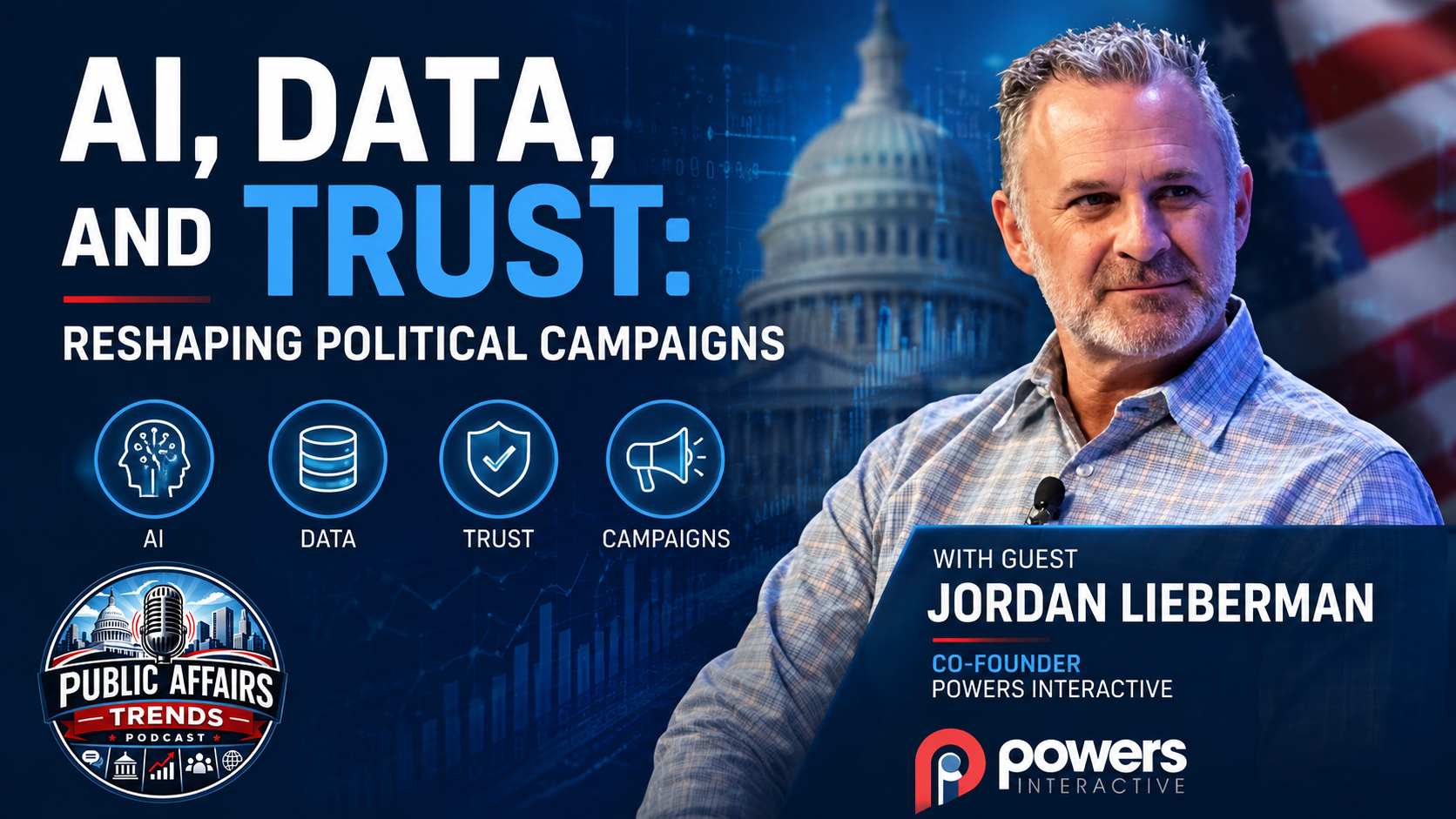
Jordan Lieberman, CEO of Powers Interactive, discusses how artificial intelligence and programmatic advertising are transforming political campaigns. He emphasizes the importance of trust and human judgment in a rapidly evolving digital landscape, highlighting the need for campaigns to adapt to new technologies while maintaining a focus on detail and urgency. Lieberman also addresses challenges such as misinformation and privacy regulations in the context of political advertising.
Jordan Lieberman on AI's Role in Political Campaigns and Trust
AI's Role in Political Campaigns: Insights from Jordan Lieberman
In a recent episode of the podcast "Public Affairs Trends," Jordan Lieberman, co-founder of Powers Interactive, discussed the transformative impact of artificial intelligence (AI) and programmatic advertising on political campaigns. Lieberman shared his insights on the evolving landscape of political marketing, emphasizing the importance of trust and strategic decision-making in an increasingly data-driven environment.
Lieberman, who has spent nearly two decades in the political advertising sector, noted that the speed of technological advancement has accelerated dramatically. "The things that we can do today, we couldn't do a year ago or two years ago," he said. He referenced Moore's Law, which describes the rapid increase in computing power, as a key factor driving innovation in political advertising.
The conversation highlighted misconceptions surrounding programmatic advertising. Many candidates and consultants underestimate the complexity involved, often believing that simply allocating funds will yield results. Lieberman pointed out that while digital advertising eliminates inefficiencies, measuring its effectiveness can be challenging, particularly in smaller communities where tracking ad exposure is difficult.
AI's integration into campaign strategies is reshaping how political organizations plan and execute their advertising efforts. Lieberman explained that AI tools allow for more efficient data processing, enabling campaign teams to focus on analysis rather than manual data handling. "What can you do that adds value to the AI tools already out there?" he asked, stressing the need for professionals to adapt and enhance their skills in this evolving landscape.
Trust remains a critical component of political campaigns, especially as AI-generated content and misinformation become more prevalent. Lieberman emphasized the importance of skepticism in evaluating information, noting that historical context is essential for understanding the current political climate. He urged campaign teams to educate voters about misinformation while maintaining a commitment to ethical practices.
As privacy regulations continue to evolve, Lieberman expressed concern about the uneven enforcement of these laws across different areas of political campaigning. He highlighted the need for transparency and accountability in data handling, particularly in the digital advertising space.
Lieberman also addressed the accessibility of sophisticated digital advertising tools for smaller campaigns. He noted that the decreasing cost of technology has made advanced marketing strategies available to candidates with limited budgets. "Smaller campaigns have access to the things that presidential campaigns did really recently," he said.
The discussion also touched on the urgency and detail orientation that characterize successful political campaigns. Lieberman pointed out that political professionals often operate under tight deadlines, a trait that can set them apart from those in other industries. He emphasized that attention to detail is paramount, as mistakes can have significant consequences in the fast-paced world of politics.
Looking ahead, Lieberman expressed concern about the increasing polarization of the electorate in the United States. He noted that this division is exacerbated by advanced microtargeting techniques and the fragmentation of media consumption. "We have not disliked each other as a country this much since the Civil War," he said, highlighting the implications for future political discourse and collaboration.
In conclusion, Lieberman underscored that while AI is reshaping how campaigns analyze data and engage voters, the fundamental qualities of trust, sound judgment, and quick action remain essential for success. As technology continues to evolve, he urged political professionals to strike a balance between automation and human insight, ensuring that technology serves to enhance decision-making rather than replace it.
For more information on Jordan Lieberman and Powers Interactive, visit their website or connect on LinkedIn.
Interview Q&A
Q&A: Jordan Lieberman on AI's Role in Political Campaigns and Trust
Q&A with Jordan Lieberman on AI's Role in Political Campaigns and Trust
Q: Can you introduce yourself and your role?
A: My name is Jordan Lieberman. I am the CEO of Powers Interactive, a programmatic digital shop focusing on politics, public affairs, and commercial work. We have been in this field for about 16 to 17 years, witnessing significant changes in data regulations and AI.
Q: What are the biggest changes you've seen in political campaigns?
A: The pace of innovation has accelerated dramatically due to Moore's Law. We can now do things we couldn't do a year or two ago, and technology is evolving quickly, especially in the political and public affairs sectors.
Q: What misconceptions do candidates and organizations have about programmatic advertising?
A: Many believe that simply investing money will guarantee ads will reach their audience effectively. However, digital advertising has complexities, and measuring its effectiveness can be challenging, especially in smaller communities.
Q: How has AI changed the way Powers Interactive operates?
A: AI allows us to focus on adding value rather than manual data processing. It enhances our ability to analyze data and optimize campaigns, which is crucial in a trust-based business like politics.
Q: What separates successful campaigns from those that fail?
A: Campaigns that start their digital strategy early tend to perform significantly better. Those that engage in digital advertising early can win by 10 to 15 points on average compared to those that delay.
Q: What inspired your work with Vendor Traps?
A: I noticed a lack of thought leadership on the anthropological side of political consulting. My research aims to provide historical context and insights into the careers of campaign managers, filling a niche that wasn't being addressed.
Q: How do you manage the vast amounts of data generated during campaigns?
A: The challenge is processing too much information. AI helps us analyze billions of data points efficiently, which was unimaginable five years ago.
Q: How do you balance long-term strategy with the need for quick reactions during a campaign?
A: We employ a barbell strategy that combines historical context with a strong work ethic. Understanding past campaign dynamics helps us avoid mistakes, while our team's dedication ensures timely responses.
Q: What challenges do campaign teams face regarding misinformation and AI-generated content?
A: Misinformation is not new, but the quality of content has improved, making it harder to discern truth. Educating voters on recognizing misinformation is crucial.
Q: How have privacy regulations impacted political campaigns?
A: Privacy regulations are often stricter in digital advertising than in other areas, creating a double standard. While we comply with these regulations, they should apply uniformly across all data handling practices.
Q: Have AI tools made digital advertising more accessible for smaller campaigns?
A: Yes, the decreasing cost of technology means smaller campaigns can access tools that were once available only to larger ones. We work with various budgets, ensuring effective strategies for all clients.
Q: What lessons can commercial brands learn from political campaigning?
A: Political professionals exhibit urgency and attention to detail, traits that are often lacking in non-political PR shops. This urgency can lead to better responsiveness and effectiveness in campaigns.
Q: What changes do you foresee in the political landscape over the next few years?
A: The polarization of the electorate is a significant concern. The divide between political parties is growing, leading to a lack of consensus and shared truths, which poses risks for the future.
Q: Where can people find more information about your work?
A: You can visit Powers Interactive online or connect with me on LinkedIn.
Key takeaways
- “The pace of innovation is such that the things I was hiring outside engineers for less than a year ago, Claude asked me this morning if I want to automate it.”
- “The better campaign doesn't always win. The better campaign doesn't always raise the most money.”
- “What I tell my staff is, is replace yourself. What can you do that adds value to the AI tools already out there?”
- “The challenge is now our senses are betraying us and we are seeing fake news as news and news as fake news.”
- “The price of technology is always inching towards zero, you know, smaller campaigns have access to the things that presidential campaigns did really recently.”
About the guest
Co-Founder — Powers Interactive
Jordan Lieberman is CEO of Powers Interactive, a programmatic digital company serving candidates, causes, and brands. He started his digital advertising career in 2010 with Audience Partners and has spent the subsequent decade leading digital teams through an acquisition and rapid changes in the business and regulatory environment. In 2015 he was a winner of the American Association of Political Consultants 40 under 40 award. Previously, he spent five years as a publisher of Campaigns & Elections magazine, where he helped create the Reed Award program and CampaignTech conference series. Before running the magazine, Jordan managed electoral campaigns and advocacy programs in the United States and abroad. In 2005, he was among the first Americans to travel to Ukraine to assist the successful Presidential campaign of Victor Yushchenko. He has lectured at Princeton, the University of Pennsylvania, and George Washington University. He has appeared as an analyst for CNN, Fox, and MSNBC and has appeared in the movies “Electile Dysfunction,” “Acorn and the Firestorm,” and the BBC documentary “Tea Party America.”
Full transcript
Show full transcriptHide transcript
Filed under
Related episodes
Max Fose on Public Affairs: The Three C's, Data, AI, and Credibility in a Fragmented World
with Max Fose
Beyond the Old Playbook: Why Human Conversations Win in Public Affairs
with Nicole Schlinger
First Friday, October 2026: AI, Trust, and What Makes Public Affairs Effective
with Neil Hughes
Disrupting Politics: Katie Harbath on Tech, Democracy and AI’s Impact
with Katie Harbath