Government • Public Policy • Public Affairs
Public Affairs Trends Podcast logo
← Public Affairs Trends

2026-07-17 · Echo Canyon Consulting

Matt Kenney on AI's Impact in Political Campaigns at Echo Canyon Consulting

with Matt Kenney, Founding Partner — Echo Canyon Consulting
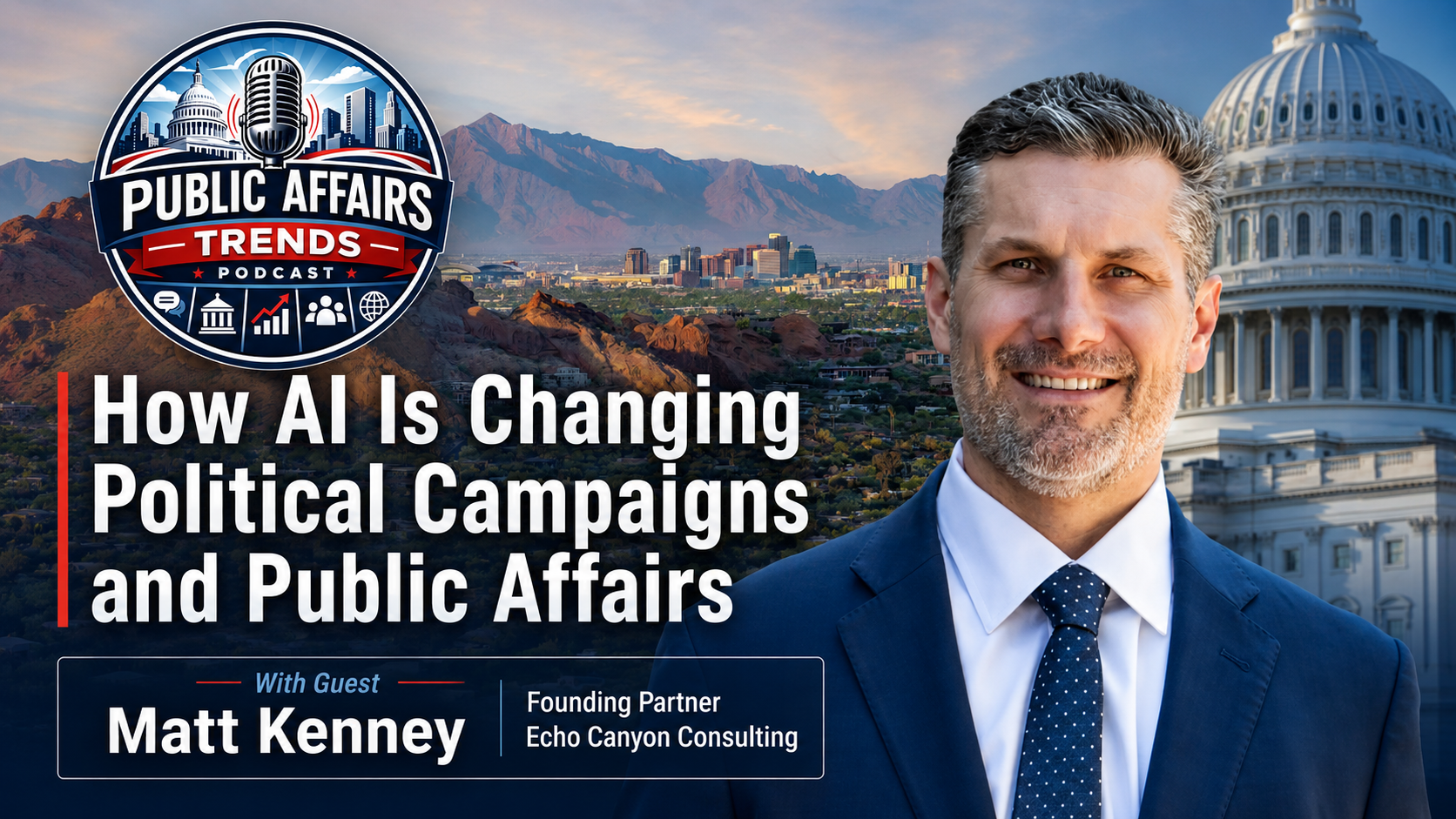
Public Affairs Trends Podcast episode featuring Matt Kenney discussing Matt Kenney on AI's Impact in Political Campaigns at Echo Canyon Consulting

In the podcast episode of "Public Affairs Trends," Matt Kenney, founding partner of Echo Canyon Consulting, discusses the impact of artificial intelligence on political campaigns and public affairs. He emphasizes the importance of authenticity in politics and outlines the differences between political consulting and public policy advocacy. Kenney also highlights how Echo Canyon Consulting assists corporations with public affairs and crisis management.

Matt Kenney Discusses AI's Role in Political Campaigns at Echo Canyon Consulting

0:00 / 0:00

Matt Kenney Discusses AI's Role in Political Campaigns at Echo Canyon Consulting

AI's Role in Political Campaigns: Insights from Matt Kenney of Echo Canyon Consulting

In a recent episode of the podcast "Public Affairs Trends," Matt Kenney, founding partner of Echo Canyon Consulting, discussed the evolving role of artificial intelligence (AI) in political campaigns and public affairs. Kenney, who has nearly a decade of experience in the field, shared insights on the intersection of technology and politics, as well as the challenges and opportunities that arise from this integration.

Kenney's background is rooted in Arizona, where he grew up in Tucson before attending Arizona State University. After serving as an active-duty Army infantry officer, he returned to Arizona to pursue law school. His political journey began with his involvement in Senator John McCain's re-election campaign, where he developed a passion for political advocacy and consulting.

Echo Canyon Consulting, founded by Kenney and his partners, has focused on political campaigns and expanded to assist various organizations, including trade groups and companies, with their government affairs challenges. Kenney emphasized the distinction between public affairs and political consulting, noting that while they share tools and strategies, public affairs focuses on broader organizational issues, whereas political consulting is more campaign-specific.

As technology has advanced, Kenney pointed out that the methods used in political campaigns have transformed significantly. He highlighted the shift from traditional voter outreach methods, such as bumper stickers and postcards, to hyper-targeted digital advertising. Utilizing data analytics, campaigns can now reach voters through their IP addresses and streaming services, allowing for more precise messaging.

AI has emerged as a significant player in this transformation. Kenney noted that organizations that embrace AI responsibly can make better decisions and operate more efficiently. Echo Canyon Consulting has developed its proprietary software, Australis, to enhance canvassing and voter contact operations. He believes that while technology is essential, the core of political engagement remains centered on authentic, people-focused communication.

Kenney also addressed the complexities of running effective campaigns. He acknowledged that unless individuals have firsthand experience in a campaign, they may not fully grasp the intricacies involved. The essence of successful campaigning, he stated, lies in delivering a compelling message to voters, a principle that has remained consistent over time.

The conversation also touched on the importance of authenticity in politics. Kenney noted that voters have become more discerning and can easily identify insincerity. He encouraged individuals to conduct thorough research on candidates and issues, particularly in an era where misinformation is prevalent on social media platforms.

Reflecting on the founding of Echo Canyon Consulting, Kenney described the challenges and uncertainties faced when starting a new firm. He credited his experienced partners for their extensive industry knowledge and emphasized the company's commitment to core values: tenacity, loyalty, and integrity. These principles have guided the firm's growth and fostered a supportive work environment, contributing to low employee turnover, which is uncommon in the political consulting industry.

Kenney explained the differences between election campaigns and public policy advocacy. While both involve strategic communication and persuasion, policy campaigns often rely more on data-driven approaches and educational messaging. In contrast, candidate campaigns require navigating the complexities of individual personalities and ambitions.

In closing, Kenney reiterated the importance of blending data-driven strategies with creative messaging in political campaigns. He underscored the role of AI in enhancing creativity and effectiveness in political advertising.

For those interested in learning more about Echo Canyon Consulting or connecting with Kenney, he provided details for reaching out through the firm's website and professional social media platforms.

As the political landscape continues to evolve, the integration of AI and technology in campaigns will likely play a pivotal role in shaping future electoral strategies and public engagement efforts.

Interview Q&A

Q&A: Matt Kenney Discusses AI's Role in Political Campaigns at Echo Canyon Consulting

Matt Kenney Discusses AI's Role in Political Campaigns at Echo Canyon Consulting

Q: Can you tell us about your background and what you do at Echo Canyon Consulting?

A: I am a founding partner of Echo Canyon Consulting. I have a unique background, having grown up in Tucson, Arizona, and attended Arizona State University. I served as an active duty Army infantry officer and later went to law school. My involvement in politics began while working with Senator John McCain on veteran advocacy and his re-election campaign.

Q: What is the difference between public affairs and political consulting?

A: Public affairs and political consulting are very similar, but we separate them at Echo Canyon Consulting. Our public affairs focus on helping associations and companies with their issues, while another department focuses exclusively on political campaigns. Both areas use similar tools for voter education and persuasion.

Q: How has technology changed political campaigns?

A: Technology has evolved significantly. We can now hyper-target voters using their IP addresses and advertise directly to their devices. Artificial intelligence has also transformed public affairs and grassroots engagement, offering both opportunities and challenges. We developed proprietary software called Australis to enhance our canvassing and voter contact operations.

Q: How can the average person understand the complexities of running a campaign?

A: It can be difficult for those not involved in a campaign to grasp all the complexities. However, the core of a successful campaign is still about effectively delivering a message to voters. Authenticity is crucial, as voters are becoming more sophisticated in discerning genuine candidates from those who are not.

Q: What challenges do voters face in finding accurate information?

A: Voters often struggle with misinformation on social media platforms like X. It's essential for them to seek out source material, such as official press releases or government information, to get to the truth about candidates and issues.

Q: What were the defining moments in establishing Echo Canyon Consulting?

A: Founding Echo Canyon was a significant decision, as we built it from the ground up without guarantees of success. Our team shared a vision for a values-driven public affairs firm, and we committed to core values of tenacity, loyalty, and integrity from day one.

Q: How does Echo Canyon Consulting retain its employees in a high-turnover industry?

A: We take pride in the fact that many of our original team members are still with us. We create an environment that encourages professional growth and offers support through training and development programs, which helps retain talent.

Q: How do election campaigns differ from public policy campaigns?

A: Working on public policy campaigns involves polling and focus groups to educate voters, while political campaigns require managing the candidate's personal dynamics. Both share similar tools, but candidate campaigns often involve more interpersonal skills and complexities.

Q: How does AI influence creativity in political campaigns?

A: AI allows for greater creativity in campaign strategies. It helps translate creative visions into tangible ads, enhancing the overall effectiveness of political messaging.

Q: Does Echo Canyon Consulting also provide corporate consulting services?

A: Yes, we assist various companies, including Fortune 100 firms, with public affairs and PR work. We help them navigate challenges and improve their brand perception, similar to how we would approach a candidate campaign.

Q: How can people reach out to Echo Canyon Consulting?

A: People can visit our website at echocanyonconsulting.com. I am also available on X at @mattkennyusa and on LinkedIn. My business partners, John Seaton and Ryan Price, can also be found on LinkedIn.

Key takeaways

  • Organizations that I think embrace these tools responsibly will be able to make better decisions, operate more efficiently, and deliver stronger results for their clients.
  • Politics, I don't think has changed in one specific way, and that's that this is a people business. It's a relationship business.
  • Voters are now becoming more sophisticated in that way in which they can start to sniff out frauds.
  • We really committed ourselves to three core values: tenacity, loyalty, and integrity.
  • I think that our greatest accomplishment is the team that we've built.

About the guest

Matt Kenney

Founding PartnerEcho Canyon Consulting

Full transcript

Show full transcript
How AI Is Changing Political Campaigns and Public Affairs [00:00:00] I'm Brian Hyde. Today, I'm joined by Matt Kenney. He's a founding partner of Echo Canyon Consulting and a specialist in public affairs with nearly a decade of experience. And Matt, glad to have you on the program, but I'm gonna ask you, tell us a little bit more about who you are and what you do. Brian, thank you so much for, for having me on and allowing me to represent Echo Canyon Consulting. Um, my background is a little unique. My business partners have been in the industry for 25, 30 years, uh, respectively. Um, I am an Arizona native. Uh, grew up down in Tucson, moved up here to go to undergrad, uh, at ASU. I've been paying for it ever since with my family, who are all Wildcats. Um, I did ROTC while I was in there, so I was in the, uh, active duty Army as an infantry officer for some time. Came back, uh, with my wife to Arizona, went to law school, and at the time, uh, [00:01:00] Senator McCain was going to be running for re-election. This was to the end ... Uh, the middle of 2013 or the fall of 2013. Um, and I found myself getting into, like, the veteran advocacy space and trying to find, like, how do I continue to give back? And, uh, Senator McCain, obviously at the time, chairman of the Senate Armed Services Committee, he was also very influential within the veteran and military community, started working with him on a number of different things and, um, you know, then ended up helping him with his re-election campaign, which is where I initially met my two business partners. Um, we have been primarily focused for the last, uh, 12 years on political campaigns, but about halfway through, you know, we saw an opportunity to really help other organizations, associations, trade groups, even companies, uh, you know, sometimes with their political or government affairs problems. And so we've [00:02:00] really expanded. Uh, we've gone through kind of multiple iterations of what the company would look like, um, but we think we got it right here with Echo Canyon Consulting and the people, uh, that we built it with. So I first have to ask, is there a difference between public affairs and, and political consulting or running political campaigns? Or are those just places where the lines cross? Yeah, I think that they are very similar, and oftentimes in the industry, public affairs, uh, firms or companies do political campaigns. We separated it just a little bit. Um, our public affairs is, uh, very much focused on helping associations and groups and, and companies, uh, with their problems and, and helping them get to the right solution. Um, and then we sort of have a different department that focus exclusively on political campaigns, candidate campaigns usually, but we've been involved in initiatives and things like that as well. You know, I think [00:03:00] that you use a lot of the exact same tools, right? We are doing public affairs, whether it's political or it's more like policy advocacy type of work. However, you know, you have to inform the voters, you have to do education, you have to do persuasion. All of that uses very similar tools, which is, you know, why we feel like we're, we are definitely, you know, one of the, the premier firms that do this in, in Arizona and one of the top in the country. So I have to ask this. Uh, in the, in the time that you've been involved with Echo Canyon Consulting, um, technology hasn't exactly stayed, you know, in, in one place. Have things changed in the way that, uh, that you would do public affairs campaigns or political campaigns? Um, I, I'm curious if, if there have been, uh, changes that, uh, that might surprise people. Yeah. You know, one of my favorite, uh, books and one of the first things that I read when I started to get more politically involved or really in the political industry was a book called How to Win Elections by Steven [00:04:00] Shadegg. You remember, um, Shad- or I'm sorry, John Shadegg, and Shadegg was the campaign manager for Barry Goldwater, uh, multiple times, and so he, you know, used his expertise there. It's funny to go back there 'cause he talks about sort of like the timing of getting bumper stickers out there to do voter contact and, um, you know, doing the postcard, uh, campaigns with the legislative districts and things like that. You're absolutely, it has definitely changed. Uh, it has changed in some really incredible ways in that, you know, we can... W- we won't ever know how they vote, but, you know, you can, uh, hyper-target voters these days. And so, um, you know, whether that's using their IP addresses or, you know, being able to, to advertise directly to their cell phones or their streaming services, it is much more down to the micro level and hyper-targeted. Um, another area in which we've seen [00:05:00] transformation is just more recently is artificial intelligence. That has obviously had an impact on every industry, but I think public affairs and grassroots engagement are no exception. Uh, you know, and we view AI as both a significant opportunity, uh, and an important challenge. Organizations that I think embrace these tools responsibly, uh, will be able to make better decisions, I think operate more efficiently, and deliver stronger results for their clients. We have actually, uh, used it as an opportunity to develop our own proprietary software, uh, called Australis, and that enhances our ability to na- to in our canvassing and voter contact operations. So, you know, while technology continues to evolve, I think that the firms and companies that are gonna be most successful are those, you know, that can successfully combine that cutting-edge technology with the authentic people-centered communication. And, you know, politics, I don't think has changed in, i- in one specific way, [00:06:00] and that's that this is a people business. It's a relationship business. And so, you know, while I think technology can be supplemental, I don't think that it'll ever replace the, uh, retail politics that we have seen be successful over decades and centuries, honestly. Matt, in, in your line of work, um, there, there is so much that goes into these campaigns. How does the average person, even those who consider themselves, you know, politically active in that, you know, "Well, I get informed and I, you know, I go to political events, and I read the literature, and I go out and I vote," but how aware are they really of everything that it takes, you know, to, to conduct a proper, effective campaign? You know, unless you spend, um, a cycle or two inside of a campaign, I'm not sure that you would ever understand, uh, all of the complexities. However, I do think that at the bottom line, it's really about getting in front of the voters and delivering a message that's effective to them. I [00:07:00] don't think that that part of it has really changed all, all that much. Uh, we see it over and over again. Um, I was on a panel recently for Campaigns and Elections. That's kind of a big company that, uh, prides themselves on delivering that type of, uh, industry information to professionals about how to be most effective. And, uh, what we ar- started to discuss is what would you argue is the most important thing in politics today? And whether you're talking about, uh, President Trump or, uh, Kamala Harris or Governor Hobbs or Governor Ducey, what, what, what the s- the, the similarity there is, is authenticity. And, um, I think that voters are now becoming more sophisticated in that way in which they can start to sniff out frauds, right? Um, and so I think that it's important for people to go do the research and do their informa- uh, do their digging [00:08:00] on, on, on the, on the candidates to figure out if they're the right person that they want representing them, you know, in their district or in the state or in the country. Um, but I do think one area that we could be better at is not believing all of the stuff on social media. I mean, X being a perfect example, it is filled with misinformation and disinformation. There are now studies out there about that, and it's really difficult, I think, for voters to figure out what the truth is. And I think that the best way to do that is to go try to find source material. Go and look at, you know, what's going on in the government or even what the f- the, the official press release is, either out of campaigns or, you know, depending on the issue that they're focused on, uh, what the company has put out. Because I think that once you start to dig into issues, they're almost never as salacious as you think they are. Well, actually, I'll take that back. In Arizona, we've had some salacious candidates in the past and, and maybe currently. But I do think that for the most part, you know, [00:09:00] um, a lot of this is spin, and that's what political consultants are sometimes really good at, especially your communications people. Um, and that, I, I can see that that being really difficult, but I think, um, doing your due diligence and doing the research necessary will, will get you to the right place. Let's pivot to Echo Canyon Consulting and talk a little bit about your company. Um, walk us through the process. How do you build something like this? This was, this was not an existing company. Um, was it hard to get it off the ground as, as you first started? Yeah. No, I think that that is one of the most defining moments of our company's history, was that decision to build something new from the ground up with no guarantees of success. But Echo Canyon was founded by a group of individuals who really had a shared vision for what a values-driven public affairs and grassroots engagement firm could be. Uh, and what we decided was we were tenacious enough to, to take on that, that, uh, that goal. I will brag about my business partners. [00:10:00] Like I said, they've got, you know, a combined 50 years of experience in the industry. Um, you know, one of them is a specialist in political campaigns and has been doing it for a long time, has done hundreds of them. So, uh, a- and through that you build a lot of relationships too. So I do think that we had a pretty good strategy going into it on how we were going to be successful, and what type of brand Echo Canyon would be and how we were going to, to stand apart. But in addition, like from day one, we really committed ourselves to three core values: tenacity, loyalty, and integrity. You know, tenacity gave us the determination to overcome challenges and continue growing even when the path forward was uncertain. Loyalty helped us build lasting relationships with our team members, clients, and partners. And integrity ensured that we always put honesty and trust at the center of our work. I think with that sort of combination of those core values, we really felt like we could be successful and that there were some, [00:11:00] uh, competitive advantages that we had o- over other firms in the country. And talk about, uh, you know, the, the people who have not only been with your firm, but stayed with your firm. My understanding is this kind of work, political consulting and policy work, i- is a very high turnover kind of business. Uh, talk to me a little bit about Echo Canyon. Yeah, uh, just to add on to that, I remember I did an internship in Washington, D.C. for a summer, and in that briefing you get the standard staffing briefing. And I think that they said that the, you know, average life cycle of a staffer in Washington, D.C. on the Hill was, like, nine months long. So you're absolutely right. This has one of the fastest turnovers, and politics is also filled with a lot of really ambitious people who wanna, like, you know, get to the next level as, as quick as they possibly can. So we do, um, feel not only lucky, but also have a lot of pride in the fact that almost everybody who [00:12:00] joined the company in the beginning is still with us. You know, and while our work in public affairs, advocacy, grassroots engagement, and political campaigns, you know, often receives a lot of the attention, I think our greatest accomplishment is the team that we've built. Uh, we've created an organization grounded in those core values, and we empower our people to grow professionally, take ownership of their work, and support one another through the successes and challenges. We have programs within, within the company in which, you know, you could go explore certifications or training or classes and courses, and our firm will pay for them because we wanna elevate you. Uh, more recently, uh, one of our staff members took a campaign course from Yale University. And so, like, you know, we- I think that we try to create an environment in which people, like, wanna work there, but also see where their future is going. And because we're a young company but an ambitious company, I think that our employees [00:13:00] also see that they can go somewhere with us. Like, we're headed somewhere, and they're, they're all, you know, welcome to come with us if they want to, and we're just generally really lucky that so many of them have stuck with us for so long. Matt, t- could you tell me a little bit about the difference between, um, say, an election campaign where you're trying to get a particular candidate elected versus trying to move the needle on, on public policy? Um, are, are they, are they, you know, different parts of the same animal, or do you have to take a, a very different approach when it comes to, um, affecting change in policy? Yeah, I would argue, um, not looking at, you know, this, w- we don't know what the issue is, but when you're working on a policy, I think that, uh, there are variables that you don't have in a candidate race that make it just a little bit easier. Um, you know, you, you stick to the science of campaigning. Of course, there's a little bit of art and creativity mixed in with that, but what I mean is you poll the issue, you [00:14:00] focus group the issue, you deliver an educational message to the voters, uh, you continue to persuade those people that, you know, weren't on your side, you know, based in the beginning, and then you basically get out the vote or you, uh, encourage whatever that action is, if it's a vote or if it's, you know, a change to some sort of a policy or rule or, or something like that. Now, on the political campaign side, as you can imagine, you also have to be dealing with the candidate, oftentimes the candidate's family, and that's... So that's like a whole nother variable where, especially if you have a first-time candidate, too, who's almost, like, learning this, trying to build the plane while it's flying, right? And try to really understand, um, what it means to create a political campaign that's successful. And so, you know, there's a little bit of a learning curve, and I think that there's more, uh, like, interpersonal skills that you learn from working on a candidate campaign. But [00:15:00] like I said at the, at the beginning of this, a lot of the tools are very similar, um, but that's the s- the sort of distinction that I would see between those candidate campaigns and issue-based ones is, you know, you're dealing with an actual human being person who has a personality, who has his or her own ambitions and, and desires, and wants to do things in a certain way. I like that you describe this as kind of a, a nice hybrid of art and science because the data, of course, is gonna play a huge role, and I think you mentioned earlier AI, um, in some ways has, has gotta be a huge game changer in terms of the data about potential voters or, or, uh, you know, who, who needs to be reached. But ultimately, it comes down to who are you gonna be able to persuade, and that seems like the real art form. Yeah, absolutely. And you can dig into that, right? You get the data, that's the science part of it, and then you really have to be creative. You know, we go to these conferences, these annual conferences for political consultants, and that are targeted around pol- uh, uh, elections and [00:16:00] campaigns and things like that, and I'm always, uh, very surprised in a good way about the creativity that's involved in those, uh, ads. AI has added a lot to that. You know, people can be more creative and make those visions that they have in their head become real to share with other people. That, I think, is one of the most exciting parts, is seeing the sort of creativity of politics, uh, grow using AI and seeing people's, you know, creative ideas, uh, come to fruition. And I, I just wanna be clear on this too. Uh, we talked a lot about, you know, public policy and advocacy, a- as well as political stuff, but, um, do you do a- do you also do, you know, corporate, uh, consulting as well? Like, if the- if people have, you know, p- p- corporations have public affairs that, that they want help on, um, Echo Canyon is, is someone they can turn to? Yeah, absolutely. We've been helping a, a number of companies, a couple Fortune, uh, 100 companies, and in addition, some very high-profile companies that [00:17:00] have been in the news in the last year or so with, uh, perception problems that, you know- were self-created. They shot themselves in the foot. And so then they're like, "Hey," like, "how do I get out of this? How do I help get my brand back to the way, uh, it was before?" And there is so many similarities between a campaign, we use a candidate campaign, for example, where, uh, you're building a brand around a person and you're using, um, you know, several different available methods to be able to do that. And so, you know, companies will, will reach out to us to do that type of, uh, public affairs and PR work. But in addition, uh, companies are, you know, subject to what happens down at the legislature and on Capitol Hill. And so we are also engaged by a number of government affairs and public affairs, y- you know, internal, uh, C-suite members to try to help them externally with, you [00:18:00] know, getting the ball across the finish line, whatever that may be for them. Okay, so final question then, Matt. How can people access you? How can they reach out to Echo Canyon Consulting? Our website is echocanyonconsulting.com. Uh, you can also find myself on X, uh, mattkennyusa. You can also find me on LinkedIn by just searching my name, Matt Kenney. You can also find John Seaton and Ryan Price. Those are my two business partners. You know, if you're, uh, i- if you're bored too, kind of digging into the work that they've done is super exciting. You know, Ryan has helped run multiple RNC, uh, conventions. John has worked on presidential, gubernatorial, Senate, congressional, a- a- anything that you can think of types of races. And, uh, so yeah, connect with us on LinkedIn, and we'd be happy to, to talk to you and see if there are ways that we could work together. Again, we've been visiting with Matt Kenney. He is a founding partner at Echo Canyon Consulting. Matt, thanks for joining us. Brian, thank you so much for having me. I look forward to [00:19:00] the next one.

Filed under

Related episodes