
AI in Public Affairs · United States
What is synthetic polling? How public affairs firms are using AI to read audiences faster
DCI Group partner Megan Bloomgren says AI-generated personas can give "a quick read on issues" before real polling validates the result. Here is how the method works and where its limits are.
Public Affairs Trends Staff · 2026-11-20
On the podcast: Public Affairs in the AI Era: Megan Bloomgren on Data, Coalitions and C-Suite Strategy
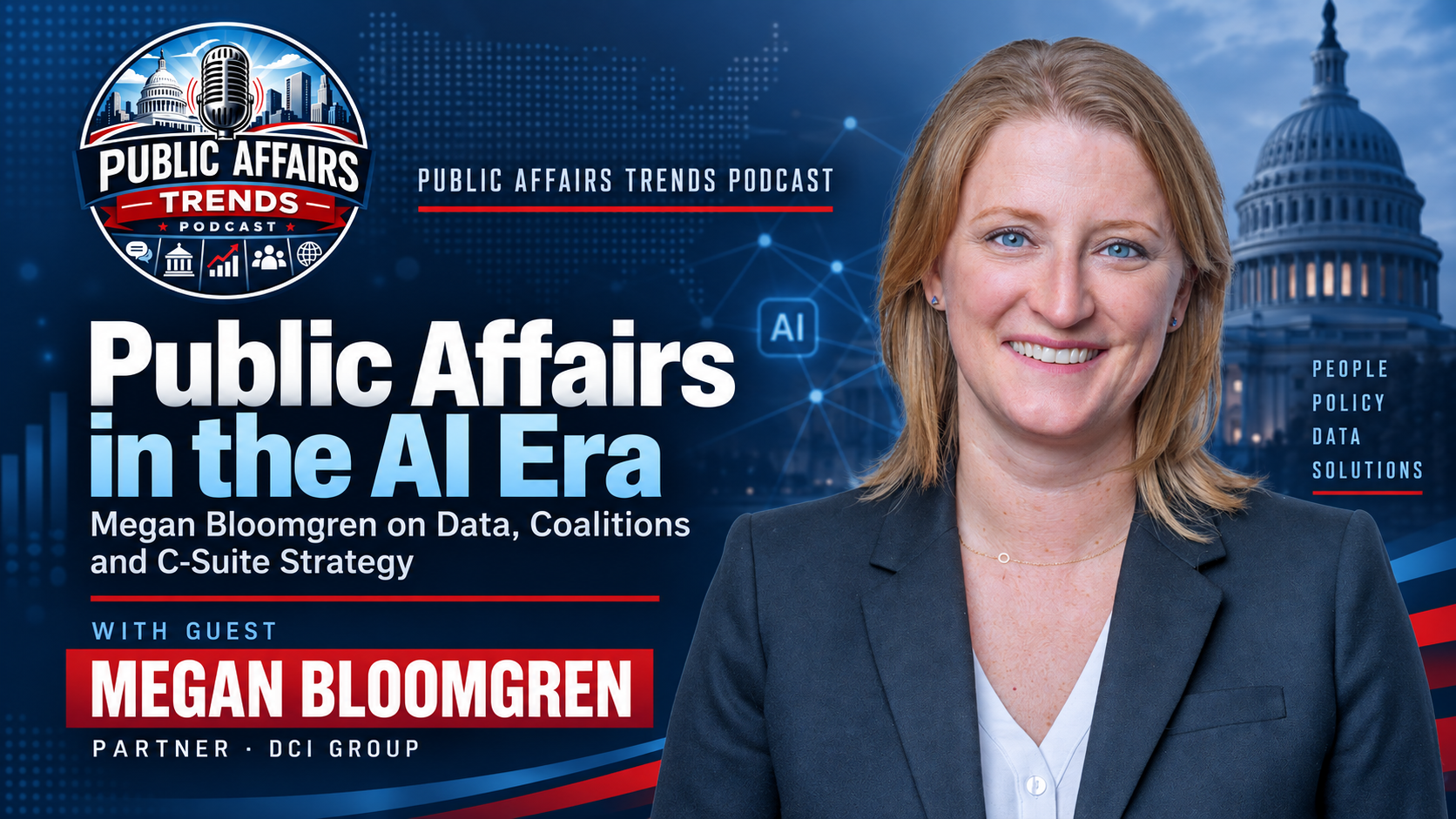
Based on reporting from Public Affairs Trends podcast (Megan Bloomgren).
The short answer: Synthetic polling uses artificial intelligence to simulate how a defined group of people would answer survey questions, often by modeling a panel on real voter-file records. Public affairs firms use it for a fast first read on an issue and then check the results against traditional polling. "There's synthetic polling that is personas that are actually giving you a quick read on issues before you actually go back and validate it with real polling," DCI Group partner Megan Bloomgren said on the Public Affairs Trends podcast.
How synthetic polling works
In one approach described on the Campaign Trend Podcast, researcher Matthew Hanauer, co-founder of Civly, builds a simulated panel of registered voters and uses AI to predict their responses, Public Affairs Trends reported. Hanauer said the method does not have AI fabricate data. It relies on real state voter files and public information about registered voters, such as demographics and donation history.
Hanauer checks accuracy by back-testing the method against previous elections, comparing results across many counties. He also runs the same questions through multiple AI models; large disagreements among them can signal a volatile race, according to the report.
How public affairs firms are using it
Bloomgren, who has worked in Washington for almost 30 years, described synthetic polling as one part of a broader shift in how AI is changing audience work. "The thing that is most interesting to me is leveraging AI for a number of different opportunities, particularly to quickly read data and create audiences at a speed that used to take a heck of a lot more, not precision, but work," she said on the September episode.
"The content creation part of this, the audience segmentation work, it has, has been really exciting," she said. On the same episode, she described how DCI Group builds audiences and matches them "across a variety of platforms using some of the Experian and other data that's available in the US."
She tied that work to results rather than activity. "We're big on outcomes as a firm, not as much on output," Bloomgren said. DC News Line reported on her comments Sept. 24.
Where synthetic polling falls short
Synthetic results are a first read, not a final answer. Bloomgren described validating them "with real polling." Hanauer found that adding more data can sometimes reduce accuracy, because social media data may replicate the biases of vocal minorities, according to the Public Affairs Trends report. He argued that synthetic polling is most useful for down-ballot campaigns without a research budget and for pre-testing surveys before committing money.
Trust is the other limit. In a survey of 400 Washington insiders released in June by DCI Group and Victory Phones, 81% reported that their organizations use AI, but only 4% expressed high confidence in AI-generated information. DCI Group said insiders "still rely on trusted, human-curated sources for verification."
Micah Roberts, a partner at Public Opinion Strategies, made a related point about traditional polling on Public Affairs Trends. "The best thing that the polling industry can do ... is be accurate, continue to do the difficult work to get as representative sample as possible," he said on an August episode.
How widely public affairs teams use AI
A Public Affairs Council benchmarking report found that 99% of organizations surveyed use AI, but just 7% said AI is embedded in strategic decision-making, and 12% have formal metrics to measure its impact, Public Affairs Trends reported.
Frequently asked questions
What is synthetic polling?
Synthetic polling uses AI to simulate how a defined population would answer survey questions. In one approach, researchers build a simulated panel from real voter-file records and public information, then use AI models to predict responses.
Does synthetic polling replace traditional polling?
Practitioners quoted here treat it as a complement. DCI Group's Megan Bloomgren described using synthetic polling for "a quick read on issues" before validating the results with real polling.
How do researchers check whether synthetic polling is accurate?
Matthew Hanauer back-tests results against past elections across many counties and runs the same questions through several AI models. Big differences between models can indicate a volatile race.
How are public affairs firms using AI beyond polling?
Bloomgren pointed to audience segmentation and content creation, including building audiences from consumer data and reaching them across platforms.
How much do Washington insiders trust AI-generated information?
Not much yet. In DCI Group and Victory Phones' We Ask DC survey, 81% of insiders said their organizations use AI, but only 4% expressed high confidence in AI-generated information.
More from Public Affairs Trends
- DCI Group on Public Affairs Trends: 2026 in review
- AI in public affairs, Public Affairs Trends topic hub
- Polling, prediction markets and persuasion, Public Affairs Trends topic hub
- AI transforms public affairs, says DCI Group's Megan Bloomgren
Share this
LinkedInXFacebookEmail