Government • Public Policy • Public Affairs
Public Affairs Trends Podcast logo
← Public Affairs Trends

2026-09-11 · DCI Group

Megan Bloomgren on Navigating Public Affairs in the AI Era

with Megan Bloomgren, Partner — DCI Group
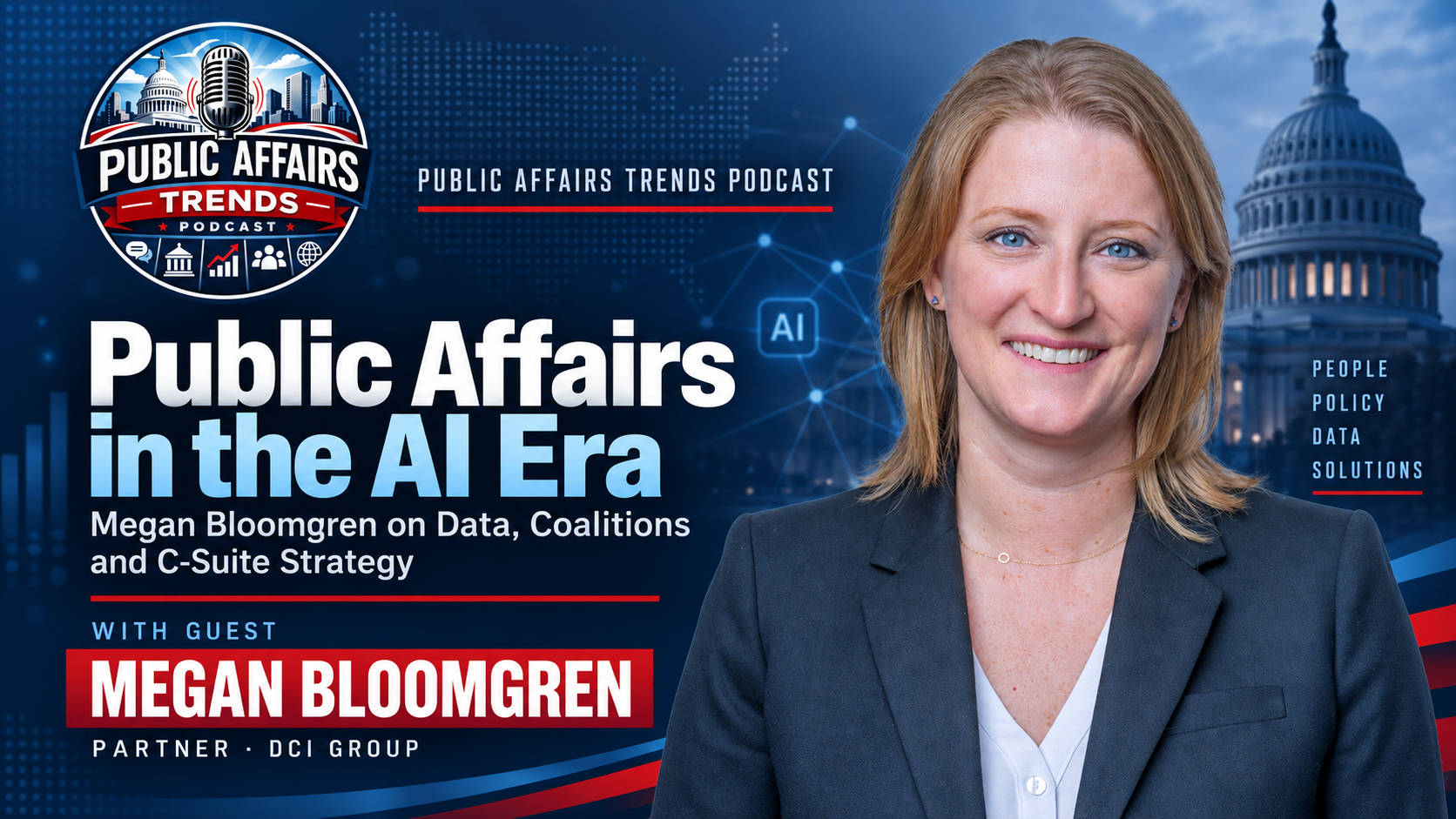
Public Affairs Trends Podcast episode featuring Megan Bloomgren discussing Megan Bloomgren on Navigating Public Affairs in the AI Era

In the latest episode of the Public Affairs Trends podcast, host Neil Hughes interviews Megan Bloomgren, a partner at DCI Group, about the evolving landscape of public affairs in the age of artificial intelligence. Bloomgren discusses the importance of data-driven strategies, coalition building, and effective communication for leaders navigating complex political and reputational challenges. She emphasizes the need for organizations to integrate public affairs with C-suite strategies to achieve meaningful outcomes.

Public Affairs in the AI Era: Megan Bloomgren on Data, Coalitions and C-Suite Strategy

0:00 / 0:00

Public Affairs in the AI Era: Megan Bloomgren on Data, Coalitions and C-Suite Strategy

Public Affairs in the AI Era: Insights from Megan Bloomgren of DCI Group

In a recent episode of the Public Affairs Trends podcast, Megan Barnett Bloomgren, a partner at DCI Group, discussed the evolving landscape of public affairs in the context of artificial intelligence and data-driven strategies. With nearly 30 years of experience in Washington, Bloomgren has worked with global business leaders, trade associations, and government officials, providing insights into the intersection of reputation, policy, and media.

Bloomgren began her career in government and political campaigns before transitioning to corporate communications. She spent seven years at the American Petroleum Institute, where she transformed the organization’s messaging and brand. “The P and the A in public affairs has always and will always stand for positioning an organization or an individual and action,” she said.

The Role of Data in Public Affairs

According to Bloomgren, the use of data has become increasingly vital in public affairs. Organizations must not only position themselves effectively but also provide actionable insights to their audiences. “At the end of the day, if you’re trying to get a drug approved in a state or position the broader affordability issue, you’re trying to meet people where they are,” she explained.

Bloomgren emphasized that the focus should be on outcomes rather than outputs. While media coverage and impressions are important, the ultimate goal is to influence public perception and drive action. “We’re big on outcomes as a firm, not as much on output,” she noted.

Rethinking Messaging Strategies

When discussing how organizations can rethink their storytelling, Bloomgren highlighted the importance of understanding the target audience. “We tier that out for different organizations,” she said. At the American Petroleum Institute, Bloomgren and her team focused on telling a compelling narrative about the energy sector's contributions to innovation and economic growth. “We wanted to make clear that we can achieve economic growth and enable greater security by having our own resources,” she said.

Bloomgren also acknowledged the challenges of communicating in a polarized environment. She believes that messages must be localized and humanized to resonate with diverse audiences. “Sharpening the message, making it short and sweet, and very relevant to our audience has been a really good formula for us to break through,” she stated.

Coalition Building and Credibility

Coalition building is a critical component of modern public affairs, according to Bloomgren. She identified three key elements that contribute to a coalition's credibility: breadth and depth, authenticity, and the ability to activate members. “If you have a leader from organized labor, a small business owner, a consumer advocate, and a local official reaching the same conclusion for different reasons, that can be really powerful,” she explained.

Bloomgren’s experience in political campaigns informs her approach to coalition building. “We don’t just identify allies; we recruit them and organize them,” she said. This strategy has proven successful in mobilizing support across various stakeholders.

The Importance of Integrated Strategies

As public affairs increasingly intersects with corporate communications and government affairs, Bloomgren stressed the need for organizations to operate from a unified strategy. “The only way to position is to be fully integrated as a C-suite and work in tandem,” she emphasized.

She shared an example of a crisis simulation conducted for a company, where a series of unfortunate events stemmed from a poorly timed tweet. “The push and pull has to do with the need to get out there quickly to define yourself before your silence is defined by others,” she said.

Embracing AI and Technological Advancements

Bloomgren expressed enthusiasm for leveraging artificial intelligence in public affairs. She noted that AI can facilitate rapid audience segmentation and data analysis, which were previously time-consuming tasks. “The content creation part of this, the audience segmentation work, has been really exciting,” she said.

She highlighted the potential of AI-generated insights to inform messaging strategies and improve engagement with target audiences. “You can get fast insights by looking at how certain people interact or comment online and get bigger conclusions,” she added.

Conclusion

Megan Bloomgren’s insights underscore the transformative impact of data and technology on public affairs. As organizations navigate an increasingly complex landscape, the ability to communicate effectively and build credible coalitions will remain essential. For more information about DCI Group and its services, visit dcigroup.com.

Interview Q&A

Q&A: Public Affairs in the AI Era: Megan Bloomgren on Data, Coalitions and C-Suite Strategy

Q: Can you tell everyone a little about who you are and what you do?

A: My name is Megan Bloomgren, and I am a partner at DCI, a public affairs consulting and business advisory firm. I have been in Washington for almost 30 years, with experience in government, political campaigns, and corporate boardrooms.

Q: How has the practice of public affairs changed since you began your career?

A: The fundamentals of public affairs, such as positioning and action, remain the same. However, the use of data has accelerated our ability to engage more people in debates and drive outcomes, rather than just focusing on outputs like coverage and impressions.

Q: Where do you begin when an organization needs to rethink its messaging?

A: We start by identifying the key audience and understanding the organization's brand and reputation. At the American Petroleum Institute, we focused on telling a proud story about American energy and its broader impacts, ensuring that the narrative resonated with various stakeholders.

Q: How do you approach difficult conversations with powerful leaders?

A: I often support presidential transitions and help leaders navigate the differences between the legislative and executive branches. Providing them with data and insights helps them see the bigger picture, even if they don't always take my counsel.

Q: What do strong leaders understand about reputation and political risk that others might miss?

A: Strong leaders recognize the importance of having good judgment and being data-fluent. They need to tie their communications efforts to measurable outcomes and understand how public affairs can impact their company's bottom line.

Q: What separates a message that gets noticed from one that changes minds?

A: Localizing and humanizing issues is key. Engaging experts and ensuring the message is relevant and concise helps in breaking through the noise and changing perceptions.

Q: What makes a coalition credible and what causes some to fall apart?

A: A credible coalition has breadth and depth, authenticity, and the ability to activate its members. It’s important to have diverse voices reaching the same conclusion for different reasons to create a powerful message.

Q: How should an organization structure its team for cohesive strategy?

A: Organizations should integrate their teams across corporate communications, government affairs, and risk management. This ensures a unified approach to addressing crises and positioning the organization effectively.

Q: What excites you about the industry at the moment?

A: I am particularly excited about leveraging AI to quickly analyze data and create audience segments. This technology allows for faster insights and more effective communication strategies.

Q: How do you see younger generations understanding the importance of oil and gas?

A: Younger generations may not fully grasp how oil and gas impact their daily lives. It's crucial to communicate these connections clearly, especially as they have grown up with technology that often obscures these links.

Q: What role does data play in your consulting work?

A: Data is foundational in our consulting work. It helps us identify audiences, tailor messages, and measure the effectiveness of our strategies, ensuring that we achieve desired outcomes.

Q: Where can listeners find more information about DCI Group?

A: Listeners can visit dcigroup.com and connect with me on LinkedIn at @MeganBloomgren for more information and potential collaboration opportunities.

Key takeaways

  • The P and the A in public affairs has always and will always stand for positioning an organization or an individual and action.
  • We're big on outcomes as a firm, not as much on output.
  • Coalitions are such an important part of sort of modern-day public affairs.
  • The test for us is really, will the allies of our organizations still make an argument when you're not in the room?
  • I think there's a demand in public affairs to have really strong judgment.

About the guest

Megan Bloomgren

PartnerDCI Group

Full transcript

Show full transcript
[00:03] Neil Hughes: Welcome back once again to the Public Affairs Trends Podcast. Now, my guest today understands what it takes to communicate when the stakes are incredibly high and the room for error is very small. Her name's Megan Barnett Bloomgren, and she is a partner at DCI Group and a trusted counselor to global business leaders, trade associations, cabinet secretaries, and elected officials, but her work sits at the heart of modern public affairs, a place where reputation, policy, media, and leadership increasingly overlap. So today I want to talk about how the profession is changing and what makes a message credible and how strong coalitions are built and what it really means to advise leaders through moments of pressure scrutiny, and uncertainty. But enough scene setting for me. Let me introduce you to Megan right now. So thank you for joining me on the show today. Can you tell everyone listening a little about who you are and what you do? [01:09] Megan Bloomgren: You bet. My name is Megan Bloomgren, and I am a partner at DCI, which is a public affairs consulting and business advisory firm. I've been in Washington almost 30 years, and I've spent about a third of my career in government or on political campaigns, another third around the corporate boardroom. I ran communications and public affairs for 7 years at the American Petroleum Institute, which is the largest trade association representing the kind of whole oil and gas supply chain. And then a third of my career here in consulting, both times at DCI. I'm what we call a boomerang, 'cause I started here 15 years ago and spent 6 years working and doing very interesting things in the healthcare and energy and financial services and tech space. And then went back into government and then over to API. And here I am back now for 2 years at DCI. Awesome. [02:06] Neil Hughes: And there's so much I want to talk with you about because you've had an incredible career, which has seen, like myself, the rise of the internet, the mobile, social media. Now we've got AI to contend with. So if you were to look back, how has the practice of public affairs changed since you first began your career? And also, what fundamentally has remained the same? Because it often feels like so much has changed, but so much feels the same. about what you've seen here. [02:32] Megan Bloomgren: You know, I think the P and the A in public affairs has always and will always stand for positioning an organization or an individual and action. So first, you gotta position the industry so the people who matter understand why it matters to them. And then you gotta give them a reason and a way to act. And what we've found increasingly is that using data to do that has accelerated our ability to really change issues dramatically and be able to get more people involved in the debate. And so we're big on outcomes as a firm, not as much on output. Obviously, we're looking at coverage and impressions, and those are really important for a lot of our clients. But at the end of the day, if you're trying to get a drug approved in a state or if you're trying to position the broader affordability issue, or if you're working to get a data center licensed and permitted, you're trying to meet people where they are. and position an issue so that their action is maybe neutralized or their action is to get involved in the debate. And so we've had a lot of success doing that with data as sort of the foundation. [03:41] Neil Hughes: And before you joined me on the podcast today, I was doing a little research and I was reading that at the American Petroleum Institute, you helped them transform the organization's messaging and brand. So I thought that this would be a great place to start. So where do you begin when an organization needs to maybe rethink how it tells its story, especially when there are so many different channels out there? [04:05] Megan Bloomgren: Great question. We're focused a lot on brand, which is how people talk about themselves, and then reputation, how others perceive them. And we really gotta start with who the audience is that's most important, and we tier that out for different organizations. But I think what we did at API was we looked at who we were, what we stood for, And how we saw, and frankly, were investing to shape the future. And there was a lot to be proud of on American energy, from the innovation and the grit and the risks that the companies were taking to power American lives and to enable the type of innovation that makes us the greatest nation in the world. And so we were really focused on telling that story unabashedly and not apologizing. We weren't we felt strongly that we were going to be the broadest problem solvers in the broader issue of global climate change, on energy security, and, you know, on the economic growth that was needed across the world. And so, you know, one of the things that I think about in a narrative is that spine of a book in many ways is who you are, what you stand for, but everybody writes a different chapter. And so we worked really hard to ensure that the industry's workforce, but also some of the downstream effects. So everything from, you know, oil and gas touches manufacturing, it touches retail, it touches transportation, of course, it touches, you know, the broader electricity markets. And so food and beverage. So we did a lot to be able to get others involved in the conversation, certainly healthcare. So many things that we use in hospitals are made and manufactured with oil and gas and the plastics that are in all of the infant needles and things like that. So anyway, lots of opportunity to tell that story, but also to recognize that not everybody is going to be for certain aspects of that, and that's okay. We, we wanted to make clear that we can achieve economic growth and, and, and enable greater security by having our own resources and making them available to the rest of the world, and then at the same time being able to do it cleaner, better, and safer than anywhere else. And that was a really big part of how we shifted the narrative there. [06:25] Neil Hughes: And I suspect that part of being a trusted counselor is sometimes on occasion having to tell powerful people what they might not want to hear. So how do you approach difficult conversations like that? Any stories you can share there? [06:41] Megan Bloomgren: I think the most interesting work that I've done has actually been supporting the presidential transitions of different cabinet secretaries. So I had the privilege of working on President Trump's first transition in helping his Interior Secretary nominee, Ryan Zinke, and then also this time around, the Energy Secretary, Chris Wright. And both of them came in with— I mean, Chris Wright obviously was an executive in the private sector but hadn't worked in the government. And then Ryan Zinke had worked in the legislative branch, which is awfully different from the executive branch. And so being able to translate some of the speak and help them to break through and be able to recognize what's the most important. They are 2 of the most savvy people ever. Ryan Zinke knew his brand like nobody else. He rode a horse to work on the first day because obviously the Department of the Interior is the Wild West. And I was clear. I said, you know, Mr. Secretary, I worry that people will be like, you know, screw you and the horse you rode in on. Or— And instead, it actually was a really important part of him being accessible to the whole team across the Department of the Interior. So sometimes you're wrong. And so I'm happy to admit that. But a lot of the folks that I've worked with over my career are engineers. And so when I have different data and information and am able to kind of weave that into how things could progress, it often helps them to see the full picture and be able to kind of take that counsel. And they don't always take it. That's part of being a consultant. But ensuring that they understand some of the most motivations of the media, some of the motivations of other organizations. And the data that defines where many of the consumers or opinion elites are is important to put in front of them, and they deserve kind of the straight talk. And I'm from Philadelphia and tend to give a lot of straight talk. [08:43] Neil Hughes: I love it. And of course, public affairs now sits much closer to the C-suite than it once did. So is there anything that the strongest leaders understand about reputation and political risk that maybe others often miss? [09:00] Megan Bloomgren: I think there's a demand in public affairs to have really strong judgment. [09:05] Neil Hughes: Yeah. [09:06] Megan Bloomgren: As a leader and more in corporate affairs generally, where you can oversee government affairs and corporate communications and things. I think leaders have to be more curious and they have to have a fluency with data in this day and age. Communications in many cases can be a cost center instead of an ability to kind of you know, bring, bring profit to companies. So you really have to be clear on what outcomes you're producing and tie a lot of your effort to data. So we do some work where we build audiences and we match those audiences across a variety of platforms using some of the Experian and other data that's available in the US. And then we have a higher knowledge of targeting those individuals to help them gain awareness on an issue or take a particular action if they're so inclined, or watch a particular video. And then with, you know, the right formula of frequency, you know, we often are able to engage them further and have them take an action in time. And that has everything to do with what your conversion rate is and how much you're paying for clicks and engagement and that return on investment. In many ways, the You're working closely with the CFO to ensure that your return is the highest you can get to get greater awareness on a product so people buy it, or from an issue standpoint, to neutralize or activate different parts of your main audience. [10:37] Neil Hughes: And the question I'd love to ask here, in an environment where audiences are more fragmented, sometimes polarized and skeptical, what separates a message that really gets noticed from one that actually changes minds? [10:53] Megan Bloomgren: I think the more you— here at DCI, we do a whole lot to localize and humanize issues from a corporate brand perspective. But we also have thousands of experts across the country from academia or from nonprofit groups or former elected officials who are really interested in getting involved in the debate and want to be educated. And so we do a good bit of outreach so that it's not just what you're saying as a company or as an industry association or as a nonprofit. But it's that kind of broader group that is educated about your issue and how they're talking about an issue. So we found that sharpening the message, making it short and sweet and very relevant to our audience and getting others to echo that and scaling that through some paid media has been a really good formula for us to break through. [11:44] Neil Hughes: Lovely. And of course, coalition building can look very straightforward from the outside, but competing interests often can make it quite messy. So from your experience and what you've been working on here, what makes a coalition credible and what is it that causes some to fall apart? [12:03] Megan Bloomgren: Coalitions are such an important part of sort of modern-day public affairs. We look for 3 things when we build coalitions. One is the breadth and depth of the coalition. The second is authenticity, making sure that it passes the smell test in many ways. And the third is the ability to activate that coalition to get more involved. 10 companies using kind of the same talking points isn't necessarily a coalition, but if you have a leader from organized labor, a small business owner, a consumer advocate, and a local official reaching the same conclusion for different reasons, that can be really powerful. It's been an important differentiator for us at DCI. Our roots are in political campaigns, so We don't just identify allies, we recruit them and organize them and engage them and give them ways to act increasingly online. And we can do that in all 50 states. So, you know, the test for us is really, will the allies of our organizations still make an argument when you're not in the room? And in many cases, people that we've educated, um, have, have built lasting platforms that outlive any interest or support from DCI. So we're proud of that work. [13:21] Neil Hughes: Well, if we zoom out for a moment, it's easy to see how communications, government affairs, grassroots activity, and indeed digital channels increasingly overlap. So how should an organization structure their team so that they are working from one strategy rather than so many different competing agendas? [13:43] Megan Bloomgren: I was just talking about this with a colleague. I mean, today, folks in corporate are incredibly talented. They know their organization in the communication space really well. And yet, you know, they're spending a lot of time on systems, structures, processes within their corporation. And in many cases, at the same time, you're seeing boards that are increasingly risk-averse. And, you know, because any move, any wrong tweet or policy position that they're in in a letter could mean major impacts to their valuation, issues with their board, issues with their job as CEO. And so the only way, in our view, to be able to position is to be fully integrated as a C-suite and work in tandem. We did a crisis simulation for a company out in San Francisco a couple of weeks ago, and we have a former CNN reporter that we hired here at DCI, and she did all these inputs into this crisis simulation. And so, you know, the CCO and the chief legal officer and the CFO were all sort of around a table and the CEO, and, you know, you had a class action suit filed and then you had a cyberattack where the system was down. I mean, all these things happening at the same time aren't necessarily as normal, but all of it was cascading from a tweet that the company inadvertently sent without it going through legal approval. So, you know, the, the push and pull has to do with the need to get out there quickly to define yourself before your silence is defined and filled by others and the ability to ensure you get it right and not have a knee-jerk reaction. And our experience at DCI with a lot of the Fortune 100 companies has given us the ability not just to come in when there's a crisis, but to help a lot of the companies avert those crises by watching trends as they're moving, putting stuff on their radar, helping update their crisis response plans and really their operating plans to ensure that they're putting emphasis in their strategy where it's going to really help them get there, the outcomes that they want from a policy perspective, from a reputation standpoint, and also from sort of a broader business operations standpoint. [16:02] Neil Hughes: And there's so much happening in the world of tech as well at the moment, and it's making us all or giving us all opportunities to work smarter, not harder. But I'm curious, with all the tools that you have and everything that you're working on, what excites you about the industry at the moment and what makes you want to jump out of bed in the morning? What's really got your focus in the industry? [16:23] Megan Bloomgren: The thing that is most interesting to me is leveraging AI for a number of different opportunities, particularly to quickly read data and create audiences at a speed that used to take a heck of a lot more, not precision, but work. [16:45] Neil Hughes: Mm-hmm. [16:45] Megan Bloomgren: And now, I mean, in many cases, there's personas that folks are watching online that are completely generated by AI. There's synthetic polling that is personas that are actually giving you a quick read on issues before you actually go back and validate it with real polling. So, and there's influencers online that are making you know, as much or more than folks that are kind of on the nightly news. So it's, to me, the content creation part of this, the audience segmentation work, it has, has been really exciting. I think change has been the new normal for many centuries. I think about it a lot because when we were at API, there was a heck of a focus on talking to younger generations about how oil and gas is part of your makeup, the headphones that you're wearing, the water bottle that's on your desk, your cell phone case. Like, and the idea was that that would help them understand the importance of oil and gas to daily lives. And yet this was a generation where there'd always been a new technological innovation to help with everything. So I didn't live in New York in my 20s. I always wanted to, but I was intimidated by like carrying big paper towels down the street because there was no Amazon or lugging lugging my laundry down 3 blocks. Well, fast forward 5 to 10 years, all of that is on an app in your phone. And so I was saying, I feel like younger generations may not yet be able to see how important oil and gas is. And if there was another alternative, that probably a Chevron or an Exxon or another company like that would've innovated and scaled it because they have that ability given all the billions that they invest in clean tech. And so Anyway, some of those insights that came through that polling and that understanding are really accelerated today because you can get fast insights by looking at how certain people interact or comment online and get bigger conclusions. So anyway, I'm kind of a tech nerd, or not a tech, a data nerd, and I'm proud of it. [18:58] Neil Hughes: And so you should be, Ali. That is a thought-provoking and powerful moment to finish on. So DCI Group is a full-service public affairs consulting firm specializing in strategic communications and advisory services. For people listening who want to find out more about what you're doing, about you and your team, where would you like me to point them? [19:19] Megan Bloomgren: To dcigroup.com. And I welcome any of your listeners to reach out to me on LinkedIn. I'm @MeganBloomgren. And we would love the opportunity to talk to anybody that's facing a challenge or just wants to chat about ways we could potentially partner. The industry is so dynamic and growing. And we always love working with partners. We do a good bit of work internationally, so it's nice to talk to you across the pond. [19:43] Neil Hughes: Well, thank you so much for sitting down with me today and discussing that evolving role of public affairs and what it takes to communicate effectively in today's complex environment. I will add links to everything in the show notes. I encourage people listening to go check you out, but thank you so much. Really appreciate your time. [20:01] Megan Bloomgren: Thank you, Neil. Appreciate it. I appreciate it so much. Great podcast. [20:04] Neil Hughes: Thank you.

Filed under

Related episodes