Show full transcriptHide transcript
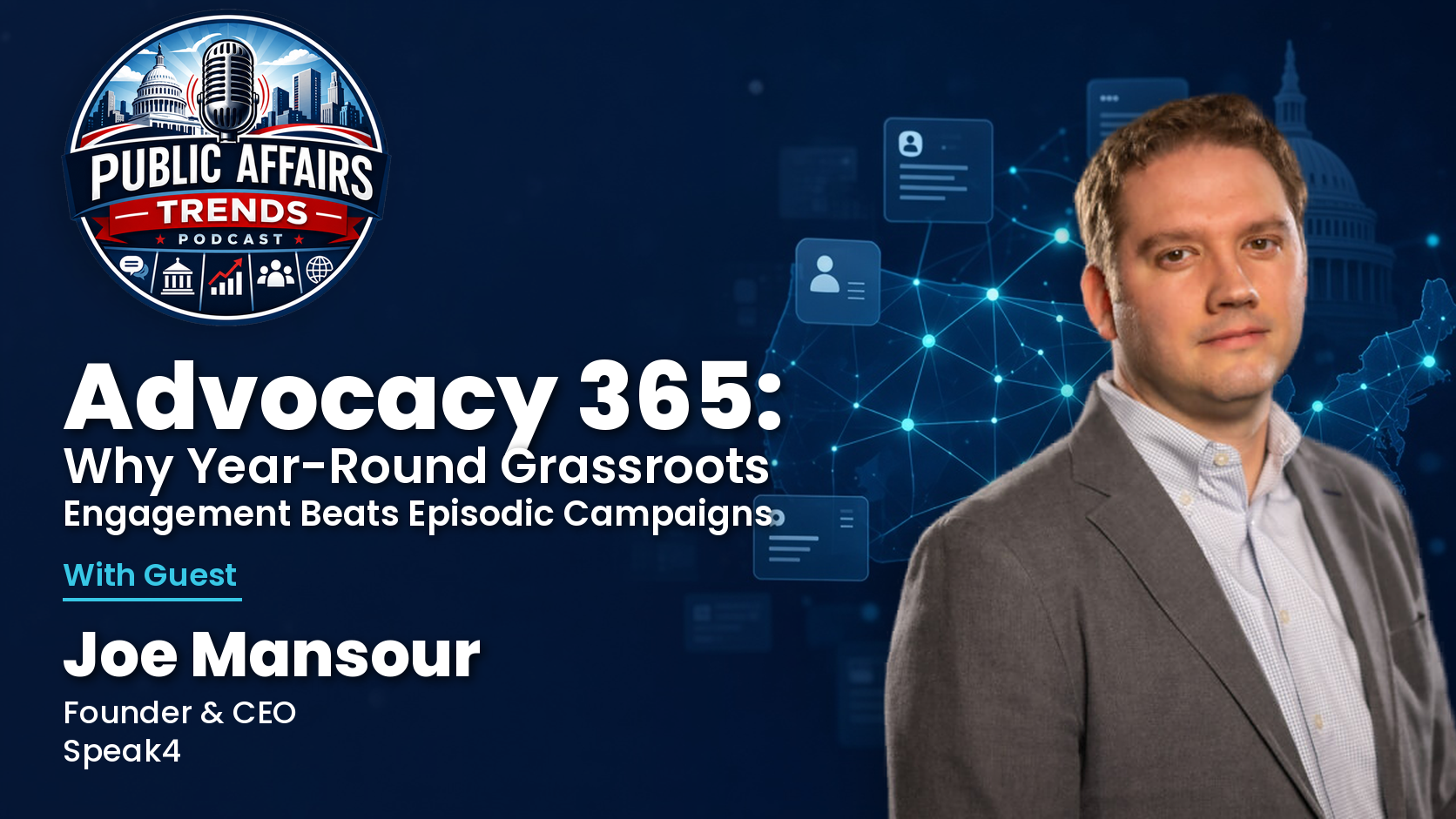
[00:03] Neil Hughes: Why do so many public affairs campaigns struggle to maintain momentum, even when they have access to more technology, data, and communication channels than ever before? For many organisations, advocacy still revolves around individual legislative battles. Supporters are mobilised, messages are sent, But the problem occurs when the campaign ends. Those relationships often go quiet. So what happens when the next policy challenge arrives? Well, my guest today is the CEO of a company called Speak4, and he brings 2 decades of experience in public affairs, digital advocacy, and grassroots mobilisation. And today I want to learn more about the practical value of what he calls Advocacy 365. And understand why consistent supporter engagement matters and how storytelling and technology can together help turn occasional campaign participants into long-term advocates. And I also want to examine the metrics that matter, from acquisition costs to advocate lifetime value, and understand where AI can genuinely help. Yeah, we're going to look beyond the hype today. So if you work in public affairs, there's plenty here to take into your next campaign. And with that scene set, let me officially introduce you to my guest today. So, a massive warm welcome to the show. Can you tell everyone listening a little about who you are, what you do, and tell us all about Speak4 too?
[01:44] Joe Mansour: Yeah, of course, Neil. Joe Mansour, I'm the founder and CEO of Speak4. I've been working in the public affairs space for— this dates me, but but basically 2 decades now, and been a practitioner. I, you know, started off in politics, I'm from Michigan, and then worked for a startup digital agency in DC, worked for a kind of bipartisan nonprofit, worked for all kinds of different sort of organizations, and then trade associations, Fortune 100 companies, et cetera, kind of running their digital advocacy and sort of public affairs programs. And about 5 years ago, Really got sort of fed up with some of the technology that was available in the space at that time and said, "Let's go kind of build a better mousetrap," and then started Speak For with a with a merry band of happy warriors to basically make it as easy as possible for professionals to build and run and sort of mobilize effective grassroots advocacy programs and campaigns. And so that's what we've been doing, and Speak For. Digital advocacy tool, sort of our tagline, sort of built by professionals for professionals, and really sort of focus on that mobilization of grassroots support, not just getting a large quantity of activation, but also quality. And how do you sort of move folks through that advocacy funnel to take higher quality actions like sharing video testimonials, telling personal stories, et cetera?
[03:12] Neil Hughes: And of course, it is an incredibly exciting time for the world of public affairs and digital advocacy. So I've got to ask though, why is it so many advocacy campaigns continue to fail? We've got more tools than ever. We've now got AI, et cetera. And where are they going wrong, so many of these campaigns?
[03:31] Joe Mansour: Yeah, what is there? There's an old line about happy families are all the same and unhappy families, they have— they're all different. You know, there's a lot of different reasons why campaigns fail. I think You could kind of simplify it down to a few things, but I think a lot of it is, you know, they sort of treat a program like it's like kind of a one-off incident. Like, hey, we have this bill, let's just sort of mobilize a bunch of support on this bill, and then we sort of wander off. And for us, that creates a lot of different issues. One, there's no follow-through. And so you're not sort of investing and sort of building an ongoing supporter base for the inevitable next fight that's gonna come up. I was listening to one of your previous episodes, Neil, and you talked about the importance of sort of owning the relationship with supporters versus renting it.
[04:25] Neil Hughes: Yeah.
[04:25] Joe Mansour: And it's like, it's like a similar concept, right? If you're just sort of renting that advocate interaction, you have no sort of vested value that you can go back to. And so that's a big problem. And then like, you're not able to react as quickly if you're just sort of like, I just gotta pop up, I gotta start from scratch. And, you know, it costs more. I also tell folks, you can pay me now or you pay me later. You know, if you're sort of starting your program from scratch immediately when you have a fight, there is a ramp-up cost. The technology, yes, but also like the list building, the recruitment, and then this— that's the staff time and resources to get all that up and going. Typically, the results are not as good as well. It's sort of a short-term sprint. You're paid more in sort of acquisition costs. And then I think probably the biggest sort of challenge with it is you don't have time to sort of move folks through what we call the advocacy funnel. There's a lot of metaphors for it, ladder of engagement, pick your metaphor, but you don't have time to do that with your supporter base, and that's a big problem. So, you know, look, crises are gonna happen. You know, you sort of go to army— go to war with the army that you have, but like, not sort of thinking long-term about your program and investing in it, that's, I mean, that's a big reason some of these programs fail, I think.
[05:45] Neil Hughes: Yeah, completely with you. And something I see on both sides of the pond is campaigns are, as you said, they're built around this one single event, and after that event, supporters go quiet and arguably sometimes even disbanded. So the teams that win though build advocacy 365 days a year. So they start every fight with their existing supporters. But What does all that look like in practice when we say that, that term advocacy 365? What does that look like?
[06:15] Joe Mansour: Yeah, so it's, it's, it's thinking year-round, not episodic, not like a one-off, like, oh, I'm gonna have this crisis, I'm gonna activate, I'm gonna send an email, run some ads, and then like sort of wander off. What does that mean practically? Um, when there's a major public affairs or sort of public policy fight, like there's a bill in Congress, do or die, we need to get a vote on it. The call to action is oftentimes very obvious. Send a message to lawmakers and be like, hey, please support or oppose this legislation depending on where you are on the issue. Got it. That's not rocket science. It's important. Um, but throughout the rest of the year, what could you be doing to keep your supporters engaged, aware, and sort of focused? So One of the big things, and a lot of folks that are really successful speak for it, is what I call story banking. It's sort of building stories and testimonials of your supporters about why they care about your issues, why it matters to them, and why lawmakers should care and pay attention. And so, you know, whether it's video testimonials, which I consider gold, written testimonials, you could do voice, there's a lot of different ways, but like smart organizations are doing that. And this is not a new concept. People have been doing this in the public affairs space for a long time, but it's still deeply effective because you can't replace that human sort of personal story. And then there's other tactics, sign a petition, take a survey, which also helps you better understand the issues and sort of priorities of your advocate base so you can better communicate and mobilize with them. Not just thinking, oh, the only thing I can do with my activist base is ask them to send emails to lawmakers. I think a little kind of a narrow aperture of how you can sort of activate supporters and then sort of sequencing them throughout the year and not letting your communications with folks kind of go silent. There's some data we have that when you sort of like wait 30 days sort of to communicate with an activist list, engagement drops 50%. When you wait 90 days, it can drop up to 75%. And so there's a real sort of penalty for not sort of continuing to engage with your supporter base, your house file, to borrow a term from sort of political fundraising, that costs organizations money.
[08:43] Neil Hughes: So for people listening in the industry here, how do they take their team from that one fight and scale to a year-round program? Because it might feel like an overwhelming or daunting prospect to many. So how can they move from that one fight to a year-round program?
[09:01] Joe Mansour: Yeah, I think, you know, I'll sort of simplify it to maybe 3 buckets.
[09:07] Neil Hughes: Yeah.
[09:07] Joe Mansour: Of ways to sort of think about it. One, I think, is time and, you know, staff time, sort of the physical time of the calendar. But like, what are you doing— to borrow analogy from sports, you know, what are you doing in the offseason to prepare, to get ready? You know, are you working out at the gym or are you eating junk food and watching Netflix? And so like, Exercising that muscle, you know, you need staff resources. You could be efficient and nimble with AI to sort of help you write content and stuff, but you still need a calendar, you need a messaging strategy, and then you need sort of staff bandwidth to do that, right?
[09:42] Neil Hughes: Yeah.
[09:42] Joe Mansour: Funding. So that's bucket one, time. Bucket two, I'd say, say is funding or money. You know, I said earlier, pay me, pay me now or pay me later. I think the argument I would make is pay me now is going to be more cost effective than paying later. But you got to, you got to resource it, you know, whether it's technology tools like Speak4 Or others, email sending, texting, you know, to sort of engage with folks, other aspects of your program, you know, funding for your staff to do the work. But there is that proper sort of resourcing this. And then, and then sort of the effectiveness piece, which I also touched on, like, you know, when you don't engage, when you don't do that, when you let the program lapse, when you don't sort of communicate with folks, whether it's 30 days, 90 days, or longer. Your engagement falls off. And what you'd see is, hey, I recruited a bunch of folks, 10,000-person list. I stopped communicating with them. I come back to them 6 months from now. No one's taking action. Why is that? Because you didn't engage.
[10:42] Neil Hughes: Yeah. And you mentioned AI there. When it comes to overcoming obstacles like time and funding and other resource challenges there, where is technology actually helping? What are you seeing there?
[10:55] Joe Mansour: I think, and this is, um, you know, I, I was listening again to some of the other guests on your podcast, and I think I agree with the general thesis of AI as the assistant.
[11:07] Neil Hughes: Yeah.
[11:07] Joe Mansour: As the helper. I think someone said Jarvis, you know, to take the Iron Man metaphor, but Tony Stark's still making the call. So I fundamentally agree with that. And, you know, the tech tools that are helping, I think, are Removing friction. They are removing barriers for folks to tell their story, to take action, but they are not trying to replace it, supplant it, or sort of be— get in front of people. I don't think, I don't think activists are looking for that, and I don't think policymakers are looking for that. And so tools like, um, Storyteller Mode, which lets folks sort of easily record and share a video testimonial, like that's really powerful. Tools like, you know, we have this kind of advanced message scheduling that lets our power users sort of sequence out, okay, people have taken action, now we're going to decide, okay, how are we going to deliver those messages from advocates at what time and, you know, sort of sequence that cadence. Like, those pieces, I think, make it, you know, reducing friction, kind of improving the overall quality of the advocate experience. and the effectiveness of the program, but not sort of replacing the advocate piece. And I think, I think when we think of like advocacy programs, there's oftentimes the thing is like, it's only like these really big, well-funded programs that can be impactful. And I don't think that's true. And in fact, oftentimes I'm like blown away when folks use our tools and they're just like, hey, you know, there was a Someone in my office actually—they live in D.C. and they were telling me how like hey there was like a neighborhood issue where they were like like there was like a local liquor store permit and they were trying to they didn't want it it was bad for the neighborhood and so they just like quickly spin up a speak for action page sent it around to the community listserv like no advertising got it's like a couple hundred letters but not thousands right yeah into like the local city council the mayor's office the like. like department in the city government that manages like liquor control. Then they got on like a call with like the neighborhood association and the relevant like approval board. And the approval board was like, we're getting all these letters from concerned citizens, like what's going on? And they were like, yeah, this is a problem. Don't do this. Bottom line, liquor license not approved. Like community won, not because they had a lot of money, but because they had a little bit of technology. They had a passionate group of like supporters and activists, and they mobilized and spoke up. And so it's stuff like that I think is really powerful to me. And again, it doesn't need to be millions of dollars and a million activists.
[13:55] Neil Hughes: Yeah. And the mantra in IT and business has always been, we can only improve what we measure. And knowing what metrics to measure though can be quite tricky. So for people listening, especially public affairs professionals, what can they be measuring to ensure that they really are moving the needle on this?
[14:15] Joe Mansour: So I talk about— we talk, we build our tools in terms of quantity and quality metrics. Yeah. Quantity means getting a large volume of activists to take action. And so what is that? What would you measure around quantity? Right. Well, okay. How many folks are taking action? What is your conversion rate on a landing page? Right. What's your cost per acquisition? So that's all sort of the quantity. And quantity is important. Quantity is a quality all its own, as you know, someone said. So quantity matters. But then the quality of advocacy. So like, how do I get folks to sort of move through that advocacy funnel to take a higher value action, write a custom letter, share a video testimonial, like make a phone call, attend an in-person event? And what you want to look for there, I think, is like number of actions taken, how many folks are sort of moving through that funnel, and then what is the advocate lifetime value? This is something you sort of borrow from like business and also sort of political fundraising. But like, if it costs me $10 to get an advocate and they only take one action, my cost per advocate— my cost per action is $10. If I pay $20 but they take like 100 actions, my cost per action is significantly less. And we just think fundamentally that's a better benchmark to look at, not just your initial cost per action, but how much advocate value do I get over the long term?
[15:35] Neil Hughes: And for people listening, I always try and give people listening a valuable takeaway here. And for those people listening, they're nodding their head in agreement thinking, Yeah, we are only focusing on one fight. We do need to maybe focus on a year-round program. What is the one thing that team could do this week to get on that journey?
[15:53] Joe Mansour: I think it's like one of kind of continual improvement, right? Like, you've won the fight. Let's say you just launched a fight. Hopefully, you won it. Maybe you didn't. Like, one, like, go back and communicate to your advocates. What happened? Like, this is such a simple mistake that I think some groups do this. Like, they won the vote and they don't tell the folks that they just mobilized what the heck happened. So go back and tell 'em, like, we won, we lost, but we're gonna be back. Like, go back and communicate to them. And then this is a second thing, but I'm gonna take the privilege, you know, like, ID one thing that worked and something that didn't, and then commit to sort of doing it a little bit differently. So those would be my 2 that would like help sort of build to it. Celebrate a win or communicate to your activists. What did we do? Did we succeed? Did we lose? What are we gonna do next? And then like do a quick teardown of your program and try and sort of what worked, what didn't, and what are you gonna change?
[16:50] Neil Hughes: Fantastic advice. I also love the story behind Speak4, how you were created by a team of experienced marketers, skilled technologists, and award-winning digital strategists just wanting to create this better tool to help organizations mobilize grassroots support online. And for anybody listening that would like to go on this journey with you, or maybe just carry on the conversation we started today, where should they go?
[17:14] Joe Mansour: Speak4.co. Come check us out. We've got a lot of resources there. You can also shoot me an email, joe@speak4.co. Would love to hear from you.
[17:25] Neil Hughes: Awesome. Well, we did cover a lot in a short amount of time there. I will include the links in the show notes. I encourage people listening, to get involved and continue this conversation. But more than anything, thank you for sparing your time today, Joe, at an incredibly busy time of year for you. Thanks again.
[17:41] Joe Mansour: Thanks, Neil.
[17:42] Neil Hughes: So a big thank you to Joe for joining me today and sharing some very practical advice that public affairs professionals can put to work immediately. One of the many things that stood out to me in our conversation today was the importance of treating advocacy as a continuous ongoing relationship. Rather than just a series of disconnected campaigns. And I think he made a particularly interesting point about engagement dropping when organisations stop communicating with their supporters. And his advice was refreshingly simple: tell your advocates what happened, whether you won or lost. Most importantly, explain what comes next. I also like the shift towards measuring advocate lifetime value and the quality of participation rather than focusing entirely on how many messages a campaign generates or how many followers somebody has. These metrics don't mean half as much as that advocate lifetime view. And as I said, the quality of participation. So you can learn more about Joe and his team over at speakfor.co. But I'd love to hear your perspective here. Is your organization building relationships with advocates Throughout the year, or are you still starting from scratch whenever the next campaign battle arrives? And after listening to today's episode, are you going to be doing anything different? As always, thanks for listening. Let me know— as always, thanks for listening. Let us know your thoughts. We'll be back again next week with another episode, but thanks for listening as always, and I'll hopefully speak to you then. Bye for now.