Show full transcriptHide transcript
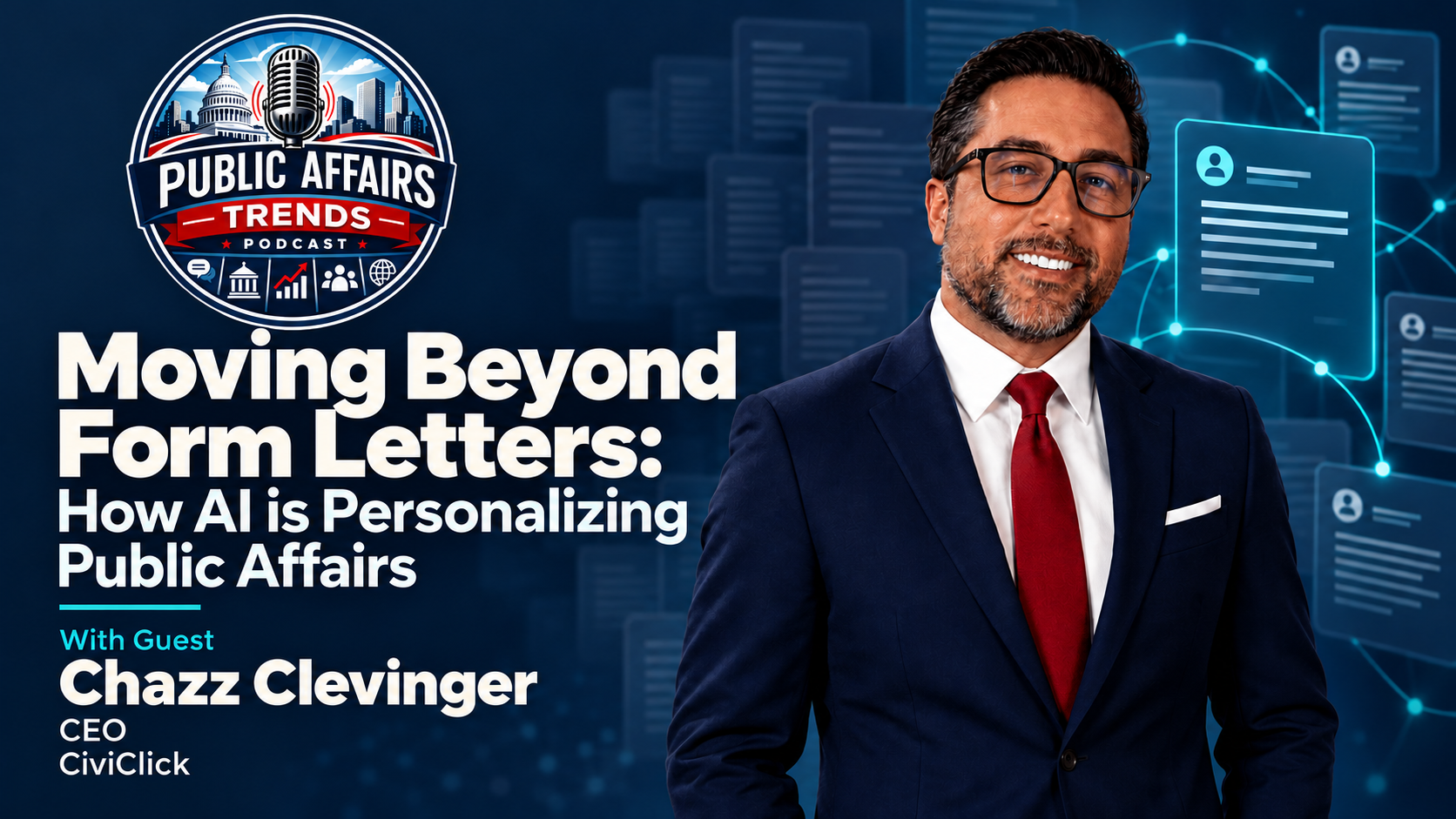
[00:03] Neil Hughes: AI is currently being pitched into public affairs from every direction, but how much of this is genuinely changing outcomes and how much of it is simply adding more noise rather than moving the needle? Well, my guest today is the founder and CEO of a company called Civiclick, a digital advocacy technology and data company, and he has spent much of his career building advocacy technology and watching the profession move from form letters and mass outreach to far more personalized engagement. So today we're going to discuss where AI is delivering real value, why authenticity still matters, and how advocacy teams can use technology without losing that human voice behind the message. But enough scene setting from me. Let me introduce you to my guest now. So thank you for joining me on the show today. Can you tell everyone listening a little about who you are, and what you do.
[01:02] Chazz Clevinger: Hi, Neil. I'm Chaz Clevenger. I'm the founder and CEO of Civiclick, a digital advocacy software, technology, and data company based in Washington, D.C., with offices in Los Angeles. We serve clients on federal, state, and local legislative and regulatory campaigns in the United States, as well as Canada, Australia, the United Kingdom, and European Union, and I'm very happy to be speaking with you today.
[01:30] Neil Hughes: And it's a real pleasure to have you sit down and have a chat with me. There's so much I want to be talking with you about. It's such a, uh, a big part of the year, and at this time right now, public affairs teams, they're all being pitched AI for just about everything, whether it's drafting advocate messages, targeting supporters, tracking legislation, writing reports. The list is almost endless. But I've got to ask, Where is it genuinely changing how campaigns get won and where is it still just another shiny demo? Because we've heard a lot of stories around AI over the last few years, especially about proving that return on investment, proving the real value. But what are you seeing here?
[02:11] Chazz Clevinger: That's a great question, Neil. I think a lot of people are asking that same question in our profession. I've spent 2 decades building advocacy technology. I started out working as an intern in the US Senate. and the White House. And then I moved on to work at CQ Roll Call, Phone to Action, 720 Strategies, and started CivicClick almost 4 years ago now. And so I've spent the better part of the last 15 years in the advocacy technology space, seeing things evolve, seeing them change, seeing them go from form letters to having the opportunity now where people can use AI to personalize messages. But I apply one test to every AI pitch that comes across my desk or that we consider internally for our software. And that question is, does this change what a legislative office actually sees or what a campaign manager actually decides, or a consultant or lobbyist, if you will, actually decides on a campaign? Most of being sold right now fails that test. There's a lot of great uses for traditional generative AI. You can go out and get subscriptions to Claude, Gemini, OpenAI, tons of great tools. But without the proper safety rails, it can be very challenging. And these tools are incredible in what they can scale and what they can do, but they're not designed for the public affairs space. They're designed for the broad economy, for the entire world. And the problem when you develop a solution for the entire world is, yes, it helps everybody and it's great, but it misses certain things in our industry. So let's start with advocate messaging because that's where the change is most profound. For 20 years, grassroots ran on a brutal trade-off where you could either have scale or authenticity, but not both. Form letters scaled, got batched as a single data point. Personal messages got read but couldn't be produced in volume. AI has killed that trade-off. When technology helps 10,000 advocates each tell their own story in their own words, and you get 10,000 genuinely different messages, and offices treat them differently because they're different, that's not a feature upgrade, Neil. That's the central constraint of the industry being removed. And that's really what we've tried to do at CivicClick is create ways for advocates to interact in a controlled environment. where a form letter that a lobbyist or campaign professional has written is taken. The advocate is taken through a very brief interview that maintains 90-95% of the core messaging points, but allows the advocate to have their own, their own take on it, right? Their own spin. So it's like going to your favorite restaurants and the server asks you, do you want your steak medium, well done? Everybody is still getting a steak, but you get that sense of getting it your way. And advocates really love that. They like the opportunity to do things like choose their tone. Do they want to be more formal? Do they want to be more happy? And if, Neil, if you and I were doing a campaign together, we might have an option on there. Do you want to be more British, more Queen's English, or more Yank, more American in the way that you wanted to convey yourself? The second area where AI is having a really big impact beyond helping advocates craft their own messages effectively, but more on that later about the importance of controlling it and keeping it tight because there are dangers with AI as well. But the second area is with policy intelligence, tracking Congress, 50 state houses, hundreds of cities used to require armies of analysts and lobbyists reading committee agendas at midnight, AI can now read everything, flag what touches your policy issues, have it briefed by morning, and just as important, it collapses the rapid response window so that if amendment drops at 9, you can have a targeted campaign live in the relative legislative districts by early afternoon. And a lot of fights in this business have been lost to lags in time. I certainly know that because for the last 15 years, hurry up and wait has been the main mantra that my clients give me oftentimes. But speed is a strategy now because you don't have to wait for information. You don't have to have it filtered through different layers, put up on a legislative or government website, and then wait hours or days for web crawlers to find it and for it to come back to you. It's there very quickly in real time and can help you act accordingly. And targeting is the third real win, though it's definitely the most oversold. Genuine value is knowing which of your 10,000 supporters is a small business owner in the chairman's district and who's likely to act this week, for instance, because those are the people that you're going to care most about. Who has, who has pull, who has sway with lawmakers? Which of your advocates have those genuine connections? And then also, who's likely to act? If you've got 10,000 people in database, but 90% of them are, are not moving or taking action or even opening up your email, then Really, you've only got like 1,000 advocates in that context. And where algorithms and AI promise to make those predictions, that's not always accurate, but it's a good finger in the wind and they're getting better. But there is no magic bullet. And so there is still a lot of human interaction needed, human excellence, human intelligence needed to help guide AI because AI is like a very highly capable child, but it still needs a parent. It still needs a human to guide it towards greatness. guide it towards how it can ultimately be impactful and serve humans rather than the other way around.
[08:00] Neil Hughes: And I suspect if you, myself, or indeed anyone listening were to open up LinkedIn now, have a scroll through, we'd all be able to instantly spot all the AI posts in there. So maybe it's unsurprising that legislative offices are now getting better at spotting and discounting messages that just lack— just look mass-produced. So When AI helps an advocate write to their lawmaker, how do you keep that message authentic enough to actually count on the Hill?
[08:28] Chazz Clevinger: Another fantastic question, Neil. I started my career answering constituent correspondence in a US Senate office, so I've seen this firsthand from the receiving end. Staff triage the email as soon as it comes in. We use a variety of different software platforms. Some of the popular ones in America are Fireside 21, gov, Internet Quorum, just to name a few. And so, the lawmakers' offices have these platforms to help them filter and screen communications that are coming in. I remember Brad Fitch, the Congressional Management Foundation, gave a talk a few years ago about how the average congressional office is getting tens of thousands of email communications a day. It's impossible for a poor 25, 26-year-old in a congressional office to be able to go through all of that on their own. They have to have systems in place to be able to screen that information. And so whereas in the past, 500 identical form letters would just get tallied as one data point in a spreadsheet, whereas a letter from a nurse describing what policy actually means for her patients gets read and flagged, and that would sometimes land in a member's desk. Because that would be unique. That would be something that, you know, as I, back as in when I was interning or as a legislative correspondent, would push on up the chain and might eventually make it to the member because that's what offices crave. They crave authenticity. They crave hearing the unique story of someone that can actually show up to the polls and vote for or against them and can tell them about what their life is actually like in the district. And just getting generic messages, all that really tells them is, oh great, we have 1,000 people in the community that generically care about XYZ issue, but how deep does that care, that urgency actually go? And so what AI allows for is instead of just having all these mass-produced messages, you can actually guide advocates towards an authentic message that helps, you know, pull their real voice out of them through some very basic survey questions and prompts. That help them create like a more authentic story, which helps the lawmaker be able to understand something more valuable and also helps the advocate convey something more valuable as well. So let me name the wrong answer, uh, you know, first about what, uh, half the industry is doing. They're just using AI to paraphrase a form letter and spinning the same 3 talking points into just unique variations. And That is not really what we focus on doing at CivicLeague. Staff can smell that, like if it's just very vague, very simple, just OpenAI-esque variations, like on a message. What you really have to do is you have to interview the advocate. You have to understand what they care about in order to be able to draw out like an honest response from them that isn't just purely the lobbyist's like form letter with a few words changed around. And so the key is capturing authenticity. Otherwise, you can risk burning your program's credibility with a legislative office. The right answer was to reverse the direction of the AI. Don't point it just at the lawmaker, point it at the advocate. Design the entire philosophy around connecting with that person. What do they do for a living? Tell me about your community. What is your actual lived experience with this policy issue? And then allow it to draft from those answers. Yes, we care about the lawmaker and whether they're in— if it's a parliament, whether they're government or opposition, or whether it's in America, they're Republican or Democrat. But ultimately, the advocate is the star of the story. They are— if it was a Shakespeare play, they're Othello, they're Henry, they're the star of the show. And where AI is best used is in highlighting what the real authentic story is from that advocate. And the advocate has to own it. Every message gets reviewed and edited if the advocate wants it to be. They have to approve it. And our test is simple. Could the advocate read that message aloud to their representative's face and stand behind every sentence? And if the answer is yes, then we've won. We've done what we needed to do in using AI and making it be effective without any of the negative consequences. And when the office sees that the email varies in length, structure, tone, story, because the people vary, then it's not just an evasion technique or detection, it's actual authenticity, which happens to be the only thing that survives scrutiny over time. Talk to any chief of staff off the record and they'll tell you the same thing. They discount volume if there's no variability, when there's no stories that stick out and remember. So the scale that AI can bring you in terms of volume is valuable only to the extent that you can also achieve, you know, variety. A pharmacist in Winston-Salem, North Carolina, explaining a reimbursement rule, its real-world effect on them, will outlast 100 messages that are just a repeat of what a Washington lobbyist has to say. Zoom out and remember that ghostwriting has always been a part of novel writing, of petitioning, of free speech. Lobbyists draft letters from CEOs all the time. Staff draft op-eds for members. Nobody blinks. The question that the First Amendment actually cares about was never who actually typed the words. It's whether the real constituents stand behind them, right? Very few presidents write their own speeches. A speechwriter does it, but the president stands behind what the speechwriter writes. And part of that job is to capture authenticity. So tools that help ordinary people articulate what they genuinely believe, without cheapening those beliefs, uh, those are the ones that people need to use, and those are the ones that public affairs professionals need to latch on to, to be able to help them be more effective. That's the point of how to be able to leverage AI effectively.
[14:30] Neil Hughes: And there are so many shiny new tech tools out there, but despite that, ultimately every campaign lives or dies on its list. And yes, I know AI now Promises to find your likeliest advocates, predict who's actually going to take action, and personalize that ask at scale. But I'm curious, from everything you're seeing and hearing here, what is genuinely moving recruitment and activation numbers? And, and what is still just slideware, for want of a better phrase?
[15:00] Chazz Clevinger: Well, let me start with a blunt truth. I cannot conjure a list. Anybody promising an algorithm is going to find you a million new supporters is selling slideware. Recruitment still runs on the value exchange it's always run on. You have to give people a reason to care and a stake in the outcome. What AI genuinely changes is the math on everything downstream of that. Who you reach, how you ask, how much of your earned audience actually converts into action, who is most likely to take action based on historical performance, depending on how much data you have and how much past history you have on those advocates and supporters. So that's really where the AI value comes into play is in helping you understand the audience that you're reaching out to, helping you understand who might actually care about this, who opens the emails, who's taken action on past campaigns, who has a higher propensity to be involved in this campaign. But it's not actually gonna do much for you beyond just helping you understand some of those basic predictive analytics around who might be a supporter for you. The first real capability is propensity on that scoring file. Instead of blasting 50,000 people identically and burning out your list, the model will tell you who to act on which issue through which channel, what time of day, things of that nature. That's the difference between treating your list like a megaphone and treating it like 50,000 actual individual unique persons. Activation rates climb, unsubscribe rates fall because you're targeting the right people at the right time. The lists stay healthier longer. It's unglamorous. It takes work. It doesn't demo like magic, but it's working quietly across the industry now. Like, that's what we do with CiviBoost, right? Like, I mean, we have like a huge owned audience network of activists that we market campaigns to on behalf of our client. And you better believe that we're using AI to help us understand based on historical performance whether somebody is likely to actually have an interest in an issue. 'Cause it does us no good, it does our clients no good to show an advocate a campaign or to push a campaign to them that they don't care about, that they're not interested in, because that's just another unopened, that's another unsubscribed, that's another impression that got no clicks. The second part is matching, finding the right person rather than just more persons, right? Because the ad industry is modeled off of just showing thousands, hundreds of thousands, millions of impressions to a supposedly targeted audience, right? So if you dump a bunch of data into Meta, for instance, yes, it can find you lookalikes. And yes, you can go model data with dozens of different professional modeling companies and hopefully have a better audience to model off of when you're dumping that data into Meta or a demand side or supply side platform. But Ultimately, you're still wasting tons of impressions on people that don't care about your issue. This is the modern-day equivalent of what I used to deal with 20 years ago when I was a young political consultant when it came to buying TV ads. I remember just thinking how silly it was here in America that if you wanted to buy cable advertising or you wanted to buy broadcast television, preemptive or non-preemptive ads, In certain markets, you would have to buy a bunch of airtime in areas that weren't even part of your candidate's legislative district. So I remember having candid conversations with candidates. I'm like, well, we can go on TV, but 50% of those ads are going to be shown to people that can't even vote for you. I mean, are you sure we still want to buy it? And the answer was usually always, well, yes, because TV was always a vanity purchase regardless of whether it moved the needle or not. And oftentimes party caucuses like to see TV, and TV was a sign that you were a real candidate and you had a real shot. But there was just so much waste in terms of showing ads to people, it didn't matter. And now the modern-day equivalent of that is digital advertising, because even with all the hype, even with all the selling points of like, oh, we can micro-target your audience and it'll be perfect and you'll save so much money versus as TV or billboards and airports. That's true. Yes. Compared to billboards and airports and TV, yes, digital advertising is way more targeted. But you know, the, the problem is, is that you're still wasting a lot of money on impressions a lot of times. And where AI can help, if you have an owned audience or if you have an organic audience you've built, is if you design like the right AI agents and the right tools, it can help you drastically cut down Not only in the money you spend, but the time you spend. And then also the advocate fatigue, 'cause you burn people out when you send them too many alerts or you send them too many things that they don't care about. And you ultimately drive up the costs on your campaign, which isn't good for anybody. And so the third is personalizing the ask itself, the action page, the email, the message of the experience. You can always go off of your gut, and that's what many public affairs professionals, including myself, have done many times throughout our career. One of the things that AI can do is it can check you and say, all right, this might be what your gut says, but this is what history says. This is what historical performance says. This is what campaigns run at this time of the day says, or these types of policy issues with these group of advocates, you know, say. When each step of the funnel speaks to the actual person individually rather than just a generic supporter or completion rates, those gains compound and a campaign converts meaningfully better at every stage versus just taking a more broad-based approach. Now for the slideware, co-registration is a methodology that can scale very quickly, can get you a lot of names, but real names without real intent are often useless because you might get somebody through a co-registration campaign that signs a petition. But if that person's message is generic, if they never take action again, If they can't stand behind the message, if they get contacted by the office, that discounts the entire program. It risks the credibility of your actual campaign. And so that's one of the things too, that again, AI, if used properly to help you optimize a list, it doesn't replace the importance of fundamental list building or replace the need to be able to run good digital advertising campaigns, but it helps you to be able to authentically identify who potentially could be a better supporter over time if it's being used correctly. And I think everything in my conversation today is predicated on if, right? Because, you know, AI is a big if. If done correctly, yes. But there are many, many different potholes that you could step in along the way.
[21:58] Neil Hughes: And I would imagine that the nightmare headline for this industry is a campaign caught flooding Congress or a comment docket with fake AI-generated voices. It's the kind of thing that might keep a lot of people awake at night. But how real is this risk and what is it that separates legitimate AI-assisted advocacy from just astroturf?
[22:18] Chazz Clevinger: Well, another great question, Neil. I feel like I'm on with Walter Cronkite. The risk is real. I won't insult anyone's intelligence by pretending otherwise because it's already happened before generative AI even existed. Let's go back to 2017, FCC net neutrality. There was a docket that was flooded with millions. I believe it was like 22 million $18 million of which were deemed as fabricated comments filed under stolen identities. It took the New York Attorney General's office years to unwind it. And ultimately, the company whose name I won't mention on this call, but Google it yourself if you're interested, that company, I believe, was fined $4.4 million for those 18 million fake submissions. So the risk is real. And the client had massive egg on their face because In addition to their vendor being fined, I believe the company faced some pretty severe blowback as well. So no, the nightmare headline isn't hypothetical. It's very real. And now more than ever, someone who's been in this space for going on about 15 years, there wasn't a lot of these types of risks 5 years ago, 10 years ago. But nowadays, with advancements in technology, lawmakers and regulators are very focused on making sure that there's good actors out there. And so now more than ever, it's very important to use every tool in your arsenal to ensure that you're combating any fake submissions that might be made. But there's a lot of different ways to go about that. So for instance, at CivicClick, we have real-time address validation, identity validation tools that will help us to filter out anyone using a fake address or a fake email address. We also track timestamp and IP addresses, and we use a third-party independent company, Active Prospect, their Trusted Form certificates to validate actions that are being taken, you know, on our Civiboost platform. Think of it as PricewaterhouseCoopers or Ernst& Young for advocacy. It's kind of a third-party audit that provides independent validation that an action was real. And I can't stress enough how important using tools like this or similar tools are because they'll help you out tremendously. Because if you get a call from a lawmaker's office or from a regulator or even from a client questioning like, hey, I had a couple people that couldn't remember they took an action, being able to go back and say, hey, I have the data for John Smith. This is IP address. This is the timestamp of when the action was taken. We can't prove beyond a shadow of a doubt it was him, but somebody at this physical address with this IP address, you know, took this action. And it looks like it matches up to a home that's owned or rented by a John Smith. So it likely was someone in his household that took the action and be able to hand that off to a lawmaker. That goes a long way. It shows honesty. It shows a commitment to ethics. It shows that everything possible is being done to ensure that real people are being sent to lawmakers' offices. And that efforts are being made to stop fake submissions because that ruins the process for everybody. It wastes the time of staff. It makes lawmakers doubt the authenticity of advocacy campaigns. It hurts the reputation of the companies and trade groups running the campaigns, and it damages the reputation of the vendors who are running the campaigns, the consultants, the tech providers. So whereas AI didn't invent fraud, it happened long before it existed. It did make old fraud cheaper. And that distinction matters because if you regulate the drafting tool instead of trying to stop the fake submissions themselves, you punish the legitimate constituents and the consultants and actually miss the real problem. The real problem is somebody in their basement who is a diehard supporter of XYZ issue. They're a hardcore supporter of an environmentalist cause, and they're down in their basement manufacturing bots to do fake submissions. Those are the people who need to be stopped, not the honest, like, trade groups who just want to be able to run good ethical campaigns. So here's the bright line, and it's brighter than people think. Is there a real verified human being who authorized the message and stands behind it? If yes, it's petitioning. However the words got drafted, however many tools helped, it's not fraud. It's real as long as somebody can stand behind it, no matter how beautifully the human prose comes out, or no matter how many spelling errors or how poorly it's written. If Neil, like, to take an English example, whether it's written by a Manchester United fan or whether it's written by a posh Londoner in Mayfair, it's still the same as long as a real person stands behind it, stands behind sending it. And that's really the theme across all the questions you've had when it comes to AI is that Ultimately, did a real person stand behind it? Did a real person participate in the process? Did a real person click the send button before it went somewhere? That's the ultimate litmus test. And if the answer to that is yes, then lawmakers, vendors, lobbyists, consultants, all of us should stand behind that as long as a real person is involved and a real person hits send. The problem is when that's not happening. And the problem is when companies or some random person in their basement is trying to cheat the system and create actions that didn't happen, because it hurts, it hurts all of us. And every legitimate player needs to understand those stakes, because scandals like what happened back in 2017, they hurt everybody. They make Hill staff skeptical. And that's why self-policing is existential in this industry. And why I support reasonable verification standards for what enters every official channel and comment docket. That's one of the reasons I really love how regulations.gov is set up in the United States, because the comments on dockets are there for everybody to see. They're there for the press. They're there for the advocates to see, for the organizations to see. Everybody's operating off the same playing card, and sunlight is legitimate operators' best friend. The only people that should fear that sunlight are the people who can't produce an authentic, you know, audit trail.
[28:37] Neil Hughes: And finally, I always try and give people listening a valuable and actionable takeaway. So let's assume for a moment we have an advocacy team listening. They're still just using ChatGPT to clean up a few email drafts. What is the one AI capability that you think they should be putting to work right away this quarter? And what's the one part of the campaign they should never hand over to a machine.
[29:00] Chazz Clevinger: Absolutely. The capability to adopt— move AI off your desk and onto your advocate's point of action. Using ChatGPT to clean up your own drafts is fine. It's also the smallest possible version of this technology. The real leverage is AI that helps each supporter articulate their own message at the moment they act. Technology that interviews the advocate about their profession, community, their life experience with the issue and drafts from their answers with the advocate approving every word. That's the difference between AI polishing your voice and AI unlocking 10,000 unique voices from the actual advocates. The reason to start there is that it attacks the single biggest performance gap in this industry, the gap between the form letter and the personal story. And it's now closable in a quarter. It's also completely measurable. Track action completion rates, message uniqueness, and how offices respond and compare against last cycle's form letter numbers. You'll see the difference within a handful of campaigns. This isn't some pie-in-the-sky idea. You can test it. You can run campaigns for 3 months, for 6 months, circle back and actually see tangible differences in terms of response rates, in terms of the way that staffers are viewing messages from the advocates of your organization. and the emails that they're reading. My advice and execution: pilot it on one live campaign. Let go for a second of that fierce desire to control everything, because that is a huge problem in this industry. A lot of people that I meet just want to control everything, and I understand as a former political consultant, the desire to control everything is always going to be there. But for a moment, just divorce yourself from the belief that you have the best and only message for the campaign and give your advocates a say. Give them some of that freedom. Pilot it in one low-risk campaign, not a platform-wide overhaul, not something that's gonna give your CEO a heart attack, just one campaign. And if your team's bottleneck is monitoring, you're drowning in bills, amendments, or dockets, then AI-powered policy tracking is the other defensible move to help back you out of that. And it'll buy back dozens, if not even hundreds of hours in time. But just pick one issue, prove it with numbers, and then expand. The team that fails at AI adoption are, are the ones that are running 6 shallow experiences at once and mastering none of them. Just one, run one really good campaign, do the boring work to go through, measure all the analytics, take the time to understand what worked, and be patient. Let it play out like over time. Like you can't expect like results like the first day. Or day number 3. You gotta let the campaign run start to finish, and then you have to measure. And you have to measure like on every aspect. And you have to do actual work. You have to call the lawmakers' offices, talk to them about their understanding of the messages came through, ask them like what their take was. Did they notice that there were more unique stories? How did they react to that? Were those reactions like good or the reactions kind of neutral? Now the other side, the first thing you never hand— For strategic judgment. So I'm not sitting here advocating saying, oh, just let AI do all the work for you. That's lazy and it's foolish. Strategic human judgment are why lobbyists have jobs. It's why public affairs people have jobs. It's why you spend years cultivating and becoming this brilliant person who's able to advise people and get them to pay you to do it. So which offices to target, when to escalate, when to hold fire, when a coalition partner gets a call. whether this is the week to spend your political capital. AI has none of these relationships, no accountability. You can't hand that over to AI. They have no skin in the game when it's wrong. It's a brilliant analyst to be able to analyze what you're doing and what you've done, but it's a terrible general. You have to still be the general, and the campaigns that forget this difference will learn it painfully and sometimes publicly. The second Is the human beings themselves are the final say, the final send. The stories in your campaign get gathered from real people, never generated through AI. AI only helps them to reveal their own story. Nothing goes out under your client's name or your advocate's name without a human signing off on it, ever, period, end of story. And the relationship work, the call to the chief of staff, the coalition breakfast, the hard conversation with a wavering member's office. That has to stay human forever. The moment you're tempted to let AI supply the people instead of amplify them, you've crossed the line from advocacy to fabrication. And no quarterly number, no campaign number, no bill is worth that. No bill is worth your integrity. The division of labor for the next decade is actually simple. Machines handle the mechanics, high-level analytics, drafting assistance, monitoring. Timing. Humans supply the intelligence, the meaning, the stories, the judgment, the relationships, and most importantly of all, the accountability. Teams that line up for activation numbers and the batch and error blast, they'll do it in a way that the Hill actually trusts if they use AI right to capture stories and bring them out. But if you get it backwards, you're either gonna become irrelevant or you're gonna become a headline. And so you have to stay authentic in the way that you use AI. and you use ChatGPT so that you're capturing the best of it and you're pushing the worst of it out into the gutter.
[34:37] Neil Hughes: Well, we've covered so much in a short amount of time today. And for anybody listening interested in continuing the conversation about mobilizing authentic advocate voices at scale using cautious and consistent and ethical approaches to AI optimization, what is the best way to reach yourself and all things CivicClick? Where can they find you?
[35:00] Chazz Clevinger: You can go to www.civiclick.com to our website. You can also email me at chazz@civiclick.com, or give me a call or text, 202-957-6687, or find me on socials, preferably LinkedIn. And I'll be happy to continue the conversation. I think it's a very important one, and I think it's one that we all need to be having. These conversations need to be had at Campaigns and Elections, at American Association of Political Consultants. I hope to have this conversation with colleagues in Spain for the International Association of Political Consultants conference in November. And I was lucky enough to actually just do an interview with the Public Affairs Council on this very topic. They were kind enough to feature me in their Impact newsletter on this topic. And so I believe that this is something that is very important. And as you can see, I'm very passionate about it and happy to engage in any offline discussions.
[36:06] Neil Hughes: Yeah, your passion really shines through in our conversation today and so many valuable takeaways around how AI is shaping digital advocacy, advertising, marketing, and everything in between. I'd urge everybody listening to check you out. include links so people can find you as well. But more than anything, just thank you for sharing your story today. Really appreciate your time.
[36:28] Chazz Clevinger: You're very welcome, Neil, and I hope you have a wonderful, uh, rest of the day and a nice trip in Austria.