Government • Public Policy • Public Affairs
Public Affairs Trends Podcast logo
← Public Affairs Trends

2026-10-09 · Campaign Headquarters

Nicole Schlinger on Why Human Conversations Dominate Public Affairs

with Nicole Schlinger, President — Campaign Headquarters
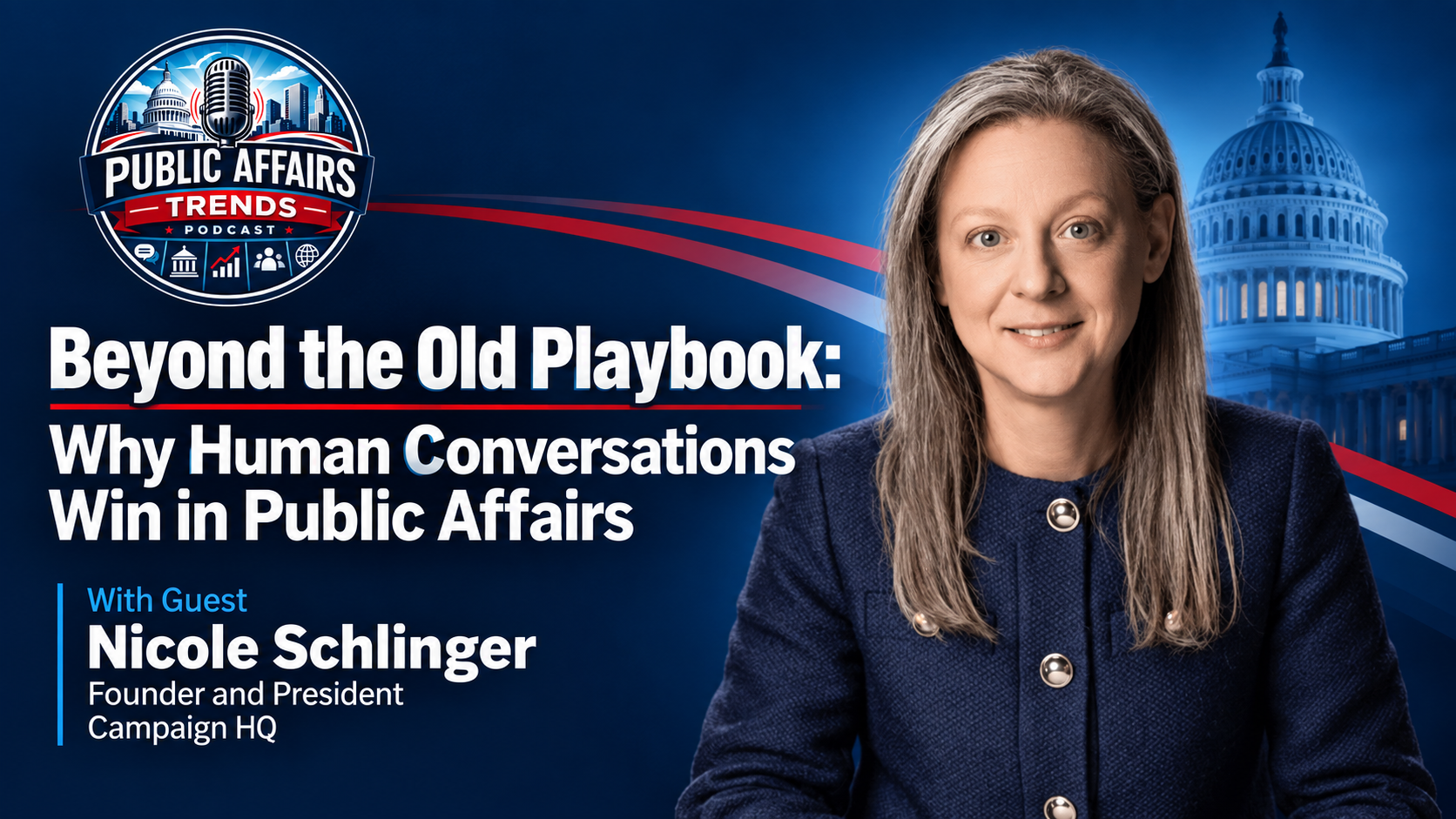
Public Affairs Trends Podcast episode featuring Nicole Schlinger discussing Nicole Schlinger on Why Human Conversations Dominate Public Affairs

In the podcast episode "Beyond the Old Playbook: Why Human Conversations Win in Public Affairs," Nicole Schlinger, president of Campaign HQ, discusses the shortcomings of traditional public affairs strategies in an era of heightened polarization and declining trust. Schlinger emphasizes the importance of grassroots engagement through live calls and direct conversations to effectively identify and persuade audiences before public sentiment hardens. She advocates for authentic communication that addresses community concerns, particularly in contentious issues like data center development.

Beyond the Old Playbook: Why Human Conversations Win in Public Affairs

0:00 / 0:00

Beyond the Old Playbook: Why Human Conversations Win in Public Affairs

Public Affairs Expert Nicole Schlinger Discusses the Evolving Landscape of Grassroots Engagement

In a recent episode of the podcast "Public Affairs Trends," Nicole Schlinger, president and founder of Campaign HQ, shared insights on the changing dynamics of public affairs campaigns. With 27 years of experience in grassroots mobilization, Schlinger emphasized the importance of direct human interactions in an era marked by polarization, misinformation, and declining trust in traditional media.

Schlinger highlighted that conventional public affairs strategies are losing effectiveness, particularly in hyperlocal issues such as data center development, renewable energy projects, and land use changes. “Citizens have less trust and less faith in their leaders,” she said, noting that endorsements from elected officials or community leaders no longer carry the weight they once did. Instead, she argued that people are increasingly skeptical of information presented through digital ads or traditional media, often questioning its authenticity.

The Role of Vocal Minorities

Schlinger addressed the challenge organizations face when navigating public sentiment, particularly when a small, vocal minority dominates the conversation. She explained that this group can create a perception of widespread concern, leading undecided individuals to adopt their views. To counter this, she recommended conducting identification calls or surveys to gauge public opinion without bias. “Asking people what they think about an issue can provide a good baseline,” she said.

Identifying supporters and persuadable audiences early in the process is crucial, according to Schlinger. “The sooner you can do it before messages are in people’s social media, the better off you’re going to be,” she advised. She noted that traditional town hall meetings often fall short, as they can be hijacked by a small group of vocal critics. Instead, she suggested using telephone town halls, which can reach a broader audience and facilitate respectful dialogue.

Tailoring Messages to Communities

When it comes to crafting messages that resonate, Schlinger emphasized the importance of understanding community dynamics. “The best way to know what message is going to resonate is simply to ask them,” she said. She encouraged organizations to analyze feedback from community members, including those who oppose their initiatives, to identify patterns and tailor their approaches accordingly.

Schlinger also discussed the complexities surrounding issues like data center development, which often involve both economic benefits and community concerns. “It’s important to make sure both sides are heard,” she stated. She noted that while proponents may focus on job creation and tax revenue, valid concerns about environmental impact and infrastructure must also be addressed.

The Power of Human Interaction

Despite the rise of digital communication, Schlinger argued that direct phone contact remains a powerful tool in public affairs. “People are hungry for real human interaction,” she said, citing a significant response rate in phone outreach efforts. She noted that while digital ads may be quickly scrolled past, personal conversations leave a lasting impression.

To ensure authenticity in outreach, Schlinger emphasized the importance of listening to constituents. She described how organizations can effectively engage with community members by acknowledging their concerns and responding to their feedback. “It’s not a conversation if you’re just throwing words at someone and not waiting to hear them,” she said.

Conclusion

Nicole Schlinger’s insights underscore the importance of adapting public affairs strategies to meet the needs of an increasingly skeptical and engaged public. By prioritizing direct communication and understanding community concerns, organizations can foster meaningful dialogue and build trust in an era of heightened emotional investment in political issues. For more information on Schlinger and her work, visit Campaign HQ’s website at www.chq.us.

Interview Q&A

Q&A: Beyond the Old Playbook: Why Human Conversations Win in Public Affairs

Q: Can you introduce yourself and your work?

A: My name's Nicole Schlinger, and I'm the president and founder of Campaign HQ. For the last 27 years, we have been helping campaigns win elections and public affairs issues through grassroots mobilization, including live phone calls, text messages, and telephone town halls.

Q: What does the traditional public affairs approach look like, and why is it failing?

A: The traditional approach often involves top-down strategies, like endorsements from elected officials or broad-based ads. This method is failing, especially on hyperlocal issues, because citizens have less trust in leaders and question the authenticity of information, particularly with the prevalence of misinformation and AI-generated content.

Q: How can organizations differentiate between genuine concern and a vocal minority?

A: Organizations should conduct ID calls or surveys to gauge public opinion without bias. This helps establish a baseline of community sentiment before misinformation spreads, allowing organizations to identify advocates and undecided individuals who need persuasion.

Q: When should a public affairs campaign start identifying supporters?

A: The earlier, the better. Identifying supporters before public sentiment hardens allows organizations to gather baseline opinions before misinformation takes hold. Engaging with the community early can help in understanding and addressing concerns.

Q: How should organizations communicate about issues with both economic benefits and community concerns?

A: Organizations need to ensure both sides are heard. Engaging directly with the community through personal outreach, rather than relying on traditional endorsements, can help convey the economic benefits while addressing legitimate concerns.

Q: Why do live conversations remain effective in public affairs?

A: People are hardwired for human interaction. Despite the prevalence of digital communication, live calls and conversations resonate more deeply with individuals, fostering a sense of connection that digital campaigns often lack.

Q: How can organizations ensure their outreach represents authentic public opinion?

A: Organizations should actively listen to feedback during outreach efforts. Responding to constituents, especially those who disagree, demonstrates respect for their opinions and fosters genuine dialogue.

Q: What challenges arise when engaging with a politically charged public?

A: The heightened emotional engagement in political discourse can be challenging, but it indicates that people care about the issues. Effective outreach involves listening and responding to concerns, rather than simply pushing a message.

Q: How can organizations identify which arguments resonate with different communities?

A: The best way to determine resonant messages is to ask the community directly. Analyzing responses to surveys and petitions can reveal patterns that inform targeted messaging.

Q: What role do telephone town halls play in modern public affairs campaigns?

A: Telephone town halls allow organizations to reach a broader audience than traditional town meetings. They facilitate respectful dialogue and ensure that both supporters and skeptics can voice their concerns and questions.

Q: How can organizations address the issue of misinformation in public discourse?

A: Organizations must engage with the community directly and provide accurate information. Building trust through personal interactions can counter misinformation and help clarify community concerns.

Q: Where can listeners find more information about your work?

A: Listeners can visit our website at www.chq.us or connect with me on LinkedIn for more information.

Key takeaways

  • “Citizens have less trust and less faith in their leaders, and so things that used to work just simply have less impact upon people.”
  • “The sooner you can get a baseline on where people start before the good information and the misinformation start flying, the better off you're going to be.”
  • “People are hungry for real human interaction... Having a human interaction with another person in real time simply resonates with people.”
  • “It's not a conversation if you're just throwing words at someone and not waiting to hear them and responding in kind.”
  • “The most vocal side will tend to have community support crystallize around it, and so if you're on the side that is having a harder time telling its story, going right to the people one by one is crucial.”

About the guest

Nicole Schlinger

President — Campaign Headquarters

Full transcript

Show full transcript
[00:03] Neil Hughes: What happens when a public affairs campaign waits until opposition is already organised, sentiment has hardened, and the loudest voices are defining the debate? Well, my guest today is the founder and president of Campaign HQ, where she has spent 27 years helping campaigns and advocacy organisations reach very real people through live calls, texting, telephone town halls, and direct grassroots engagement. So today we're going to discuss why the public affairs playbook might be losing impact, but also how organisations can identify supporters and persuadable audiences much earlier and understand why real human conversations matter way more than ever in this age of AI, social media, polarisation, and declining trust. But enough from me. Let me introduce you to my guest now. So thank you for joining me on the show today. Can you tell everyone listening a little about who you are and what you do? [01:04] Nicole Schlinger: You bet. My name's Nicole Schlinger. I'm the president and founder of Campaign HQ. And for the last 27 years, we have been helping campaigns win their elections and more importantly, public affairs and issue advocacy campaigns win their issues using grassroots mobilization by phone. So that means live phone calls, patch-through calls, text messages, ringless voicemails, and telephone town halls that bring large groups together so you can have a podcast-style conversation with exactly the audience you want to talk to. [01:39] Neil Hughes: Incredibly cool. And I love how that grassroots action is still alive and thriving and well there. And I think many organizations are are still using an outdated public affairs playbook. And again, I know this is something you're incredibly passionate about. So what does that traditional approach look like and why is it failing in issues like data center development, which is a big topic right now? [02:03] Nicole Schlinger: When it comes to these hyperlocal issues, whether it's a data center or maybe a wind or solar energy farm or even multifamily housing, anything that involves changes to land use in your backyard, those are the kind of issues where that top-down approach no longer works. You can see in our political climate today, citizens have less trust and less faith in their leaders. And so things that used to work like having an elected official or having a member of the community endorse something just simply has less impact upon people. Running broad-based ads and trying to educate people through digital ads or through broadcast or even radio or mail, people are less inclined to believe at face value what they see. They question whether things are fake, they're AI-generated, are they taken out of context? Or any or all of the above of those things can be true. And what we found is that as, as citizens become more politically aware and these issues become more heightened and emotionally charged, people want to really hear directly from the source. They want to get the information themselves and, and they want to have direct contact. So the ways that we used to do things by proxy just aren't having the effect that they used to have. And in fact, in some cases, They're having the opposite effect. [03:39] Neil Hughes: You made a great point there about how difficult it can be knowing what is real and what isn't, especially with AI and deepfakes, etc. But when opposition appears to be driven by a relatively small but highly vocal group, how can an organization tell the difference between genuine widespread concern and just a very loud minority that is trying to dominate the conversation? [04:04] Nicole Schlinger: One of the things that you need to be aware of in a situation like that is that small vocal minority will get an outsized amount of attention. And so the group of people in the community who haven't made up their minds will often believe that that's the default position. So people will tend to adopt the position of that very loud minority if there's not something else going on to make sure that people are given Both sides of the coin information in that case. Some of the things that we found particularly useful are doing ID calls. So you can, whether you're asking people their opinion in a survey by phone or by text, even going to their door and talking to people person to person, simply asking people without any bias, without any effort to persuade or influence one way or another, what do you think about this issue, can provide a really good level set baseline. What do people think before all of the accusations one way and another start flying? And once you find that, then of course, then you've got a group of advocates to start with, a group of people who are in the middle and on the fence who need persuasion and need to be educated by— you need to be educated by either side in order to win those people. And then, you know, the people who are opposed to you. And one of the things that we see organizations making the mistake of, unfortunately, time and again, is when you continue to mobilize your position, you're running contrary to everything that you're trying to accomplish. [05:38] Neil Hughes: A question I'd love to ask you here is at what point should a public affairs campaign begin identifying supporters and persuadable audiences? And what happens when organizations wait until public sentiment has already hardened? And one of the reasons I ask you that is I know my son will point out to me straight away how cringe it can be if an organization or campaign will jump on a viral TikTok meme or something like that, but they jump on too late after everything's moved. [06:08] Nicole Schlinger: In terms of trying to ID people in the community, earlier is better. The sooner you can do it before messages are in people's social media or they're talking about it at the coffee shop or the kids' soccer game, the sooner you can get a baseline on where people start before the good information and the misinformation start flying, the better off you're going to be. And then when it comes to the persuasion aspect of it, what we found is unfortunately in-person town meetings used to be an ideal venue for that. And in this day and age, what winds up happening is a small vocal group of people can hijack an event like that, and then that becomes the story. We've seen organizations successfully using telephone town halls for this, not because you want to mute or silence any particular group, I think it's important if you want to build something in the community, it's important that you answer the questions of people who are skeptical or people who may not agree with it. I think both sides, including those in the middle who are undecided, want to know that, and they have a right to know that, and they deserve to hear it from the source. And so a telephone town hall is different than the old-fashioned town meeting in that in that the organization dials out to folks. It tends to get people who are concerned citizens, but they're not the type of people who are going to go to something like that. So instead of talking to your 25 fiercest supporters and harshest critics, you could talk to a few thousand people and do it in a way that isn't meant to silence anyone, allows people to ask questions on both sides, but also allows for respectful dialogue and for both sides truly to be heard without that mentality taking over that can happen in a And I know another topic very close to your heart is getting the right message to the right person. [08:11] Neil Hughes: So how do you work out which arguments really resonate with different communities rather than just assuming one message will work for everyone? [08:19] Nicole Schlinger: The best way to know what message is going to resonate with which community is simply to ask them. And there are lots of ways to do that. There are so many measurable ways to get feedback on the information you're putting out to people. If you're launching a petition drive, for instance, not just logging the people that say yes, they want to be on your petition drive, log the people who say no. Are there patterns in the people who say yes and patterns in the people who say no? Many of these issues do not cut across the typical political party lines, age, gender, education levels, the kind of things we ordinarily use to target segments of the population. often don't work in these cases. And so it is best to know rather than guess when you're looking at segments of people like that. [09:08] Neil Hughes: And although there are 4,000 miles between us today, one topic that is huge on both sides of the pond is data center debates because they often involve jobs, tax revenue, electricity demand, water use, and indeed the impacts on local infrastructure. So how should organizations communicate around issues where the economic benefits and equally the community concerns can both be real at the same time. [09:35] Nicole Schlinger: This is one of those areas where oftentimes one side is much better at getting their message out than the other. And the people who are going to be interested in the economic benefits of it— fire, police, safety, schools, roads, even property tax relief has been one of the big benefits in places that have seen these kinds of developments. But there also are legitimate concerns. Concerns about power bills, about the power grid itself, about water safety, about noise. All of those are valid concerns. And so there are a number of ways to make sure both sides are heard. But what winds up happening often is the people who are in particular concerned about where it's going to be built or some of the certain impacts of it, those people tend to be out forward. And it's important to make sure both sides of that are heard. What we found is that the most vocal side will tend to have community support crystallize around it. And so if you're on the side that is having a harder time telling its story, going right to the people one by one and not relying on some of what we see as that old school playbook, a former state senator endorses something, a Farm Bureau president might write an op-ed in a local newspaper and it gets online. Those are the kind of things that just simply have less impact than they used to have. Whereas going out in a community, going door to door and directly asking people, have you heard about this? What questions do you have? May I answer those questions for you? People are hungry and eager for one-to-one in-person dialogue. [11:18] Neil Hughes: And one of the things that I love about your work here is how you focus on areas that many have forgotten about, and that is the importance of live calls, patch-through calls, telephone town halls, and Texting, real human-to-human conversations. And in a world dominated by social media, why does direct phone contact still work? What can it achieve that some of those digital campaigns that everyone's obsessed, obsessed with just simply cannot compete with? [11:45] Nicole Schlinger: One of the things that people are continually amazed about when I tell them is over the course of making several attempts, I can get 35% of a list to pick up the phone. And people are hungry for real human interaction. People may see a digital ad, they see things in their social media, but they're scrolling past it really quickly. And human beings are still hardwired to interact with other human beings. There's an epidemic of loneliness in our country from, from the very young to the very old and all ages in between that. So whether it's in person or it's by phone or on a telephone town hall, Having a human interaction with another person in real time simply resonates with people in a way that, in a way that the kind of communication that doesn't allow you to speak back to it doesn't, in terms of having the impact of remembering it and having it be influential on people's opinions. [12:45] Neil Hughes: And when you're looking at a constituent contact there, how do you ensure it represents real authentic public opinion rather than creating the appearance of grassroots pressure without any meaningful engagement behind it. Is that a tricky balance to get and ensure that authentic message gets out? [13:03] Nicole Schlinger: One of the things that I love to do is, let's say we're doing a survey of people in a community by text message. One of the beauties of that is you might be pressing 1 if you agree and 2 if you disagree, but people type back all manner of comments, opinions, Responses, feedback. When an organization takes the time to look at it, read it, respond to it, I think there is absolutely nothing better than someone knowing that they were on a telephone town hall, they wanted to ask a question, we didn't get to their question, but someone from the organization called them back and answered it. Making sure that if someone says they disagree with you, that you respectfully say that you heard them. There's nothing wrong with people disagreeing. I sometimes get people who ask me, well, you know, isn't it terrible, the heightened level of emotion in our political discourse today compared to maybe 5 or 10 years ago? Post-COVID, people are so politically engaged and involved, and they're so emotionally committed to these issues. And I think that's good for our society. I think it's good for our country. I think the time we should worry is when the arguing stops, because until then, it means people truly care. But I think that in terms of how do we make our outreach effective, it's by listening to what the other person has to say. It's not a conversation if you're just throwing words at someone and not waiting to hear them and responding in kind. [14:34] Neil Hughes: Absolutely love chatting with you today. I, for one, have learned so much. And for anyone listening would like to dig a little bit deeper on anything we talked about today, or maybe even get in touch and work with you, where can they find more information? [14:48] Nicole Schlinger: You can visit our website at www.chq.us. That's chq.us. Or you can find me on LinkedIn. I'm there often and look at all my messages. [14:59] Neil Hughes: Awesome. Well, I will have links to everything that you mentioned. I encourage people listening to go check it, check you out and find out more information. We've only scratched the surface today. It would be great to speak with you again in a few months, but more than anything, thank you. for joining me today. [15:15] Nicole Schlinger: Thank you so much.

Filed under

Related episodes