
Elections · United States
Digital midterms: Democrats out-reached GOP on all 12 channels
A Center for Campaign Innovation survey of 1,545 voters found Republicans matched Democrats on TV but trailed on every other channel, with AI the one tie.
Public Affairs Trends Staff · 2026-11-23
On the podcast: First Friday, November 2026: After the Wave — What the Midterms Mean for Public Affairs
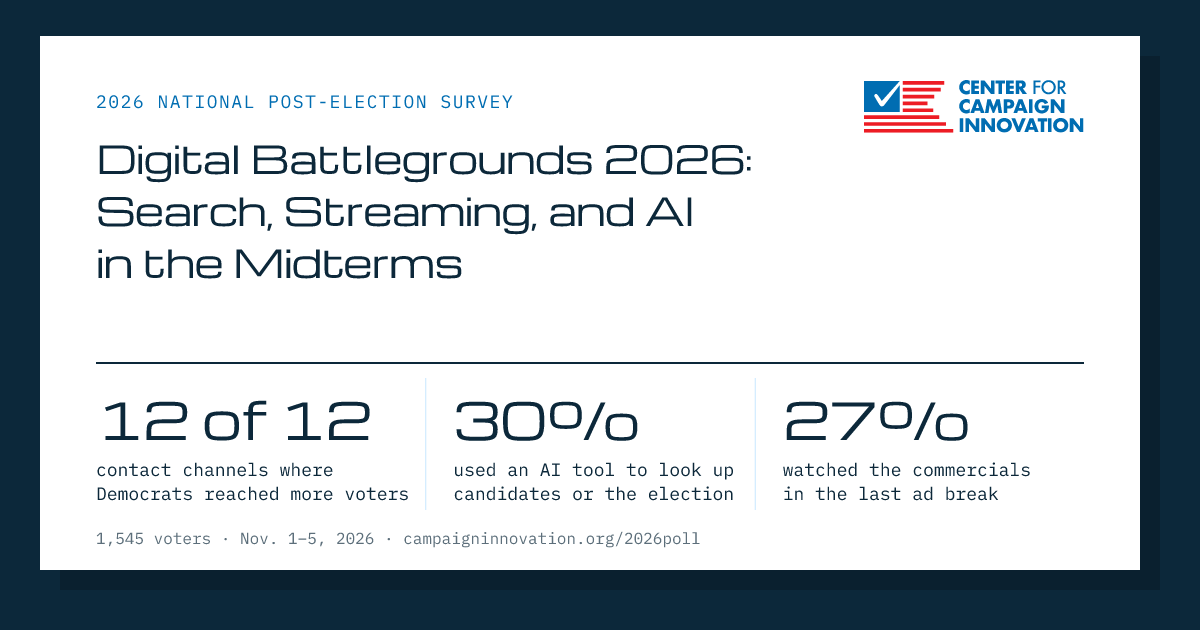
Based on reporting from Center for Campaign Innovation, Digital Battlegrounds 2026.
Republican campaigns held their own on television in the 2026 midterms and fell behind nearly everywhere else, according to a post-election survey the Center for Campaign Innovation released Nov. 20.
Quick facts
- Survey: 1,545 voters, Nov. 1–5, 2026, conducted by i360 for the Center for Campaign Innovation
- Contact gap: Democrats reached more voters on all 12 contact channels measured
- TV ads: 35% saw more Republican ads, 36% more Democratic; 27% say they actually watch the ad break
- AI tools: 30% of voters used one for election information, up from 11% in 2024; the parties tied at 22%
- Margin of error: About ±2.5 points; larger for subgroups
The group's "Digital Battlegrounds 2026" report says the party's "digital, data, and tech operation left opportunities on the table" in a year when the political environment already favored Democrats. In the survey, 67% of voters said the country is on the wrong track, 61% viewed President Donald Trump unfavorably and 9% of Trump's 2024 voters chose a Democrat for Congress.
Where did Democrats out-reach Republicans?
Voters split almost evenly on whose TV ads they saw more: 35% said Republican and 36% said Democratic. But the report found that more voters heard from Democrats on every one of the 12 direct-contact channels it measured.
The widest gaps were in turnout mechanics, including early-vote reminders, social-pressure notices and door knocks. Among respondents, 58% of Democrats said they voted before Election Day, compared with 48% of Republicans. Democrats also did better at reaching their own base: 66% of Democrats got a text from their party's candidates, while 60% of Republicans got one from a Republican.
Television's value was limited, the survey suggests. Only 27% of voters said they watched the ads the last time a commercial break came on.
How did voters go looking for candidates?
On 17 of 18 information-seeking behaviors, more voters said they did it for a Democratic candidate. Sixty-one percent searched online for candidate or election information, 35% visited a candidate's website and 46% saw or heard an independent creator or podcaster talk about the election, including 78% of voters ages 18 to 34.
Artificial intelligence was the exception. Thirty percent of voters used a tool such as ChatGPT, Gemini, Grok or Claude to learn about candidates, nearly triple the 11% who did so in 2024, and the parties tied at 22% each. On social platforms, voters saw more Democratic content on Facebook, YouTube, Instagram and TikTok, while Republicans led only on X and Truth Social.
What did the survey find about fundraising texts?
Sixty-one percent of voters were asked to donate, and text was the most common channel. Among voters solicited by text, 53% said they got three or more asks a day in the final week, and 26% got six or more. Republican donors quoted in the report described the messages as annoying and guilt-tripping.
What does the center recommend before the next cycle?
The report urges Republicans to move budgets toward reach and attention, invest in early-vote and mobilization tools, treat search, websites and AI as persuasion channels, compete beyond X and rethink fundraising volume.
"More effective campaigns would not have reversed a 13-point deficit driven by the President's standing and the economy, but in many unexpectedly close races they would have narrowed the gap," the center wrote.
More from Public Affairs Trends
Share this
LinkedInXFacebookEmail