Government • Public Policy • Public Affairs
Public Affairs Trends Podcast logo
← Public Affairs Trends

2026-09-25 · Anchor Change

Disrupting Politics: Katie Harbath on Tech's Impact on Democracy and AI

with Katie Harbath, CEO — Anchor Change
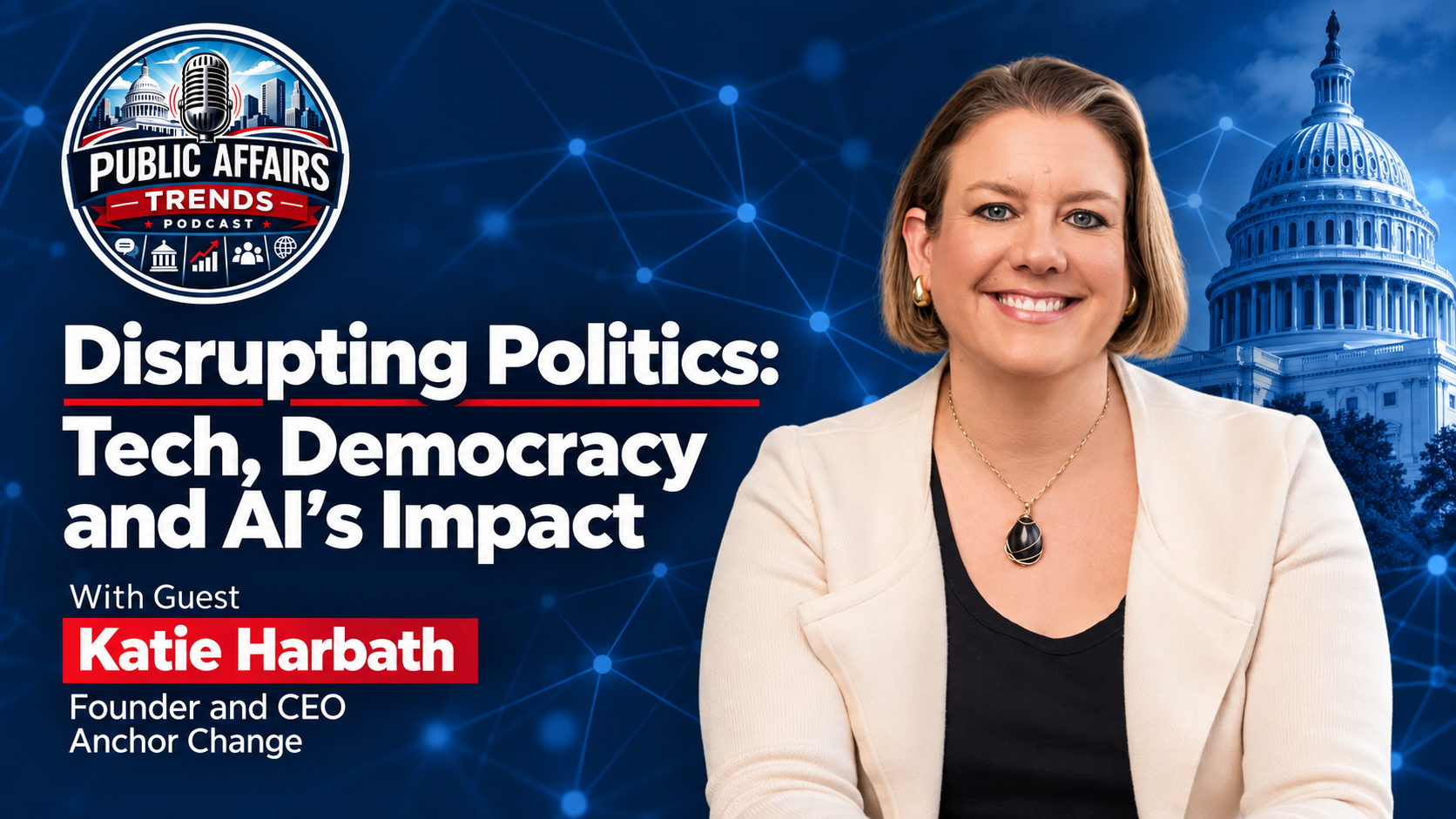
Public Affairs Trends Podcast episode featuring Katie Harbath discussing Disrupting Politics: Katie Harbath on Tech's Impact on Democracy and AI

In the latest episode of the Public Affairs Trends podcast, host Neil Hughes interviews Katie Harbath, CEO of Anchor Change and former Facebook executive. They discuss Harbath's new book, "Disrupting Politics," which examines the intersection of technology, democracy, and the implications of artificial intelligence on political processes. Harbath shares insights from her decade at Facebook, the challenges of content moderation, and the need for transparency in AI use during elections.

Disrupting Politics: Katie Harbath on Tech, Democracy and AI’s Impact

0:00 / 0:00

Disrupting Politics: Katie Harbath on Tech, Democracy and AI’s Impact

Tech Expert Katie Harbath Discusses AI's Impact on Politics and Democracy

Katie Harbath, CEO of Anchor Change, is at the forefront of discussions on the intersection of technology, politics, and public trust. With a decade of experience at Facebook, where she led global elections work, Harbath has witnessed firsthand the evolving landscape of political discourse shaped by technology. In her new book, Disrupting Politics, released on October 6, she reflects on 25 years of technology's influence on democracy.

In a recent interview on the Public Affairs Trends podcast, Harbath shared insights on the complexities of decision-making in tech and politics, particularly in the context of artificial intelligence (AI). She emphasized the importance of understanding the trade-offs that leaders face when navigating crises, noting that there are often no clear right answers.

"Before the crisis hits, having a sense of the values that matter most to you is crucial," Harbath said. She advocates for organizations to establish frameworks for decision-making that can guide them through challenging situations. This preparation can help leaders assess the risks and consequences of their choices.

As AI continues to reshape the political landscape, Harbath highlighted that organizations often focus on short-term challenges, such as upcoming elections, without considering the broader implications of technological advancements. She pointed out that the 2028 presidential election will coincide with significant global elections, urging organizations to think ahead about the role AI will play in these events.

Harbath also addressed the concept of "panic responsibly," a phrase she coined to describe the need for leaders to acknowledge the potential downsides of AI while still making progress. "It's about taking small steps forward to prepare for change management," she explained. This approach encourages organizations to have open discussions about the ethical implications of AI usage.

The conversation turned to misinformation, a persistent issue in politics. Harbath noted that while misinformation has existed throughout history, AI amplifies the problem by creating personalized content that can further entrench individuals in their own ideological silos. "AI changes and turbocharges the way information is shared," she said, raising concerns about the implications for voters seeking reliable information.

Reflecting on her career, Harbath acknowledged a shift in her perspective on free speech and content moderation. Initially a staunch advocate for unrestricted speech, she now recognizes the need for platforms to establish their own community guidelines while balancing user safety. "I still think there's a way for people to have speech while ensuring they aren't harmed in the process," she stated.

Harbath's book aims to empower readers by illustrating their agency in the digital landscape. She encourages individuals to be mindful of their online habits and the information they consume. "Understanding how we got to this point with politics and technology is important," she said, emphasizing that voters play a crucial role in shaping the future.

Disrupting Politics is available for purchase on platforms such as Amazon, Barnes & Noble, and Target, in both ebook and paperback formats, with an audiobook version forthcoming. Harbath's insights serve as a valuable resource for those navigating the complexities of technology's impact on democracy.

As the political landscape continues to evolve with advancements in AI, Harbath's expertise will be essential for organizations and individuals alike. Her call for thoughtful engagement with technology and its implications for democracy resonates in an era where the intersection of these fields is more critical than ever.

Interview Q&A

Q&A: Disrupting Politics: Katie Harbath on Tech, Democracy and AI’s Impact

Q: Can you tell everyone listening a little about who you are and what you do?

A: My name is Katie Harbath. I run a tech consultancy and newsletter called Anchor Change, where I work with tech companies on election policies and content moderation. I also collaborate with think tanks and nonprofits to help them understand the intersection of technology and politics, especially regarding AI.

Q: What did you see from the inside of Facebook during the 2016 election that people may still misunderstand?

A: Many people look back with hindsight, but there wasn't a playbook for the challenges we faced. The decisions involved impossible trade-offs, and I hope my book, "Disrupting Politics," helps people understand the complexities of those situations.

Q: How has technology changed politics beyond social media?

A: Technology has both positive and negative use cases. In the early days of online politics, we didn't have the platforms we do now. We need to consider the incentives technology creates, especially as we enter the AI era, which can amplify existing issues.

Q: What did your time at Facebook teach you about making decisions without clear answers?

A: It's crucial to establish values and criteria for decision-making before a crisis hits. This framework helps leaders assess risks and understand the potential consequences of their choices, including the decision to do nothing.

Q: What are organizations getting wrong about political risk preparation for upcoming elections?

A: Many organizations focus only on the immediate future, like the midterms, without considering the long-term implications of AI in politics. They need to think about transparency and trust regarding AI use in campaigns.

Q: What does "panic responsibly" mean?

A: "Panic responsibly" refers to acknowledging the potential downsides of AI while still taking small, proactive steps. It's about finding a balance between being cautious and moving forward with change management.

Q: How does AI change the landscape of misinformation?

A: Misinformation has always existed, but AI turbocharges it by personalizing content and creating new challenges in how information is curated. This raises philosophical questions about how voters receive and interpret information.

Q: What belief about technology and democracy have you changed your mind about?

A: I initially held a strong free speech advocacy stance but have since recognized that private platforms can set their own community standards. Balancing free speech with user safety remains a challenge.

Q: What do you want readers to take away from your book?

A: I want readers to understand that they still have agency in the political and technological landscape. Their choices about information consumption matter, and they play a role in shaping the future.

Q: When does your book "Disrupting Politics" come out, and where can people find it?

A: "Disrupting Politics" comes out on October 6th and will be available on Amazon, Barnes & Noble, and Target in both ebook and paperback formats. An audiobook will be released soon.

Key takeaways

  • “There really wasn't a playbook for this kind of stuff back when we were trying to deal with it.”
  • “There were impossible trade-offs. So like there where there's no really great answer, but you have to pick one.”
  • “I think that one of the things that we need to be paying more attention to that I wish we had thought about more during the social media era are what incentives are we giving people in the social media era?”
  • “Any decision, even if that decision is to do nothing, is a decision in and of itself.”
  • “Panic responsibly is... thinking about how do you not get frozen in place and still think about how do you take small steps forward.”

About the guest

Katie Harbath

CEO — Anchor Change

Full transcript

Show full transcript
[00:03] Neil Hughes: Welcome back to the Public Affair Trends Podcast. Now, my guest today, she spent much of her career where technology, politics, and public trust collide. She spent 10 years at Facebook building and leading its global elections work, giving her a front row seat to the 2016 election, Cambridge Analytica, congressional hearings, and some of the biggest questions of the social media era. She now leads Anchor Change, advising tech companies and policy organizations on political risk, regulation, and crisis preparation. And her new book, Disrupting Politics, looks back at 25 years of technology and democracy. And today, we're going to talk about what happened inside the room, the trade-offs leaders are facing, and what AI is changing now. But enough from me, let me introduce you to her now. So, thank you for joining me on the show today. Can you tell everyone listening a little about who you are and what you do? [01:10] Katie Harbath: Hey, thank you for having me on. My name is Katie Harbath. I run a tech consultancy and newsletter called Anchor Change. where I work both with tech companies about everything from their election policies, content moderation, what's happening here in DC and around the globe. But then I also work with think tanks, nonprofits, public affairs groups, et cetera, who are trying to understand what's happening in Silicon Valley and particularly right now with AI. And so I try to help both of those worlds learn more about one another. [01:42] Neil Hughes: Well, it's a pleasure to have you join me today. I mean, when I was doing a little research on you before you came on the podcast, I was reading you had a front row seat to the collision of technology and democracy during some of Facebook's most consequential years. I'm curious, from looking back there, what did you see from the inside of that room that people looking back from the outside maybe still misunderstand? Does anything stand out there? [02:10] Katie Harbath: Yeah, absolutely. And this is a lot of why I wrote my book, Disrupting Politics, that comes out on October 6th. is to bring people into those rooms. And I think, you know, when people think about the 2016 election, Cambridge Analytica, Russian ads, all of those different types of things, it's very easiest to look backwards, right? Hindsight's 20/20 about like, we kind of know how things played out, what we might do differently. There really wasn't a playbook for this kind of stuff back when we were trying to deal with it. There is a lot of precedent setting about how do you handle a presidential nominee and then President of the United States who's really pushing the boundaries of your content moderation rules, this tension between speech and safety. I oftentimes say too that there were impossible trade-offs. So like there where there's no really great answer, but you have to pick one, um, and you're going to make somebody angry in the process of doing it. And so in the book, I go into these a lot more, and I'm not necessarily asking people to all of a sudden agree with every decision Facebook made. But if I can get people to be like, huh, that was a little harder than I thought it was, like that's a little bit more difficult, I'm not sure what I would've done in that situation, I will have achieved one of my goals. [03:26] Neil Hughes: So as you said, the book is called Disrupting Politics. And I'm curious, how has technology changed politics in ways that go way beyond social media? And what do you think, is there anything you think we're still underestimating as AI enters the picture now too? [03:43] Katie Harbath: So I think, well, one thing I think we can sometimes forget is that any technology has both good use cases and bad use cases, right? And I think that one of the things when you go back to the early 2000s or even the mid-'90s when you had the first campaign websites, the first White House website, like to put people's, you know, brains back in that time period, it was the time period of MySpace and BlackBerry. We didn't have the iPhone. Facebook didn't exist. Twitter didn't exist. TikTok, Instagram, YouTube, none of these existed at the, those beginning days of politics being online. And one of the things that I think that we need to be paying more attention to that I wish we had thought about more during the social media era are what incentives are we giving people in the social media era? We thought it was fantastic. You could measure every click. You could know exactly which piece of content was getting more engagement and There was this philosophy that more equals better, right? And so you just keep slowly over time, and that proverbial frog being, being boiled in water pushes people to the extremes cuz you're like, I'm just gonna keep doing what gets me more attention, which gets me more clicks. Not thinking necessarily or realizing what's happening. We can see it again in hindsight, but while you're in the middle of it, you don't necessarily realize what is happening. And I, as we go into this AI era, I'm at least trying to think a lot more of like, Okay, what incentives are we creating for people when they use this not only to create content, but in a campaign or business environment, you're using it to draft press releases, to help do voter modeling, to help maybe analyze your polling, so many different things. [05:24] Neil Hughes: In your book, you do talk a lot around impossible trade-offs. Looking back, what did your time at Facebook teach you about making decisions when There isn't clearly a right answer. [05:36] Katie Harbath: Yeah, I think the first thing is before the crisis hits, right, before you all of a sudden are under pressure to make a decision, whether you're a social media company or any business, having a sense of the values that you're— and the criteria that you want to measure your decisions up against. What are the things that matter the most to you? Are there red lines that you have? But some sort of framework that you're going to put these decisions through to help be a gut check for you. Because oftentimes when you're in a crisis mode, you're just trying to get the pain to stop in that moment and not necessarily thinking about, okay, what might this— what impact might this decision have on me? Or is it putting me in a tough spot down the line if something were to change, et cetera? And so I think that that at least allows you, and, That allows you to then think through what level of risk are you willing and pain are you willing to tolerate? Because any decision, even if that decision is to do nothing, is a decision in and of itself. And there will be consequences for that. And you have to think about as a leader, which ones am I willing to live with versus not? [06:44] Neil Hughes: And fast forward to present day, you now advise companies on political risk before they're in crisis. So what are you seeing organizations get wrong about that? preparation for the next election cycle and the collision of AI, politics, and regulation? [07:01] Katie Harbath: So one of my frustrations is that I totally get how we're just thinking about the midterms right now, but we tend to only think in these very short timeframes. And I'm trying to think about not only through the 2028 presidential, but actually the year after that, 2029, is going to be another major year of global elections. So we will be bringing in a new administration here in the US at a time period when a bunch of countries around the world will also be electing their leaders and probably using AI as a part of that. And so now is the time for us to be thinking about not just the guardrails, but the transparency that we want campaigns to have about how they're using AI. But there's a conundrum there, which is I still think that being transparent about it will ultimately build up trust. But because the AI sentiment is so low right now, if campaigns say they're using AI, it might erode trust with voters. So it's kind of like it's this trade-off of like, am I transparent about it and have people maybe not trust what I'm saying, or do I hide it and then they get mad at me if they find it out later? And so this is something that they're going to be balancing throughout the— these next couple of campaign cycles. [08:14] Neil Hughes: And you use a great phrase that caught my attention, which is panic responsibly. So what does that mean and how should leaders apply it when the tech and the political environment are changing faster than their organizations can realistically keep up with? [08:29] Katie Harbath: So I came up with panic responsibly back in 2023, early days of AI, when you were seeing it was either everybody was— people were either an AI doomer, it's going to destroy the world, or they were an AI optimist. There didn't seem to be room in between those two. And what panic responsibly is, is that it is not to ignore the potential downsides of it because we absolutely need to pay attention to that. But it's also thinking about how do you not get frozen in place and still think about how do you take small steps forward to prepare yourself and your organizations for this type of change management, for introducing these new technologies. I see a lot of people right now, they're like, I'm told if I use AI it's cheating, but if I don't use it, I'm gonna lose my job. What, what do I do? Right? [09:16] Neil Hughes: Mm-hmm. [09:17] Katie Harbath: And so I will have the conversation with them. Well, let's talk about where your ethical guardrails are, um, what you are okay using AI for versus not. And I find people just exhale this sigh of relief of like, okay, I can actually have this conversation and nobody's gonna yell at me as I try to like figure my way through all of this. And so it's, it's having just sort of the right level of anxiety, I think, in a way that doesn't paralyze you. And thinking through for yourself and your organization, okay, what are the steps that we need to do and risk mitigations we need to do as we go through this? And so I help organizations think through that. [09:56] Neil Hughes: It's such a great phrase and more important than ever because looking back, we spent the social media era worrying about misinformation spreading between humans. But now AI introduces synthetic content, automated accounts, and potentially autonomous agents communicating at a phenomenal scale. So does that fundamentally change the problem or are we just seeing a technologically amplified version of a very old problem? [10:25] Katie Harbath: It's a little bit of both, right? Like, mis- and disinformation have been around since the beginning of the republic and people being able to share information. I think Where AI changes it and turbocharges it is if you listen to Mark Zuckerberg on earnings calls, he talks about AI starting to make very personalized content to each of us. So take my likes and interests and it's gonna be able to create videos. It's gonna be able to create, like, it'll bring me more and more into my own world, which makes me worried about from a silo perspective of what that looks like. But then also too, I'm also worried about right now as news organizations rightfully withhold their content from these AI platforms while they're trying to figure out the right level of compensation and partnership. But while they are negotiating that, it leaves this big gap right now in our information environment online where if you are building these websites and trying to get a certain message out and you make them scrapable by these AI platforms, That might be what gets pulled in when somebody searches for what candidate should I vote for. And that's very different than the social media world and what's being chosen to be in your newsfeed. Now it's actually how are these AI tools curating the information that is being pulled together for you? And there's some very interesting philosophical questions that I've been talking to not only the tech companies and think tanks and civil society about how do we even begin to answer those and think about how this type of information is presented to a voter. [12:03] Neil Hughes: Your book gives you the benefit of looking back across several technological eras, but I've got to ask, what belief about technology and democracy have you personally changed your mind about most dramatically in those 25 years? Is there anything that you've changed your mind on? [12:20] Katie Harbath: I think when I first started, I was much— I was a very, not super extreme, but I was a very far free speech advocate around— [12:30] Neil Hughes: Mm-hmm. [12:31] Katie Harbath: Very loath to take stuff down or, or put any guardrails around that. I haven't changed a ton on that, but I have moved away from that a little bit because I think that these companies, they're their own private platforms too. They can have their own philosophies about what they do or do not want to allow and what sort of community they want to allow. And again, if I could have a magic wand and we could know now and go back to the beginning of the social media era of trying to figure that out. You know, who knows where we could be today, but that is one where I still think there's design, there's ways for people to still be able to have speech, but also being able to make sure that people aren't being harmed in the process. We haven't figured out the silver bullet, but I'm still optimistic that we can kind of figure that out. [13:18] Neil Hughes: And I'm curious, when you were spending those hours, days, weeks, and months putting this book together, and you're writing there wanting to deliver a clear message, what is it that you want people to walk away with? upon reading this book? [13:31] Katie Harbath: So the biggest thing is that we all still have agency. It can feel very overwhelming that like, what can I do to make any AI company change, right? But in our day-to-day interactions, just even understanding that when you Google something right now, you are engaging with an AI tool. So what AI tools you use, where you use it or don't use it, where— how much time are you spending on social media? I encourage people, I try to do this twice a year, try to take a week where I'm like really thinking about and paying attention. Okay, how much time am I spending on Instagram? How much time on TikTok? What accounts am I following? What newsletters am I reading? What news outlets am I getting news from? And does it match my aspirations? If somebody asked me what kind of information diet I would want, does it actually match those? And so I want people, you know, understanding better how we got to this point with politics and technology. But then also understanding that we, the voter, plays a role in this too. [14:32] Neil Hughes: Perfect moment to end on that. And for anyone listening, when does the book come out? Where can they get it from? Tell me more. [14:40] Katie Harbath: So Disrupting Politics comes out on October 6th. It is available Amazon, Barnes& Noble, Target, all of those good places where you can get your books. You can get it in ebook and paperback. Right now, and then audiobook will be coming soon. [14:56] Neil Hughes: Awesome. Well, I will add links to everything that you mentioned there in the show notes that will accompany this episode. We covered a lot in a short amount of time there. I'd love people listening to check the book out, and I'd love to stay in touch with you, get you back on once the book's out, and hear more about the feedback and the conversations that come from that too. But thank you for joining me today. [15:15] Katie Harbath: Thanks for having me on.

Filed under

Related episodes