2026-08-21 · Public Affairs Podcast
AI in Public Affairs: Why Faster Tools Demand Better Human Judgment
with Neil Hughes, Host — Public Affairs Podcast
In the latest episode of the Public Affairs Trends podcast, host Neil Hughes discusses the role of artificial intelligence in public affairs. He emphasizes that while AI can enhance efficiency, human judgment remains crucial for effective communication and relationship-building. Key themes include the importance of strategy over speed, the need for authentic audience engagement, and the balance between rapid response and thoughtful restraint in crisis situations.
AI in Public Affairs: Balancing Speed and Human Judgment with Neil Hughes
AI in Public Affairs: Balancing Speed and Human Judgment
In a recent episode of the Public Affairs Trends podcast, host Neil Hughes discussed the evolving role of artificial intelligence (AI) in public affairs. The episode, titled "AI in Public Affairs: Balancing Speed and Human Judgment," emphasized the need for human oversight as technology accelerates content creation and distribution. Hughes synthesized insights from previous guests, including Jordan Lieberman, Matt Kenney, Curt Mercadante, and Jonathan Greller, to highlight key themes shaping the industry.
Hughes opened the discussion by posing critical questions about the implications of rapidly advancing technology. He noted that as the cost of content creation decreases, smaller campaigns can access tools that were once exclusive to larger operations. This democratization of technology allows public affairs teams to analyze issues, draft responses, and distribute messages more efficiently than ever.
However, Hughes cautioned that while AI can perform tasks quickly, it cannot replace human judgment. He referenced Mercadante's analogy of Tony Stark and his AI assistant, Jarvis, to illustrate that while AI can assist in execution, the strategic direction must come from humans. “AI works best as an assistant, not an architect,” Hughes stated, emphasizing the importance of maintaining accountability for outcomes.
The Importance of Strategy
The podcast highlighted that the effectiveness of public affairs relies heavily on trust, authenticity, and human relationships. Lieberman pointed out that access to cheaper technology does not guarantee better decision-making. He stressed the importance of understanding which data points are relevant and how they can be translated into actionable insights.
Hughes echoed this sentiment, noting that campaigns that establish a digital presence early can adapt and refine their strategies over time. He remarked, “Technology rewards speed, but strategy rewards preparation.” As digital tools become more accessible, building trust with clients becomes a competitive advantage.
Content Creation and Audience Engagement
The discussion also delved into the relationship between content creation and audience engagement. Mercadante raised concerns about whether organizations are genuinely building an audience or merely borrowing one through social media platforms. He warned that reliance on these platforms can be risky due to their changing algorithms and policies.
Hughes highlighted the importance of owned media channels, such as email lists and direct relationships, as organizations seek to establish a more stable foundation for communication. He noted that while AI can facilitate rapid content production, the challenge remains to create meaningful messages that resonate with audiences. Greller contributed to this theme, reminding listeners that sometimes “less is more” when it comes to communication.
The Need for Restraint
As public affairs teams gain the ability to respond quickly, Hughes emphasized the need for restraint in messaging, particularly during crises. He pointed out that rapid responses should focus on clarity rather than overwhelming audiences with information. “What are the one or two points that people genuinely need to understand?” Hughes asked, advocating for a more deliberate approach to communication.
Kenny reinforced this notion by reminding listeners that despite the technological advancements in campaigning, the core of public affairs remains a people-centric business. Authenticity and understanding stakeholders' needs continue to drive effective communication.
Conclusion
In conclusion, Hughes underscored that AI is not diminishing the human element in public affairs but rather streamlining some of the mechanical tasks associated with it. This shift allows professionals to focus on strategic thinking, relationship building, and nuanced communication.
As the industry evolves, Hughes posed three questions for public affairs teams to consider: Which repetitive tasks could AI handle while maintaining human accountability? Which audiences and channels do organizations truly own? If limited to two sentences, what would be the most persuasive message for key stakeholders?
These inquiries aim to provoke thoughtful discussions among public affairs professionals as they navigate the intersection of technology and human judgment. The episode serves as a reminder that while tools may become faster, the need for sharp human insight remains paramount in effective public affairs.
Interview Q&A
Q&A: AI in Public Affairs: Balancing Speed and Human Judgment with Neil Hughes
Q: What is the main theme of the episode?
A: The episode discusses how advancements in AI technology are changing public affairs, emphasizing the importance of human judgment alongside faster tools.
Q: How does Neil Hughes describe the role of AI in public affairs?
A: Neil Hughes states that AI works best as an assistant rather than an architect, helping to complete tasks while leaving strategic decisions to humans.
Q: What analogy does Curt Mercadante use to illustrate the relationship between AI and human judgment?
A: Curt Mercadante compares AI to Jarvis, Tony Stark's assistant in the Marvel films, where AI aids in building but does not take responsibility for the outcomes.
Q: What impact does cheaper technology have on public affairs campaigns?
A: Cheaper technology allows smaller campaigns to access tools previously available only to larger operations, enabling them to analyze more data and reach precise audiences.
Q: What does Jordan Lieberman emphasize about data in campaigns?
A: Jordan Lieberman stresses that having access to data is not enough; understanding which signals matter and how to act on them is crucial.
Q: Why is trust considered a competitive advantage in public affairs?
A: As digital teams become more accessible, building long-term relationships based on trust becomes more valuable than short-term transactions.
Q: What caution does Curt Mercadante raise regarding content creation?
A: Curt Mercadante notes that while content creation is cheaper, organizations should focus on building their own audience rather than relying on borrowed ones from social platforms.
Q: What advice does Jonathan Grello give about communication during a crisis?
A: Jonathan Grello advises that rapid responses should focus on one or two key points rather than overwhelming the audience with details.
Q: How does Neil Hughes suggest public affairs professionals should approach repetitive tasks?
A: He encourages teams to identify repetitive tasks that AI can handle while maintaining human accountability for the outcomes.
Q: What questions does Neil Hughes propose for public affairs teams to consider?
A: He suggests teams ask which tasks AI could remove, which audiences they genuinely own, and what two sentences would be most persuasive to key stakeholders.
Q: What is the overarching conclusion about AI's impact on public affairs professionals?
A: AI is not removing the human element but rather automating mechanical work, allowing professionals to focus on relationships and strategic thinking.
Q: How does Neil Hughes view the future of public affairs with AI advancements?
A: He believes the future will require professionals to enhance their judgment and strategic skills as tools become faster and more capable.
Key takeaways
- “AI works best as an assistant, not an architect.”
- “If we ask a vague question and just accept the first answer, and then send it straight out to the world without checking it, that is not transformation.”
- “Access to more data does not automatically produce better decisions.”
- “The objective is not to fill every channel, it's to communicate something that is worth remembering.”
- “Politics remains a people business and a relationship business.”
About the guest

Host — Public Affairs Podcast
Full transcript
Show full transcriptHide transcript
Filed under
Related episodes

Max Fose on Public Affairs: The Three C's, Data, AI, and Credibility in a Fragmented World
with Max Fose
Beyond the Old Playbook: Why Human Conversations Win in Public Affairs
with Nicole Schlinger
First Friday, October 2026: AI, Trust, and What Makes Public Affairs Effective
with Neil Hughes
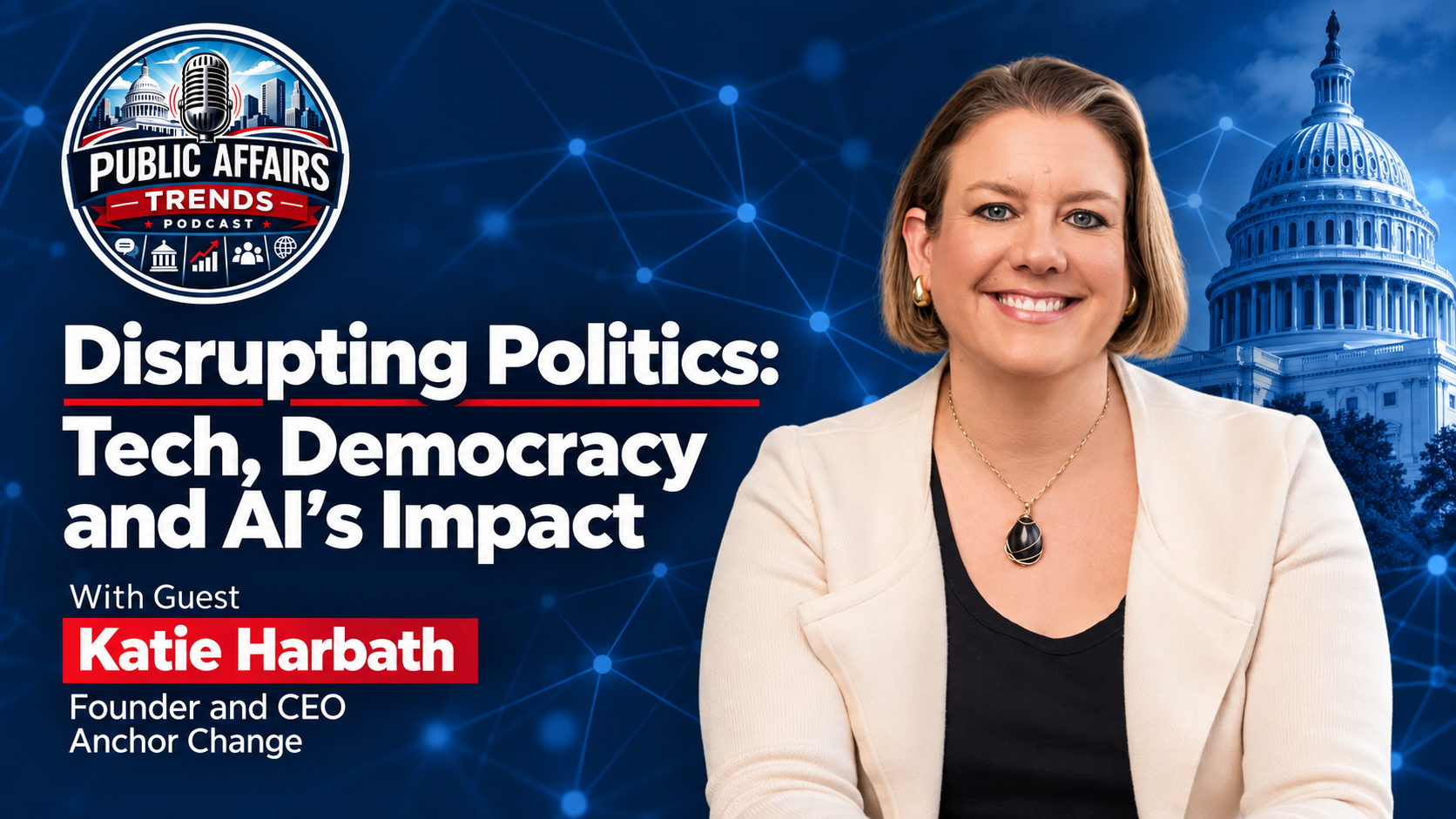
Disrupting Politics: Katie Harbath on Tech, Democracy and AI’s Impact
with Katie Harbath