Government • Public Policy • Public Affairs
Public Affairs Trends Podcast logo
← Public Affairs Trends

2026-10-16 · Fose + McKay

Max Fose on Public Affairs: The 3 C's, AI, and Credibility Today

with Max Fose, President — Fose + McKay
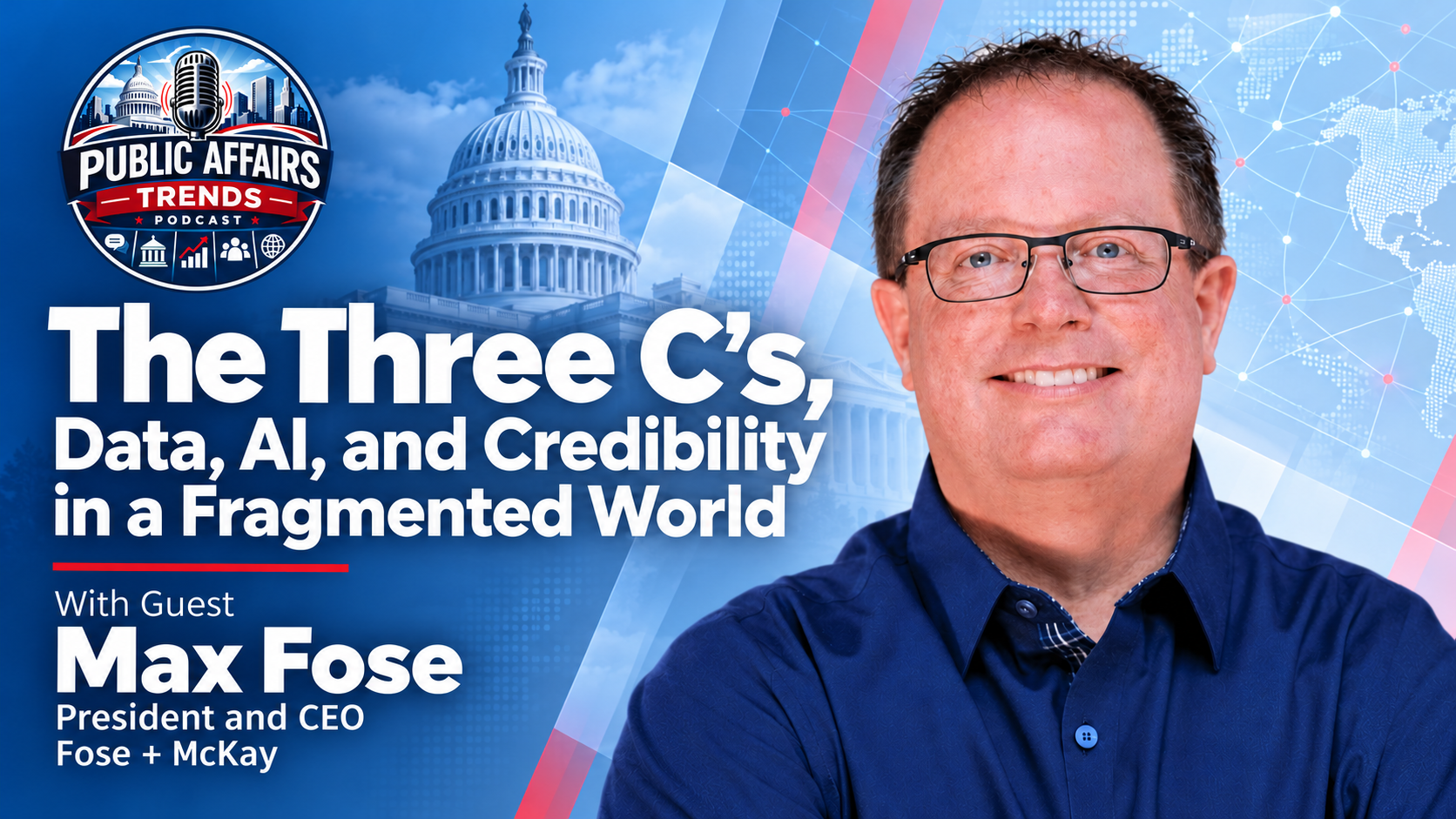
Public Affairs Trends Podcast episode featuring Max Fose discussing Max Fose on Public Affairs: The 3 C's, AI, and Credibility Today

In the latest episode of the Public Affairs Trends podcast, Max Fose, President of Fose + McKay, discusses the evolution of public affairs in a digital age. He emphasizes the importance of creativity, consistency, and credibility in communication, while exploring the impact of data and AI on public affairs strategies. Fose also highlights the need for agencies to adapt to rapidly changing media landscapes and the significance of maintaining trust in an era of fragmented information.

Max Fose on Public Affairs: The Three C's, Data, AI, and Credibility in a Fragmented World

0:00 / 0:00

Max Fose on Public Affairs: The Three C's, Data, AI, and Credibility in a Fragmented World

Max Fose Discusses Evolution of Public Affairs Amid Rapid Change

In a recent episode of the Public Affairs Trends podcast, Max Fose, President of Fose + McKay, shared insights on the evolving landscape of public affairs and marketing. With over 26 years of experience in the field, Fose addressed the impact of technology, data, and credibility in a fragmented media environment.

Fose's agency operates nationally with offices in Washington, D.C., and Phoenix, Arizona. He noted that while the channels for communication have transformed significantly, the core principles of effective messaging remain unchanged. "We've built the company off what I call the 3 C's: creative, consistent content," Fose said. He emphasized that creativity and content are still vital, despite the shift from traditional media to social platforms.

The conversation highlighted how public affairs professionals must navigate a faster-paced and more fragmented media landscape. Fose pointed out that the speed of news cycles has accelerated, moving from 24-hour news to real-time updates. "If you're not in the news cycle, which is all the time, you miss out," he stated.

Fose also discussed the importance of understanding various disciplines within public affairs, including marketing and voter data. He explained that the political aspect of his agency operates in real time, allowing for immediate application of strategies and ideas. "Everything happens in real time," he said, contrasting it with the slower pace of traditional marketing.

The discussion extended to Fose's experience owning media properties, including All About Arizona News and The Upper Middle. He noted that having a media perspective enhances understanding of credibility in storytelling. "Everything is local," he remarked, emphasizing the significance of hyperlocal news in both media and politics.

As public affairs become more fragmented, Fose underscored the importance of targeting the right audience with authentic messaging. He acknowledged the changing production values in advertising, stating that audiences now prefer content created directly by individuals rather than polished advertisements. "How do you take that message and get it in front of the right people?" he asked.

Fose also addressed the growing influence of AI in public affairs. He noted that while AI can process vast amounts of data quickly, it is essential to apply human judgment to ensure accuracy. "You still need to have the experience behind AI to look at what it's producing," he said. He expressed concern about the potential for misinformation generated by AI, particularly in political contexts.

Looking ahead to the midterm elections, Fose mentioned trends in how public affairs firms are leveraging social media and current events. He observed that politicians are increasingly using popular trends to engage audiences, emphasizing the need for timely participation in conversations. "You don't want to be at the end of the circus," he advised.

Fose also reflected on the qualities that distinguish successful public affairs firms from those that remain project-based. He highlighted the importance of reputation and long-term relationships with clients. "My name is my brand," he said, noting that trust and integrity are crucial for sustained success.

As the conversation concluded, Fose encouraged young professionals in public affairs to seek diverse experiences and embrace opportunities for growth. "Do the job that no one else wants to do," he advised, emphasizing the value of learning through hands-on experience.

For more information about Fose + McKay, visit their website at foessmckay.com.

Interview Q&A

Q&A: Max Fose on Public Affairs: The Three C's, Data, AI, and Credibility in a Fragmented World

Q: Can you tell everyone listening a little about who you are and what you do?

A: My name is Max Fose. I own a national public affairs and advertising agency called Fose + McKay. We have offices in Washington, D.C., and Phoenix, Arizona, and we run public affairs campaigns for clients across the nation.

Q: What has changed most about what clients expect from a public affairs agency? What has remained constant?

A: We've built the company on what I call the 3 C's: creative, consistent content. While creativity and content have remained important, the delivery platforms have changed significantly. The way people consume information has evolved from traditional media to social media and streaming.

Q: How valuable is it for agencies to understand multiple disciplines like marketing, voter data, and media?

A: Understanding these disciplines gives us an advantage. In politics, everything happens in real time, allowing us to implement techniques and ideas quickly. The political side moves faster than marketing, which has a longer lifecycle.

Q: How has owning media properties changed your perspective on credibility in storytelling?

A: Owning media platforms like All About Arizona News has made me more attuned to local communities. It emphasizes the importance of local news and events, which is crucial in both media and politics.

Q: With the fragmentation of media, how do you decide where a client should focus their message?

A: It’s about putting their message in front of the right audience authentically. The production value has changed, and now people want to see genuine content. Using credible third-party messengers can also amplify a message effectively.

Q: What are the implications of individuals playing both sides of a political argument?

A: While I haven't seen significant blowback yet, it raises questions about credibility. If a campaign lacks transparency, it can undermine other messaging and hurt long-term trust.

Q: How has the use of data in public affairs changed since you started?

A: The use of data has exploded, but clients often struggle to cut through the noise. AI can process data in real time, allowing for tailored messaging, but some clients get overwhelmed and fail to execute effectively.

Q: How do you see technology, particularly AI, being a force for good in public affairs?

A: Technology can connect people and ideas effectively. However, it requires experienced oversight to ensure accuracy and relevance. Misinformation generated by AI poses a long-term risk to democracy.

Q: What trends are you observing in public affairs as the midterms approach?

A: There’s a focus on leveraging current trends, like social media challenges, to stay relevant. Politicians are trying to engage with trends to break through the noise in a crowded media landscape.

Q: What separates trusted long-term public affairs firms from those that are just project vendors?

A: Success and reputation are key. A firm needs to be strategic and honorable. Building a strong reputation leads to long-term relationships with clients.

Q: What excites you most about the current political landscape?

A: I'm interested in how quickly history repeats itself and the shifting dynamics in American politics. Observing trends, especially among independent voters, is particularly engaging.

Q: What advice would you give to younger public affairs professionals?

A: Do the job that no one else wants to do to gain experience. Focus on what you’re passionate about and seek opportunities for learning, as this will pay off in the long run.

Q: How can listeners connect with you or learn more about Fose + McKay?

A: You can visit our website at foessmckay.com or email me at max@foessmckay.com. I look forward to the conversation.

Key takeaways

  • “We've built the company off what I call the 3 C's, and it's creative, consistent content.”
  • “The way people consume information, advertisement, public, you know, elected officials' information has changed dramatically since we've been in the business.”
  • “Credibility is incredibly important in politics, whether it's a candidate, whether it's a public affairs campaign.”
  • “AI can make it happen in real time to where we can serve an ad.”
  • “You don't want to be at the end of the circus, right? The end of the parade. So, you want to be in the front or the middle.”

About the guest

Max Fose

President — Fose + McKay

Full transcript

Show full transcript
[00:03] Neil Hughes: Welcome back to the Public Affair Trends Podcast. My guest today has spent more than 2 decades watching public affairs change from a world dominated by television, newspapers, email, and traditional media into one shaped by social platforms, real-time data, influencers, and now AI. His name's Max Fose. He's the President and CEO of Fose and McKay, which is a national marketing and public affairs agency, and his career has also crossed politics, advertising, voter data, media ownership, and entrepreneurship. And I think this gives him a particular broad view of how messages are created, distributed, and received. So in our conversation today, Max will explain why the fundamentals of communications have remained remarkably consistent, even though the delivery channels might have changed completely. We'll also learn about what he calls the 3 C's, how public affairs teams can use data without drowning in it, and why credibility becomes even more valuable when anybody can publish, influence, or generate content instantly. And if we have time, I also want to discuss, yes, AI technology tools, the growing overlap between politics and influencer marketing, not to mention the speed of today's news cycle and what separates trusted long-term advisors from short-term vendors. So this is a conversation about what has changed in public affairs. what hasn't changed, and what practitioners need to understand now. But enough from me. Let me introduce you to Max right now. So, thank you for joining me on the podcast today. Can you tell everyone listening a little about who you are and what you do? [01:59] Max Fose: Sure. My name is Max Foss. I own a national public affairs and advertising agency called Foss McKay. We have offices in Washington, D.C., and Phoenix, Arizona. We do marketing and run public affairs campaigns for clients across the nation. [02:17] Neil Hughes: Well, again, thank you for joining me today. And as someone that has spent 26 years building Fosse McKay, I've got to ask, what has changed most about what clients expect from a public affairs agency and what has also remained surprisingly constant? Although there's a lot of talk around technology at the moment, it often feels that so much has changed and so much hasn't at the same time. [02:39] Max Fose: Sure, you know, we've built the company off what I call the 3 C's, and it's creative, consistent content. And what has changed is, you know, the creativity hasn't changed. You have to be creative. The content hasn't really changed that much, but the delivery platforms have changed, right? You know, when I started, and we were one of the first companies in the country to really use email, especially in politics, And, you know, using email was a big deal, right? And now it's, you know, people don't even think of using email. It's all social media. And so I think the delivery platforms have definitely changed the way TV has moved from, you know, being the primary focus of where people get their information to now, you know, people are watching TV. If they are watching it, they're streaming it, right? They're jumping through commercials, but they're also sitting there on, you know, some sort of other device. while they're watching that. And so, I think the way people consume information, advertisement, public, you know, elected officials' information has changed dramatically since we've been in the business. [03:44] Neil Hughes: Yeah, I completely agree with you. I'm seeing very similar over here too. And you've also worked across marketing, voter data, media, and public affairs. How much more valuable is it today for agencies to understand all of those disciplines rather than just treating them as separate worlds? [04:03] Max Fose: Yeah, I think what gives us an advantage is, you know, in the political part of our company, of our agency, is, you know, everything happens in real time and you get to put into practice techniques and content and ideas in real time, you know, whereas in the marketing, there's a longer lifecycle, right? And so, I like both of them. But definitely the political part of our agency moves a lot faster, right? I mean, you've gone from, you know, 24-hour news to, you know, every 24-hour news to 60-minute news. And now it's, if you're not in the news cycle, which is all the time, you know, you miss out. And so I think that part of our business allows us to be very successful. In the advertising part of the business, it's definitely a lot slower and— It, you know, but it's— there's lessons on both sides, I guess. [04:58] Neil Hughes: Yeah. And I know you also own media properties through OE Media. And has being on both sides of the media relationship, has that changed how you think about what makes a story credible, what makes a story useful and worth covering? [05:14] Max Fose: It definitely does. The, you know, the— we own a couple of media platforms, one called All About Arizona News. And the other called The Upper Middle. And The Upper Middle is a lifestyle magazine or a lifestyle media platform, you know, where we— and it's very hyperlocal. And so coming up with hyperlocal news, hyperlocal events, hyperlocal restaurants and things like that, it definitely, you know, it makes you get very into the community, which, you know, isn't different from politics as well, right? Everything is local. And then All About Arizona News has a great you know, has almost 200,000 people on an email list that we email daily with news that is relevant to people in Arizona. And so it's definitely being on the other side of that coin. And it's interesting, like, it's interesting looking for advertisers and seeing, you know, where I'm normally the advertiser, but coming up, coming in from it from the other angle and saying, how can we provide value to these advertisers and get them in front of the people that they want to be in front of? [06:19] Neil Hughes: And I think it's fair to say that public affairs has become so much faster, but equally on the flip side of that, it has also become more fragmented. So with social platforms, dare I say influencers, AI, and traditional media all competing for that same attention, how do you decide where a client should actually focus? [06:38] Max Fose: Yeah, I think it's where you can put their message in front of the right audience the best. You know, and with the right authentic, you know, I think where advertising's kind of changed, it's, you know, you had to produce this high-quality TV spot, or, right? And I used to laugh every time someone came and said, oh, we're gonna use a, you know, a drone, right? And now it's, but now people want, they're looking at the camera creating content. So I think that production value has definitely changed, but how do you take that message and then get it in front of the right people? You know, or how do you, you know, have other people share your message that are credible, that are authentic, you know, that can, can add value to your message in front of the right people? And, you know, we're seeing a little pushback of that. I just read this morning, and we've, you know, been solicited by this with our clients, where people are selling their credibility and, you know, and trying to push a message out to their audience. And one person I heard was She did one side of the coin in one state and another side of the coin in the other state or side of the party. And, you know, so that kind of thing, I would never recommend for our clients. But can you use third-party messengers to get your message out as well? And, you know, that influencer marketing has definitely taken off. It's interesting how it's intersecting with politics right now. [08:03] Neil Hughes: And I'm curious, what was the blowback like, the feedback from that individual there that was playing both sides of the coin? and accepting a paycheck for both sides of the argument. How's that been received? [08:15] Max Fose: Well, I haven't seen the blowback on the campaign yet, right? I mean, it's definitely been published in the media, but I haven't seen the blowback on either side of the campaign. The article approached it with the, they're not putting the paid-for disclaimer on the social media posts. That was the gist of the article. But the blowback on the campaign, then it puts all your other messaging in question, right? And so that's why you don't want to, you know, that credibility is incredibly important in politics, you know, whether it's a candidate, whether it's a public affairs campaign, and it's important, you know, with your brand in advertising. And when you lose that credibility, it hurts long-term. [08:58] Neil Hughes: Yeah, once that credibility is gone, it is gone. It's hard to get it back. And I know you've also founded a voter data company very early in your career. So how has the use of data in public affairs changed since then? And where do you think organizations possibly still misunderstand what data can and cannot tell? Obviously, we've got AI now that can make sense of vast amounts of data, but what are you seeing here? What have you experienced here? [09:25] Max Fose: Yeah, I think the use of data has exploded since I've started in politics, definitely, and in the advertising part of it as well. And a lot of times there's so much data, you can't cut through the noise. And so, and this is where AI is great, right? Instead of taking days or weeks to crunch data, AI can make it happen in real time to where we can serve an ad. You know, imagine going down a street and we're serving one ad to, you know, person on the first house and a different ad that's relevant to them, you know, to their neighbor. And so that's where data's— incredibly important and allows, you know, either an advertising campaign or a political campaign or a public affairs campaign to, to tailor their message, right? The, the problem that some clients get in is it's so much data and they get so wanting to use data to, for the sake of saying they're, they're using data that they, that they don't execute or they execute in such small numbers that it doesn't have an impact. [10:28] Neil Hughes: And you mentioned the use of AI there to cut through the noise, especially with all that data there, especially as you guys are approaching the midterms and the whole electoral season there. How do you see technology being a force for good for what you do? [10:43] Max Fose: Yeah, I think it's a force for good because it can connect people, it can connect ideas, right? And I think when it's used that way, it's an awesome tool. I think you still need to have the experience behind AI to look at what it's producing and, one, call BS if it needs to be called BS, right? But also have the experience to ask, okay, how can we use this information that we've collected and put it into practice? I think it's also a force for bad, right? You see the content being shared that's AI-driven that isn't accurate, right? And some of that comes directly from the White House, right? And that's And to me, that's a long-term problem for democracy in general when the White House or anyone that's in leadership position is sharing information created by AI that's fake. So, I think we're going to see guardrails after this election, whether they're legal guardrails put into practice or just people rejecting it. I think that's going to come out of this election. [11:55] Neil Hughes: And before then though, before those guardrails may or may not be put into place, from everything you're seeing in the midterms with all the different technology tools out there and all the kind of conversations you're having with potential clients, are there any trends in the kind of conversations people are having, whether it be, I don't know, TikTok, social media, or AI, or the next big thing to jump on? Any trends in the kind of conversations that you're having? [12:22] Max Fose: Yeah, I think the trends are actually looking at trends and saying how, you know, the, um, the ice challenge, right? Like, I saw Mark Cuban do it the other day again, and I was like, oh, I didn't know that was back. Um, but I think, you know, using trends, um, to be in the conversation, again, whether that's for politics or not, um, whether using a TikTok trend to be in the conversation, and I think that's what we're seeing a lot for our clients is when a trend happens, how can we use that trend? How can we use the underlying music in a social media post that then gets the algorithm to pick up what we're posting? And so I see a lot of that out there. And I definitely, I think politicians are trying to lean into it, right? They're trying to be relevant, trying to be in the daily conversation, trying to break through, right? Because there's so much noise. So I would say the trend is to use trends in your content calendar. [13:20] Neil Hughes: So, as someone with a young son that will always tell me that people my age will jump on trends when it's too late, it's all about timing as well, isn't it? You've got to get in there quickly when that trend is really going viral. [13:34] Max Fose: Yeah, you don't want to be at the end of the circus, right? The end of the parade. So, you want to be in the front or the middle. [13:43] Neil Hughes: Yeah, 100%. And after what, more than 2 decades running an agency, what do you think separates the public affairs firms that become trusted long-term advisors from those that remain primarily campaign or just project vendors? What's the difference there? [13:58] Max Fose: Yeah, I think one is your success, right? You have to be successful and people hire you because you're successful. But I think also having a great reputation. Like, you know, my name is my brand, right? And people hire me because they know me, they know I'm going to do good work, they know I'm going to be strategic. And, you know, at the end of the day, you know, whether they like you or not, right? Like, that's important too. But I think a great reputation, I think a reputation of doing things that are honorable, that things you believe in, you know, and I think at the end of the day, that is why we've been in business so long. And we haven't always done it right, but we've always tried to do it better than we did it before. [14:47] Neil Hughes: And obviously, this is an incredibly busy time of the year for you. And what excites you? What's making you want to jump out of bed in the morning? What are you monitoring very closely? What tools are you using? Anything you can share there about what's completely consumed your life and you expect to over the next few months? [15:05] Max Fose: Yeah, it's hard. I'm always trying to get out of what I see and see how the world is with everybody else. [15:12] Neil Hughes: Yeah. [15:12] Max Fose: And to me, it's interesting how history repeats itself so quickly now. And we look for the content and the thing that hurt Joe Biden was crisis, right? And that was used against him. And now we're not even 2 years away from that and we're back here and it's going to be used on the other side. So, that's So that's one thing that I don't say excites me. I'm very interested in seeing how that's flipped so quickly. And the pendulum in American politics is really, it's going back and forth so much. And eventually, I'm looking forward to being down here a little bit, and I'm interested in when it's going to get there. And I think you're starting to see trends of people going, okay, too left is too much. Too over here is too much. We need some— We need to be right here again and come back together. So that looking for cues in that and polling, which I'm starting to see, especially with independent voters, that kind of thing excites me. [16:14] Neil Hughes: And for any younger listeners, obviously you've been in this game a long time, so much experience and knowledge about what works, what doesn't. And as you said, history does keep repeating itself. For any young public affairs firm here that are looking for any tips, advice, any advice that you would pass down to them or indeed a younger you? [16:34] Max Fose: Yeah, I, I would say do the job that no one else wants to do, right? Um, I mean, because you get experience. And look at everything as, um, you know, not— don't go for that quick dollar. Go for something that, one, you're passionate about, and two, that you can get experience and, and learn from it, you know. Um, I, I did things early in my career that I look back now and go, wow, you know, I've got— I, I learned so much from just being in that room. And maybe getting my client the Coke, right? But being able to— and at the time, you don't appreciate it, but I think getting as much experience now before you have a family, before you settle down, and really embracing that opportunity you have when you're in your 20s and early 30s to get that experience, and it'll definitely pay off long-term. [17:24] Neil Hughes: Fantastic advice. And for anybody listening that wants to keep up to speed with your work, connect with you, send you a message or learn more about how they can work with you and Foes and McKay, et cetera, where should they go? [17:38] Max Fose: Yeah, I mean, our website's foessmckay.com and all our social links are on there. You can email me at max@foessmckay.com and I look forward to the conversation. [17:48] Neil Hughes: Awesome. Well, I will include links to the website and your LinkedIn profile. Encourage people, anybody listening interested in this space and anything that we've talked about today, it's an exciting time of year. I encourage them to keep talking with you, but more than anything, just thank you for sitting down and sharing your story and your expertise. Really appreciate you, Tom. [18:07] Max Fose: Thank you, I appreciate the opportunity.

Filed under

Related episodes