Government • Public Policy • Public Affairs
Public Affairs Trends Podcast logo
← Public Affairs Trends

2026-09-18 · Gunster Strategies Worldwide, Inc.

Beyond the Data: The Art and Science of Modern Persuasion with Gerry Gunster, CEO of Gunster Strategies Worldwide

with Gerald Gunster, Founder and CEO — Gunster Strategies Worldwide, Inc.
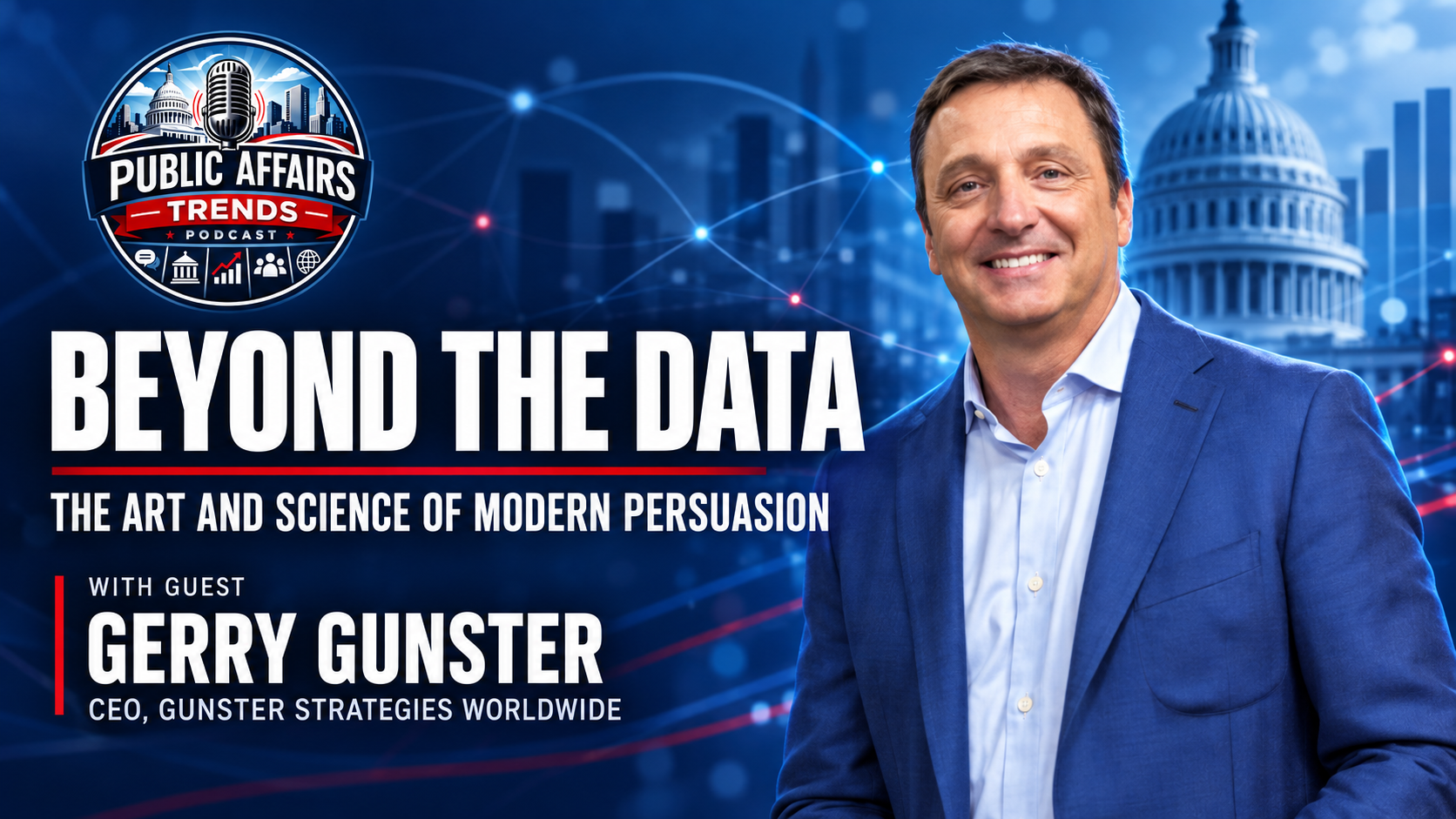
Public Affairs Trends Podcast episode featuring Gerald Gunster discussing Beyond the Data: The Art and Science of Modern Persuasion with Gerry Gunster, CEO of Gunster Strategies Worldwide

In the Public Affairs Trends Podcast episode titled "Beyond the Data: The Art and Science of Modern Persuasion," host Neil Hughes interviews Gerald Gunster, founder and CEO of Gunster Strategies Worldwide, Inc. Gunster discusses the evolution of public affairs campaigning, emphasizing the importance of understanding human behavior alongside data analysis. He shares insights from his experience as a strategist for the Leave campaign during the UK's 2016 EU referendum and highlights the need for authenticity and effective communication in modern advocacy efforts.

Beyond the Data: The Art and Science of Modern Persuasion

0:00 / 0:00

Beyond the Data: The Art and Science of Modern Persuasion

Public Affairs Expert Discusses Evolution of Persuasion in Campaigns

In a recent episode of the Public Affairs Trends Podcast, Gerald Gunster, founder and CEO of Gunster Strategies Worldwide, Inc., shared insights on the changing landscape of political communication and persuasion. With decades of experience in public affairs, Gunster discussed the evolution of campaign strategies, the role of data, and the importance of understanding voter sentiment.

Gunster's firm specializes in issue advocacy, referendums, and political communications. He has been involved in significant campaigns, including the Leave campaign during the United Kingdom's 2016 EU referendum, known as Brexit. Gunster emphasized that while the tools of persuasion have evolved, the foundational principles remain unchanged.

"The fundamentals are still the same," Gunster said. "You need to do good qualitative and quantitative research to figure out what it is that you're going to say externally." He noted that the methods for conducting this research have become faster and more varied, thanks to advancements in technology.

The conversation highlighted the impact of data on modern campaigning. Gunster acknowledged that while data provides valuable insights, it can also lead to "analysis by paralysis." He stressed the importance of understanding the psychological aspects of voter behavior, which cannot be captured solely through data analytics. "You've got to sit in a room and listen to what people think," he said.

Gunster also addressed the significance of identifying trusted voices within communities. He explained that effective communication requires not only a strong message but also credible messengers. "The messenger matters as much as the message," he said, citing the Leave campaign's success in utilizing relatable figures over traditional political leaders.

Reflecting on the Brexit campaign, Gunster pointed out that many analysts overlooked key voter sentiments. He noted that a significant portion of the UK population believed the country was heading in the wrong direction leading up to the referendum. "You cannot win an election when you have the majority of the population believing that the country is headed in the wrong direction," he said.

Working alongside prominent figures like Nigel Farage taught Gunster about the complexities of political communication. He described Farage as a driven individual who resonates with certain segments of the population, despite being polarizing. "He's a fascinating political figure," Gunster said, highlighting the importance of authenticity in messaging.

Gunster also discussed the transformation of public affairs in the digital age. He argued that organizations must adapt to a landscape where influencing public opinion requires more than just engaging with political insiders. "Everything is now a mini campaign," he said, emphasizing the need for integrated strategies that combine lobbying, communication, and external affairs.

As technology continues to advance, Gunster raised concerns about the ethical implications of using artificial intelligence and synthetic media in campaigns. He cautioned against generating misleading content, advocating for transparency in the use of AI-generated materials.

In reflecting on the corporate world, Gunster noted that business leaders often misunderstand public opinion dynamics. He warned against the "false consensus" phenomenon, where executives assume their views will resonate with the broader public. "Missing that step... is a massive mistake," he said, urging leaders to engage with stakeholders before launching campaigns.

Gunster's insights underscore the importance of adapting to the evolving landscape of public affairs while remaining grounded in fundamental principles of persuasion. His experiences highlight the need for continuous listening and understanding of voter sentiment in an increasingly complex communication environment.

For more information about Gerald Gunster and his work, visit gunsterstrategies.com.

Interview Q&A

Q&A: Beyond the Data: The Art and Science of Modern Persuasion

Q: Can you tell everyone listening a little about who you are and what you do?

A: I'm Jerry Gunster, founder and CEO of Gunster Strategies Worldwide. We primarily focus on issue advocacy, referendums, and some traditional lobbying. My work involves political communications, taking opinion research, developing messages, and raising issues externally.

Q: What can a campaign do today that would have seemed impossible in the past? What fundamentals of persuasion haven't changed?

A: The fundamentals of persuasion remain the same, such as conducting qualitative and quantitative research. However, the tactics have changed dramatically. Today, we have faster methods for understanding public opinion, but the core principles of messaging still apply.

Q: Has the availability of data improved our understanding of what moves people, or can too much data hinder curiosity about the audience?

A: There is a risk of analysis paralysis with too much data. I still rely on psychoanalytics to understand why people think a certain way, which requires listening to them directly rather than solely relying on data.

Q: How do you identify trusted voices within a community?

A: Identifying trusted voices involves listening to community members through focus groups and public engagement. The messenger is as important as the message, and local voices often resonate more than political figures.

Q: What insights did you gain from working with Nigel Farage during the Brexit campaign?

A: Working with Nigel Farage taught me about authenticity and message discipline. He is a driven figure who connects with people, and his polarizing nature highlights the importance of understanding audience sentiment.

Q: How has digital communication changed the model of public affairs?

A: Digital communication has transformed public affairs into a series of mini-campaigns. Organizations must integrate lobbying, communications, and external affairs to effectively influence decision-makers.

Q: Where do you draw the line between using technology effectively and undermining trust in the public affairs process?

A: While technology can enhance understanding and communication, using AI-generated content risks authenticity. It's crucial to maintain real human connections in advocacy efforts.

Q: What do business leaders often misunderstand about changing public opinion?

A: Many CEOs operate under the false consensus that their views reflect broader public opinion. This can lead to branding mistakes and misaligned campaigns if they don't engage with their audience.

Q: How can the corporate world learn from political campaigns?

A: Corporations should prioritize listening to public sentiment before launching campaigns. Engaging with stakeholders can prevent costly missteps and enhance their messaging.

Q: What resources do you offer for those interested in public affairs?

A: We have a website, gunsterstrategies.com, where people can learn more about our work. I also offer an online course based on my university lectures to help others understand public affairs better.

Q: How can people connect with you further?

A: People can visit our website or connect with me on LinkedIn for more information and to continue the conversation.

Key takeaways

  • The fundamentals are still the same. You need to do good qualitative and quantitative research to figure out what it is that you're going to say externally.
  • What I still rely heavily upon is the sort of the psycho analytics, which means why do people think that way? You've got to sit in a room and listen to what people think.
  • The messenger matters as much as the message.
  • You cannot win an election... when you have the majority of the population believing that the country is headed in the wrong direction.
  • You run into chief executive officers who have built massive companies who believe that what they think should happen is the way that it should go.

About the guest

Gerald Gunster

Founder and CEOGunster Strategies Worldwide, Inc.

Full transcript

Show full transcript
[00:03] Neil Hughes: Welcome back to the Public Affairs Trends Podcast. My guest today has spent decades studying one question: what is it that actually persuades people to act? His name's Jerry Gunster. He's the founder and CEO of Gunster Strategies Worldwide, an international public affairs and issue advocacy firm known for major ballot initiatives and political campaigns. His career has taken him from advising members of Congress and global corporations to leading strategy behind the Leave campaign in the UK's 2016 EU referendum. And along the way, he has watched campaigning move from television, radio, and direct mail to the world of real-time data, digital targeting, and rapid response communications. But today we're going to discuss what has changed, what hasn't, and what modern public affairs can learn from both. We've got a lot to get through today, so let me introduce you to my guest now. So thank you for joining me on the show today. Can you tell everyone listening a little about who you are and what you do? [01:16] Gerry Gunster: Great. Thanks for having me. I'm Jerry Gunster, Gunster Strategies Worldwide. I'm the founder and CEO of the company. We primarily do 3 things. Issue advocacy. 2, I do a lot of referendums and initiatives, which I know we're going to talk a little bit about Brexit later. And then 3, some traditional lobbying, not so much anymore. Those are common disciplines, professions in the Washington, DC metropolitan area, but for people outside of it, it's probably more accurate to say that it's political communications, taking opinion research, developing messages, and then figuring out a way that it goes external. Lobbyists are doing their work inside the buildings talking to congressional members and staffers, and then I come along and I can go into the districts. I can do television, radio, print just to kind of raise these issues to a higher level. So it's more accurate to say it's political communications. [02:20] Neil Hughes: I love it. And you've had a hugely successful career, and I was doing a little research on you, and you entered public affairs when the famous Harry and Louise campaign represented the cutting edge, and the toolkit was essentially television, radio, print, and direct mail. So much has changed since then. So what can a campaign do today that would've seemed impossible back then? And what fundamentals of persuasion haven't changed at all? Because it sometimes feels that so much has changed and so little has changed at the same time. [02:54] Gerry Gunster: Yeah, that's a really good question. I get it a lot. You have to be a certain age to remember the famous characters, Harry and Louise. Worth a look for some research by your listeners because it really was a groundbreaking campaign that completely turned what was Hillarycare before there was Obamacare, completely upside down. The fundamentals, and I do teach this at Georgetown University and George Washington here in DC to students, the fundamentals are still the same. You need to do good qualitative and quantitative research to figure out what it is that you're going to say externally. The way to do those 2 things has dramatically changed. It's quicker, it's faster. There's all kinds of ways to look at what people are thinking about a particular topic. So the fundamentals are there. You gotta start there. The tactics then come into play. What are you gonna do once you've figured out what the core messaging is? That obviously is, that's changing on a daily basis. You were, you're right. Direct mail, print, television, radio was Harry and Louise. and it made a massive impact. Didn't have phones, didn't have digital, didn't have social, didn't have a website to learn more information. So all of those tactics have drastically changed. But again, the fundamentals to get there, I believe, are relatively the same. It's just the toolkit that you've got to get there is just vastly different. [04:28] Neil Hughes: Yeah, completely agree. And fast forward to present day and technology has given campaigners extraordinary amounts of data targeting and real-time time feedback. So I'm curious, from what you are seeing and hearing, has this made us genuinely better at understanding what moves people, or can having too much data actually make strategists less curious about the humans behind the numbers? [04:54] Gerry Gunster: You know, I get a lot of analysis by paralysis. You can just throw data out there. But what I still rely heavily upon is the sort of the psycho analytics, which means Why do people think that way? Which you're still not getting that by data. You've got to sit in a room and listen to what people think because there's such a broad range of thought. And frankly, some of my best campaigns, slogans, lines, ways to look at things have come out of just sitting there listening to people talk about a subject matter. So that is still there. And I don't think it's as— people would love to skip that. phase, but you got to understand how people got there. And that, that the only way to do that is to just listen. You need to listen. Yeah. [05:42] Neil Hughes: And I was also reading that you argue that knowing who people will believe is every bit as important as knowing what they believe. So how do you identify the voices that genuinely carry trust within a community, particularly when audiences are so fragmented across social media, podcasts, traditional media, and even private online groups there? How do you identify those voices, Ben? [06:05] Gerry Gunster: Well, part of it is through listening to people in the communities. Again, this was by just the good old-fashioned focus groups and going out into the public and hearing what people have to say. Some of it you can pick up on social media, but the messenger matters as much as the message. And if you look at some of the campaigns that have failed. And we'll talk about Brexit, but the messengers for Brexit were far better on the Leave side than when they were the Remain side. And it made a big difference. People didn't want to hear from David Cameron every single day. In fact, the more they did, the worse it got. There's a famous moment in Brexit when President Obama came over there and told the people of the United Kingdom they're going to be at the back of the queue. That's the wrong messenger. So the messenger matters. They need to be local voices. They need to be third-party voices. You need to get into the community. You want to hear from nurses and doctors and police officers and border control people in these kinds of issues. You don't want to hear from the political people who frankly have approval ratings that are in the 20s and 30s. I mean, it's pretty— it's not common, but it's pretty common sense, if you will. [07:23] Neil Hughes: And you were the lead strategist for the Leave campaign during the UK's 2016 EU referendum, Brexit. I can't believe 10 years has passed already, but I mean, much of the political and media establishment back then, they all expected a different result. And then without going all beyond the politics of Brexit itself, what were you seeing in voter attitudes, behavior, and communications that maybe convinced you that Conventional wisdom and traditional media was missing something. [07:55] Gerry Gunster: Yeah, I'm glad that you mentioned putting politics aside because I have to walk into these rooms and give people lectures on what happened to Brexit, which I do quite often, particularly with my students at George Washington and Georgetown University. And I say, please put the politics aside because there's a number of things that happened during Brexit that people need to understand about why this happened. One of the most telling numbers, and you're obviously from the UK, but one of the most telling numbers back in 2016 prior to the vote, if you asked people in the United Kingdom, which we did on a daily rolling basis, how do you, do you believe the country is headed in the right direction or the wrong direction? It was well over 65%, sometimes teetering close to 70%. That people in the UK thought the country was headed in the direction, wrong direction. That is exactly the number that happened with Trump in 2016. You cannot win an election. You cannot win an election, whether it's a referendum or a candidate campaign, when you have the majority of the population believing that the country is headed in the wrong direction. It is begging for change. And that's a number that I just think every pollster just sort of ignored. Like, well, that might be true, but they're certainly not going to make this radical change. They made the radical change because they were not happy with the direction of the United Kingdom. [09:20] Neil Hughes: And of course, that campaign would bring you into close contact with Nigel Farage. And I'm curious here, what did working alongside such a prominent and polarizing political communicator, what did that teach you about authenticity, message discipline, and actually understanding an audience regardless of whether people agree with the message that was being delivered there? [09:44] Gerry Gunster: Yeah, you know, he is a polarizing figure and love him or hate him, he's still one of the most consequential figures in the United Kingdom of the last 12, 15 years, arguably longer. He's driven. He is a true patriot, meaning that he believes very much in being British. Working alongside of him, you're not keeping up with him. You know, you, you look at, uh, maybe people say this about Trump and again, love him or hate him. He's constantly working. Nigel is working all the time, constantly doing, you know, doing his job. So there, you know, he's a fascinating political figure. He's actually a very good sense of humor. But there are moments when you wouldn't walk down the street and you'll hear people yell nasty terms at him and he just kind of lets it roll. And then you'll go to other places where I've seen people come up and give him big hugs and thank him for doing what he's doing for the country. I mean, it's a fascinating part of my experience to have worked alongside with him. But again, love him or hate him, it's a man who's arguably one of the most important figures of the last 15 years in the UK. [10:52] Neil Hughes: And when we look at public affairs as a whole, it once depended heavily on relationships with politicians, journalists, and other influential people in the capital. But how has digital communication changed that model? And why is an organization potentially making a serious mistake if it still believes influencing the people in the room is enough? Because it feels like a few things have changed here. It's not. [11:19] Gerry Gunster: It's not at all. Obviously, you go back to Harry and Louise and that broke the ground, but everything here, and particularly in the United States, and I believe it's international as well, everything is now a mini campaign. You need all the various parts to work. You need lobbying, you need communications, you need external affairs. All these things need to work together. It is extremely important for this White House. I mean, if you think about this White House, it's almost like The Apprentice. When you have a subject matter or an issue that you need to get the attention of the White House, it's like you're trying out for The Apprentice. You need to get the attention of the White House. Just going into the room. and speaking with him isn't enough. You have got to turn up the volume outside of it, not only to sort of help him make that decision because he could use third-party support, but also if you're not in agreement with him, then you got to do something about it and it has to be an external communication. So everything is a mini campaign, everything. [12:25] Neil Hughes: And of course, we now find ourselves in an era of TikTok, generative AI, synthetic media, deepfakes and incredibly sophisticated microtargeting. So where do you draw the line between using technology to understand and communicate with an audience more effectively and using it in ways that might undermine trust in the overall democratic or public affairs process? [12:50] Gerry Gunster: Yeah, I think it's becoming a real problem. I have not gotten to the point where I'm doing television or broadcast or videos online using AI figures. You know, candidates might be able to get away with that, but you're not getting away with that on some of these, you know, quote unquote issue advocacy campaigns. You need authenticity, you need real people. Our jobs have gotten a lot easier with AI though, because you're taking massive datasets that are based out of the quantitative survey and you literally could dump it into AI. And ask for it to give you a summary that frankly would take me days and days and maybe a week or two to go through the cross-tabulations to figure out how to micro-target. This stuff is now at your fingertips. So there's some good, there's some bad. I personally am not there and I hope that I won't get there, but I don't want— I'm not generating fake stuff. And I think that people do that. there ought to be some sort of either voluntary or trade association or watchdog that says, you need to put a disclaimer on that that says that this is AI-generated because it's going to create confusion. [14:13] Neil Hughes: Yeah, completely agree. And if I was to ask you to look back after what, more than 3 decades working on campaigns across so many different countries and cultures, what do you think business leaders misunderstand most about changing public opinion? And what do you think the corporate world could possibly learn from political campaigns about, again, that same word we're coming back to, listening to people before trying to persuade them? [14:39] Gerry Gunster: Yeah, look, I have a ton of corporate clients and that's the backbone of this company is really helping political communications and being able to use that for corporations to express to policy leaders and opinion leaders why something's good or bad for their company. the answer to your question is easy, and that answer is that you run into chief executive officers who have built massive companies who believe that what they think should happen is the way that it should go. And psychologists refer to this as the false consensus. It's a consensus that's made in the boardroom, maybe driven by one personality, Where everybody says, yeah, that's what we should do. And then they take it and it falls flat outside that room. That's called the false consensus. So part of my job over the last 30 years has been to talk to these CEOs and this leadership to say, what you are presenting to me may or may not be the right way to approach this campaign. Let me test it to make sure that it's okay. But missing that step and thinking just because you created this wonderful company that you know what opinion leaders and decision makers ought to be thinking about you is a massive mistake in the country. Recently, it's like a cemetery of companies that have made that mistake, whose people have lost their jobs because they've made a branding mistake. without really listening to anybody when they've done it. [16:18] Neil Hughes: And I think that is a thought-provoking moment to close on today. But before I let you go, anyone listening wanting to find out more about you, your work, and anything we talked about today, or just carry that conversation on, where should they go? [16:33] Gerry Gunster: Yeah, gunsterstrategies.com, that's our website. And also offer an online course for people to learn how to do public affairs correctly. Over the last 30 years, I turned my lecture series that I do at the various universities into an online platform for people to enjoy. [16:49] Neil Hughes: Awesome. Well, I'll include links to everything you mentioned there and encourage people to connect with you and on LinkedIn as well. We'll include links in the show notes. But more than anything, just a big thank you for taking the time to sit down with me today. Appreciate it. [17:03] Gerry Gunster: You're welcome.

Filed under

Related episodes