Government • Public Policy • Public Affairs
Public Affairs Trends Podcast logo
← Public Affairs Trends

The Brief · Pici and Pici Onc

Joe Pici on Turning Public Affairs Expertise into Profitable Revenue

with Joe Pici, Ownder/CEO — Pici and Pici Onc

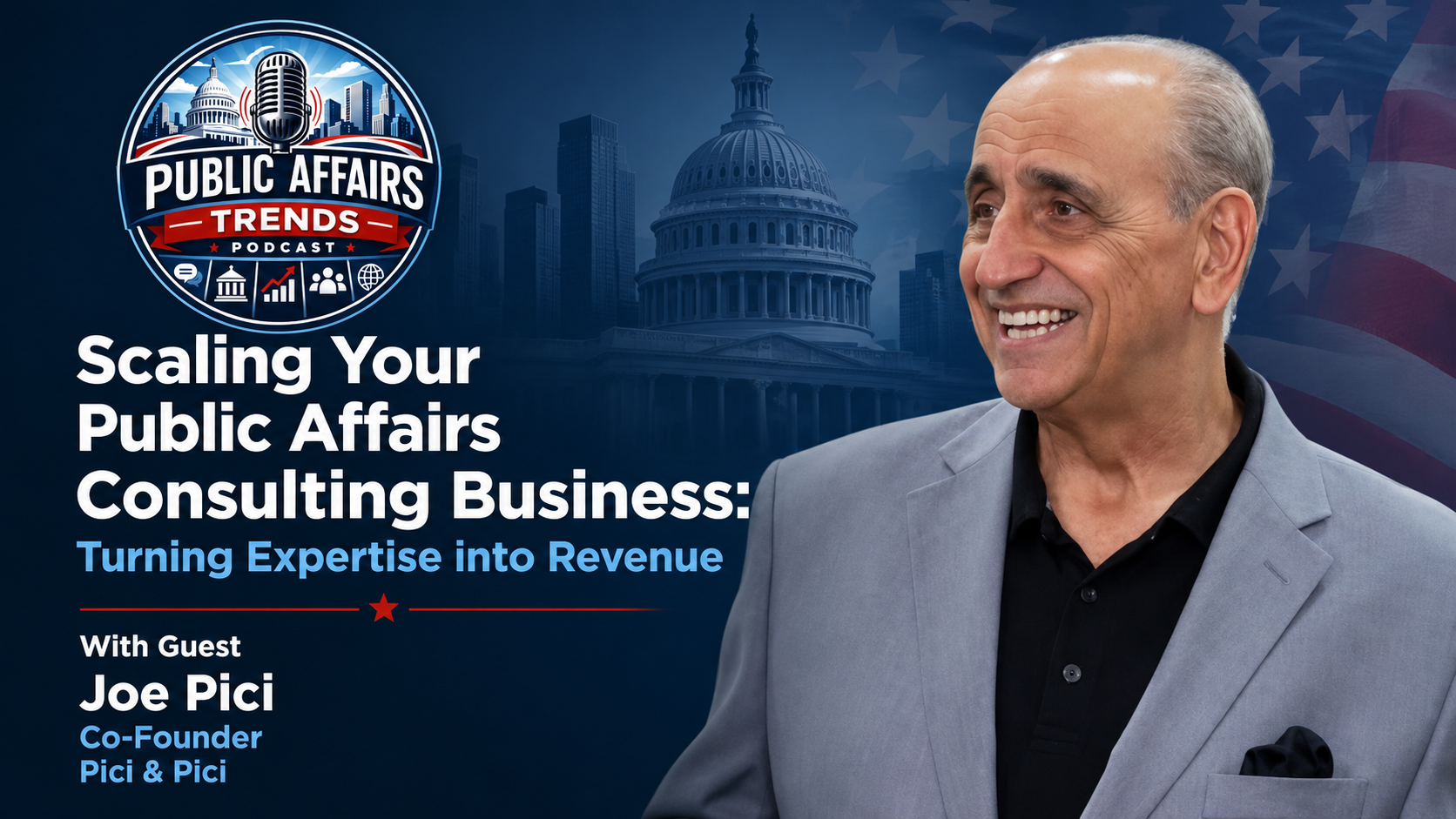
Public Affairs Trends Podcast episode featuring Joe Pici discussing Joe Pici on Turning Public Affairs Expertise into Profitable Revenue

In this episode titled "Scaling Your Public Affairs Consulting Business: Turning Expertise into Revenue," host Neil Hughes interviews Joe Pici, Owner and CEO of Pici and Pici. Pici discusses strategies for consultants to convert their expertise into revenue, emphasizing the importance of building genuine relationships on LinkedIn, developing effective sales processes, and maintaining authenticity in communication. He shares insights on overcoming common pitfalls in the consulting industry and offers practical steps for professionals to enhance their business models and client acquisition strategies.

Scaling Your Public Affairs Consulting Business: Turning Expertise into Revenue

0:00 / 0:00

Scaling Your Public Affairs Consulting Business: Turning Expertise into Revenue

Scaling Public Affairs Consulting: Insights from Joe Pici

In a recent episode of the podcast "Public Affairs Trends," Joe Pici, owner and CEO of Pici and Pici, discussed strategies for growing a consulting business by effectively converting expertise into revenue. The episode, hosted by Neil Hughes, highlighted the importance of leveraging platforms like LinkedIn, building authentic relationships, and developing repeatable processes to attract clients.

Pici specializes in helping businesses and individuals generate leads, secure appointments with decision-makers, and close sales. He works across various sectors, including small, medium, and large companies, as well as with speakers, coaches, trainers, and consultants. "I help them make money with their talent and intellectual property," he said.

Mistakes in Building Credibility on LinkedIn

Pici emphasized that many consultants fail to effectively utilize LinkedIn, which he noted accounts for about 85% of his leads. He cautioned against getting lost in the platform's influencer culture. Instead, he advocates for a more direct approach. "I literally look in the industries I want to approach, generate the leads, and then quickly pick up the phone and call them," he explained.

He pointed out that many professionals fall into the trap of comparing themselves to others on LinkedIn, which can lead to wasted time and effort. "Social media has allowed us to compete with much bigger companies, but if speakers, coaches, and trainers get in the comparison game, they can waste a lot of time," he said.

Effective Engagement and Authenticity

Pici stressed the importance of genuine engagement over mere self-promotion. He described his approach to building relationships on LinkedIn, which involves reaching out to new connections and initiating conversations. "I might just say, 'Hey, this is Joe Pici. We just connected on LinkedIn. Did I catch you at a bad time?'" he said. This directness helps establish trust and opens the door for meaningful dialogue.

In an era dominated by technology and AI, Pici believes that mastering communication skills is crucial. "A person that has mastered communications and the ability to have quality conversations will have an advantage," he said. He warned against relying solely on AI for content creation, as it can dilute one's unique voice and intellectual property.

Building a Sustainable Business Model

Pici noted that many consultants struggle to monetize their expertise effectively. He highlighted the need for a solid business model that encompasses various revenue streams. "Most speakers in the world cannot feed themselves," he said, underscoring the importance of understanding the business side of consulting. He encourages consultants to learn about their target market and develop a core story that resonates with potential clients.

He shared a success story from his boot camp, where a participant transitioned from corporate leadership development to running her own consulting business. After implementing strategies learned in the boot camp, she quickly secured clients and filled cohorts, demonstrating the effectiveness of Pici's approach.

Overcoming Self-Limitation and Building Trust

Pici acknowledged that many professionals face fears related to public speaking and building trust. He advocates for breaking down these challenges into manageable steps. "The best way I have seen people overcome fear is to break it down into learnable processes and skills," he said. His boot camps incorporate practical applications, allowing participants to practice skills in real-time.

He also emphasized the importance of authenticity in building a personal brand. "The majority of speakers, coaches, trainers, and consultants have never done what they're speaking about," he noted. By focusing on their unique experiences and developing content around them, professionals can establish credibility and overcome imposter syndrome.

Practical Steps for Improvement

To enhance their LinkedIn presence and commercial value, Pici advises professionals to clarify what they do and how they can help potential clients. He suggests using a whiteboard or legal pad to outline their expertise and develop content that addresses client needs.

Pici concluded the podcast with an offer for listeners. He invited U.S. listeners to text "Sales Edge" to 59925 for access to a free webinar aimed at acquiring clients. For international listeners, he offered a complimentary consultation via phone or email.

The insights shared by Joe Pici provide valuable guidance for public affairs professionals seeking to scale their consulting businesses. By focusing on authentic engagement, effective communication, and a solid business model, consultants can turn their expertise into sustainable revenue.

Interview Q&A

Q&A: Scaling Your Public Affairs Consulting Business: Turning Expertise into Revenue

Scaling Your Public Affairs Consulting Business: Turning Expertise into Revenue

Q: Can you tell us about yourself and what you do?

A: I'm Joe Pici, and I specialize in helping companies and individuals generate quality leads, book appointments with decision-makers, and close business. I work with all types of companies and also assist speakers, coaches, trainers, and consultants in monetizing their talent and intellectual property.

Q: What do you see on the whiteboard behind you?

A: The whiteboard contains formal proposals and outlines my process for generating leads. I generate leads, make calls, and conduct qualified sales meetings. If a potential client is interested, I provide them with a formal proposal. I aim to generate about 70 proposals a month.

Q: What are the biggest mistakes you see consultants making on LinkedIn?

A: Many consultants focus too much on trying to become influencers rather than using LinkedIn to generate leads. They can get lost in the platform and fall into the comparison trap, believing everyone else is making vast sums of money.

Q: How should professionals engage effectively on LinkedIn?

A: Effective engagement involves reaching out to potential clients directly after connecting. For example, I call new connections to introduce myself and explain how I can help them. This direct approach fosters real conversations rather than superficial interactions.

Q: How has AI impacted the consulting business?

A: AI is here to stay, but mastering communication and quality conversations is essential. Many in our industry are relying too heavily on AI, which can lead to losing ownership of intellectual property. It's important to maintain human connections.

Q: What advice do you have for building authentic relationships in public affairs?

A: Professionals should be authentic and stop pretending to be someone they're not. I recommend making personal calls to clients and maintaining relationships without always trying to sell something.

Q: How can consultants avoid adding to the noise on social media?

A: They should be intentional about their messaging and target audience. Many professionals don’t know their niche or how to brand themselves, leading to generic posts that don’t resonate.

Q: What makes a LinkedIn profile effective?

A: An effective profile focuses on the client rather than the individual. It should highlight value propositions and the results achieved for clients, rather than self-promotion.

Q: What separates successful consultants from those who struggle to monetize their expertise?

A: Successful consultants understand the business side of their work. They learn how to structure their offerings and identify their target market, rather than relying solely on free speaking engagements.

Q: Can you share an example of how you help clients monetize their expertise?

A: One client, Pradeepa, transitioned from corporate America to consulting. After attending our boot camp, she learned how to package her services and secured two $50,000 clients shortly after.

Q: How do you help clients overcome fears related to public speaking or self-promotion?

A: We break down the process into learnable skills and encourage practical application. Our boot camps include live calls and presentations to build confidence and provide immediate feedback.

Q: What should professionals focus on to protect their credibility while using social media?

A: They should focus on their unique experiences and develop content around that. Authenticity is key, and professionals should avoid speaking on topics they haven't personally experienced.

Q: What practical first steps do you recommend for improving LinkedIn presence?

A: Professionals should identify what they do to help clients and develop content around that expertise. This clarity will help them market themselves effectively.

Q: What gifts do you offer to listeners?

A: U.S. listeners can text "Sales Edge" to 59925 for a free 45-minute webinar on client acquisition. International listeners can reach out to me directly for a complimentary conversation.

Key takeaways

  • Most speakers in the world cannot feed themselves. They're good people and they speak well, but what they don't know how to do is the business side.
  • I believe first of all, they need to stop pretending they're somebody they're not. We need to be authentic.
  • LinkedIn for us is about 85% of the leads that convert to business, but I don't spend a lot of time trying to become an influencer.
  • The more free stuff you do, the less likely you are to get paid.
  • I think they need to be intentional about what are they saying and who are they saying it to.

About the guest

Joe Pici

Ownder/CEOPici and Pici Onc

Full transcript

Show full transcript
[00:07] Neil Hughes: What if the biggest thing holding back your consulting business isn't your expertise, but your ability to turn that expertise into paying clients? Well, my guest today is Joe Peachey, and he's going to share very practical lessons on using LinkedIn with intent, how to build real relationships in this AI era that we find ourselves, and how to create repeatable processes for turning your knowledge and intellectual property into revenue. So if you are a consultant, trainer, speaker, or communicator looking to grow your business, there are plenty of ideas here that you can put to work straight after the podcast. And my guest even graciously offers a gift to you all too. But enough from me, let me introduce you to Joe right now. So thank you for joining me on the podcast today. Can you tell everyone listening a little about who you are and what you do? [01:07] Joe Pici: Well, I'm Joe Peachey and I specialize in helping companies, individuals generate quality leads, book appointments with decision makers, close business. And I work in all verticals, small, medium, and large companies, individuals. But then I also work with speakers, coaches, trainers, and consultants to help them make money with their talent and intellectual property. [01:33] Neil Hughes: Well, thank you so much for taking the time to sit down with me today. Although this is an audio-only podcast, there is a whiteboard behind you which is absolutely full. You're a busy guy. For everyone listening, tell me what is on that whiteboard behind you there. [01:48] Joe Pici: Well, I think mistakes people make in our industry is they love speaking, they love coaching, they love training, but they don't have a process or the skills to get clients. So what you see on that whiteboard are formal proposals, which by my process is I generate leads, then I pick up the phone. Whether it's B2B market, I get through the gatekeeper. B2C market, I get to that person. We go into what, a qualified sales meeting. And then at the end, I ask them, do you want a formal proposal? And if they say yes, they get one. And I get about 70 of those out a month. And then I'm the one who does the training, coaching, and speaking also. [02:36] Neil Hughes: Wow, 70 a month. That is incredible. And I expect many people listening will automatically think around LinkedIn because that has become such an important part for professional information. influence. But I'm curious, you must hear and see so many stories, see a lot of mistakes there. So what would you say are the biggest mistakes that you see consultants, communicators, public affairs professionals— what do you see them making again and again when trying to build credibility on LinkedIn? [03:05] Joe Pici: Well, LinkedIn for us is about 85% of the leads that convert to business, but I don't spend a lot of time trying to become an influencer. Okay? [03:20] Neil Hughes: Yeah. [03:20] Joe Pici: I'm just looking at LinkedIn and I use the search box and I literally look in the industries I want to approach. I generate the leads and then I quickly pick up the phone and I call them. And I think LinkedIn is a magnificent tool, but you can get lost in it. The other mistake I think speakers, coaches, consultants is they believe what they see on LinkedIn and they think all those people are making all these kazillion dollars. And social media is a blessing and a curse. Social media has allowed us to, to our sales training bootcamp is ranked number 1 in the world by Global Gurus. And it's allowed us to literally compete with much bigger companies. But if speakers, coaches, and trainers get in the comparison game and try to be someone they're not that they're looking at on LinkedIn, they can waste a lot of time. [04:27] Neil Hughes: They really can. I've heard so many stories of one of those hiring private jets literally for 10 minutes just so they can sit on there, have their image for their Instagram and LinkedIn profile, and make them look something that they're not. And I mean, kudos to you for not going down that road and not wanting to try and be an influencer. And I think one of the problems as well is many people treat LinkedIn as just a broadcasting channel rather than a place to build very real human relationships. [04:55] Joe Pici: Exactly. [04:56] Neil Hughes: What does effective engagement actually look like when your goal is to influence people rather than simply collect views and followers and you want to work with them and build those relationships? Tell me more about that. [05:07] Joe Pici: It's more like, let's say for example, I'm looking to work with speakers, coaches, and trainers. Okay, well, I'll do a search, but I want to ask for a connection. Once I ask for a connection, I look in their contact and see if their phone number is there, and I immediately call them. Okay, and, and I might just say, hey, hey Bob, this is Joe Pici. We just connected on LinkedIn. Did I catch you at a bad time. And they'll go, well, what is this all about? And I'll say, Neil, I specialize in helping speakers, coaches, trainers, and consultants make money with their talent and intellectual property. Well, Neil, you have one of two things you can say: no thank you, or how do you do that? And that either starts the— see, I am politely direct, but I don't play games with people. [06:08] Neil Hughes: Yeah. [06:08] Joe Pici: Look, if I didn't have a business, I wouldn't be on social media. [06:13] Neil Hughes: So much has changed with running a business now with the influx of technology. And now we're seeing so many AI posts and everyone's LinkedIn profile almost looks the same as well. So what would you say are the keys to running a profitable business like yours? [06:28] Joe Pici: Okay. I just spoke to 120 electrical contractors. They own their own business. And my topic was human behavior, okay, as an advantage in an AI world. I think the world of AI is here. However, a person that has mastered communications, okay, and the ability to have quality conversations and understand technology is going to have an advantage. And I know people in our industry that are dumping all of their stuff into AI. Well, now it's open domain. There is no protection. And, you know, so what do we own? We used to own intellectual property. The minute you start dumping stuff on AI, you don't own intellectual property anymore. [07:29] Neil Hughes: It is such a good point. And I think if we put all the AI and technology for one side for a moment, because I think we are gonna come full circle. At the moment, everyone's just posting AI and sharing and creating lots of content. But I think that naturally creates an urge to return to the human connection again. So for someone that's maybe listening to our conversation today, they're working in public affairs or communications, how should they be thinking about that relationship relationship between the personal profile, the professional reputation, and ultimately the organization that they represent? Any advice there? [08:05] Joe Pici: Yeah, I believe first of all, they need to stop pretending they're somebody they're not. Yeah, I think we need to be authentic. We need to be real with people. I answer my own phone. I make my own phone calls. I create immediate trust You know, I make 3 kinds of phone calls. I make new outreach for potential clients. I make follow-up calls. And then I make calls with present and past clients, keeping the relationship strong. That doesn't mean every time I talk to them, I'm trying to sell something, but I'm keeping that relationship strong. And AI can't do that. Technology can't do that. But then I also recommend people become master communicators, whether they study DiSC, Myers-Briggs. There's so many different human behavior models. We're dealing with people. And the amazing thing is people have lost their capability of really good communications. [09:10] Neil Hughes: Yeah, I completely agree with you there. And I think very often people get lost and almost distracted by that constant pressure to post more frequently. and chase the algorithm, etc. And again, kudos to you for not doing any of that stuff. But for people listening that are, how can those professionals listening decide what is genuinely worth saying online and what is— what can they do to avoid just adding to them, to the noise online that just bombards our newsfeeds? [09:39] Joe Pici: I think they need to be intentional about what are they saying and who are they saying it to. And like, for example, we have a 3-day bootcamp on the business of speaking, coaching, training, consulting. And these are people that already speak well. They're already authors. These are people that want to monetize. And the amazing thing is most of them do not know what they really want to speak about, train about, coach about. They don't know who is their target market. They don't know how their branding plays into that, how to put on— they really don't know those things. So what they do is they just shotgun information onto social media thinking that people are going to go, wow, that person's wonderful, let me hire them. And that's not going to happen. [10:34] Neil Hughes: It really isn't. And as you said at the beginning of our conversation, people trying to be something they are not is something that we see. Also, others just shamelessly self-promoting constantly. So what would you say makes a LinkedIn profile communicate authority and expertise and be open to building relationships and being genuine and authentic without crossing that line into self-promotion or sounding overly polished? Is there a balance there? [11:02] Joe Pici: Yeah, there is. I think number one, the profile needs to be more about the client than about themselves. It needs to engulf value propositions. Like we specialize in helping client blank blank blank. See, I think most people talk about themselves, whether it's on LinkedIn, whether it's in a sales meeting. It's all about them rather than when you are in business. You find out it's more about the client. So I invite anyone to go look at my profile, Joe PG. I look like this and and connect with me. But look at what is said on our profile, which is more, probably 90% is about the clients we work with, who we serve, the results, benefits, and solutions of what we provide. Not that I'm ranked number 1 in the world and all, by whose ranking? [12:06] Neil Hughes: Yeah. [12:06] Joe Pici: It's just like Amazon bestselling books. You write a book and on Tuesday between 2:00 and 2:03, you sell 5 books. And now you're a bestseller. [12:17] Neil Hughes: So true. I think, well, I think we've all seen that. And I think there'd also be many consultants listening too that they often have a deep knowledge within their industry, but they struggle to turn that expertise that they've spent years building into a real sustainable business. So from the people you work with, what separates those who successfully monetize their intellectual property from those who remain dependent on, on just selling their time? [12:46] Joe Pici: Okay, so most speakers in the world cannot feed themselves. Yeah, they're good people and they speak well, and you put them on stage, they will do a great job. But what they don't know how to do is the business side. And so what we've experienced when people come to our training is once they understand how their business model plays into their revenue Like we have 10 different ways we generate revenue in the same business. Once they understand who would be their prime clients, once they understand how do we get to this person and how can we tell what's called a core story or an effective sales meeting that's consultative, right? How does our branding line up? With who we are, what we do, and who we serve. Okay, what so the people that we see doing very well have decided they're going to learn the back end of the business. Okay, once they learn the back end, then then they get to get paid for what they do instead of doing all this free stuff, hoping that somebody in the audience is going to go. Wow, I want to pay this person. Look, the more free stuff you do, the less likely you are to get paid. [14:16] Neil Hughes: And you're someone that you and your organization, you help consultants, trainers, speakers all make money with their individual talent and their intellectual property. And that is pretty much speaking to everyone that listens to these podcasts. So for all those people that have just heard me say that, that you're going to help them make money, Tell me, I don't know if you can give any examples or maybe walk me through how you help them and just to bring to life what we're talking about. [14:41] Joe Pici: I'll give an example. In our last boot camp, we had a woman, Pradeepa, and she came and she was in corporate America for 25 years and she was in their leadership development department and she wanted to go out on her own and she did. But she wasn't making any money. And so she was doing a lot of free stuff. So she came to our sales bootcamp and our speaker bootcamp. And on day 3 of our sales bootcamp, we make live outbound calls, no role play. And she wanted to get into the corporate market and she also wanted to build cohorts. So she made her phone— after we did all the scripting and all the work, she made phone calls, she booked appointments. [15:30] Neil Hughes: Yeah. [15:30] Joe Pici: And then we helped her package herself up, look at what she wanted to train, how to take it to market. Within 2 weeks of that boot camp, she filled 2 cohorts where people were spending over $800 a month to be with her, right? And then we did some coaching and 2 weeks ago we started going after the corporate market. We did the same process in coaching and she landed 2 $50,000 clients. [16:04] Neil Hughes: Wow. [16:05] Joe Pici: That happens a lot. This is not a one-off and it's not because I'm special. It's not because, you know, I'm a guru. It's because client acquisition is about processes, strategies, skills, and communications which can be learned. So that's what we do in our 3-day Speaker and Consultant Bootcamp is we help people get a business approach and be able to attract and retain clients that are going to pay their fees. [16:38] Neil Hughes: And I suspect that many people that you work with, they've got the expertise, they're incredibly good at what they do, but putting themselves out there in those early days is very terrifying for a lot of people. Maybe they've not done public speaking in front of large organ— uh, large audiences, or maybe they're worried about what people think and how they're perceived and imposter syndrome and all that stuff. Do you, do you hear that side of things too? And how do you help them overcome some of those self-limitations? [17:08] Joe Pici: We hear it all, okay? It's like we've been doing this for 30 years, okay? And so people come, all different backgrounds, all different skill levels, The best way I have seen people overcome fear or blockages is to break it down into learnable processes and skills, but then actually do the thing. When we opened up our bootcamps, we said they would be application bootcamps. That's why in our sales bootcamp, we actually do the live calls on day 3. But in our speaker bootcamp, we teach people how to do a standing, what we call core story, which is not a hard sell, but it shows great value and it compels people in the audience to want to have conversation about hiring them. Well, we work on that and they deliver it on day 3. So when they walk out of that bootcamp, they have a business in a box. And generally, they start getting paid relatively quickly. [18:19] Neil Hughes: And I also suspect there'll be many people listening that will fear building or earning trust and reputation that's required to take them to that next level. So for those people, how can they use content and social media to create opportunities but most importantly protect their credibility that they've been spending years building? So again, many will be afraid of losing that. [18:43] Joe Pici: Well, I think once again it comes down to knowing what are my— what is my uniqueness and what is my core ability, and sell that and talk about that. This is controversial, and I don't mean to be, but I'm going to get— let it go. The majority of speakers, coaches, trainers, and consultants have never done what they're speaking, coaching, training, consulting about. That's where imposter syndrome comes from. Right now, the world is being flooded by college graduates who can't find jobs and they're going into consulting. And they may be brilliant, but they've never done anything. So I recommend to the speakers out there, the consultants, take something that you have some experience doing and then develop content around that. So what we do is we don't speak, coach, train, or consult on anything that we don't do. That erases imposter syndrome. And then when you post on LinkedIn, then when you, you come out and you develop, but we didn't develop our brand for 3 years. We let our clients tell us who we were in the marketplace. So when we do post something, it comes from authenticity, which is, I believe, one of the strongest ways to build a brand. Did I answer your question? [20:13] Neil Hughes: You really did, 100%. Fantastic answer there. And finally, to give anyone listening a real valuable takeaway, especially on improving the numbers there, if someone listening today, they want to improve both their LinkedIn presence and most importantly, the commercial value of their expertise. Any practical first steps that you'd recommend that they make? [20:35] Joe Pici: Yeah, I think what they, they need to do is they need to get with a whiteboard or a legal pad and they need to say, what is it that I do that helps potential clients? Okay. And say, now, how do I develop my own content around that expertise and take that to market. Now, I have to ask a question. Is this an international podcast? Is this an American podcast? Who, who does this podcast serve? [21:10] Neil Hughes: I would say it is an international podcast, but by far the biggest audience is US. [21:15] Joe Pici: Okay. I have a gift then for everyone in the US, and then I'll have a gift for the people in the non-US. If they take out their cell phone and they put in the text box the word Sales Edge, S-A-L-E-S-E-D-G-E, and text it to 59925, it'll take you to a peachy and peachy link. Hit the link. It may ask you for an email, but it's, they're, it's going to be sent to you a 45-minute free webinar that will help you acquire clients. Now, for the people internationally, there's a couple ways you can reach me, and I'll give you a complimentary cup of joe. I will not sell you. I will answer a question for you. You can call me at 407-947-2590. You can link up with me on LinkedIn. You can send me an email at joe@picandpic.com. Let's have a conversation. I know that you'll have a question and I'll answer it for you. [22:22] Neil Hughes: Wow, that is incredibly generous and selfless of you there. And I think we've talked a lot today around authenticity and working with people, building relationships. But it's great to see you living and breathing exactly what you said. So, anybody listening out there, if you've got your Sharpie out, if you're on your whiteboard or making notes in your phone, please, take my guest up on his offer there and let's see where this leads. And maybe you can improve everything that we've been talking about today. But more than anything, just thank you so much for taking the time to sit down with me, share your time with me today. Really appreciate you. [22:58] Joe Pici: My pleasure. Thanks for the honor. [23:00] Neil Hughes: So, Joe has left everybody with a simple challenge there. Get clear on what you do and how your expertise solves a very real problem. Yes, technology can help you reach more people, but conversations, trust, and communication, these are the things that turn opportunities into business. So over to you. What is the one thing that you can do today to turn more of what you know into something your clients will genuinely value and pay for? Lots for you to take away there. I'll be back again next week with another guest. A big thank you to Jo, and thank you to you. for listening. Speak to you next week. Bye for now.

Filed under

Related episodes