Show full transcriptHide transcript
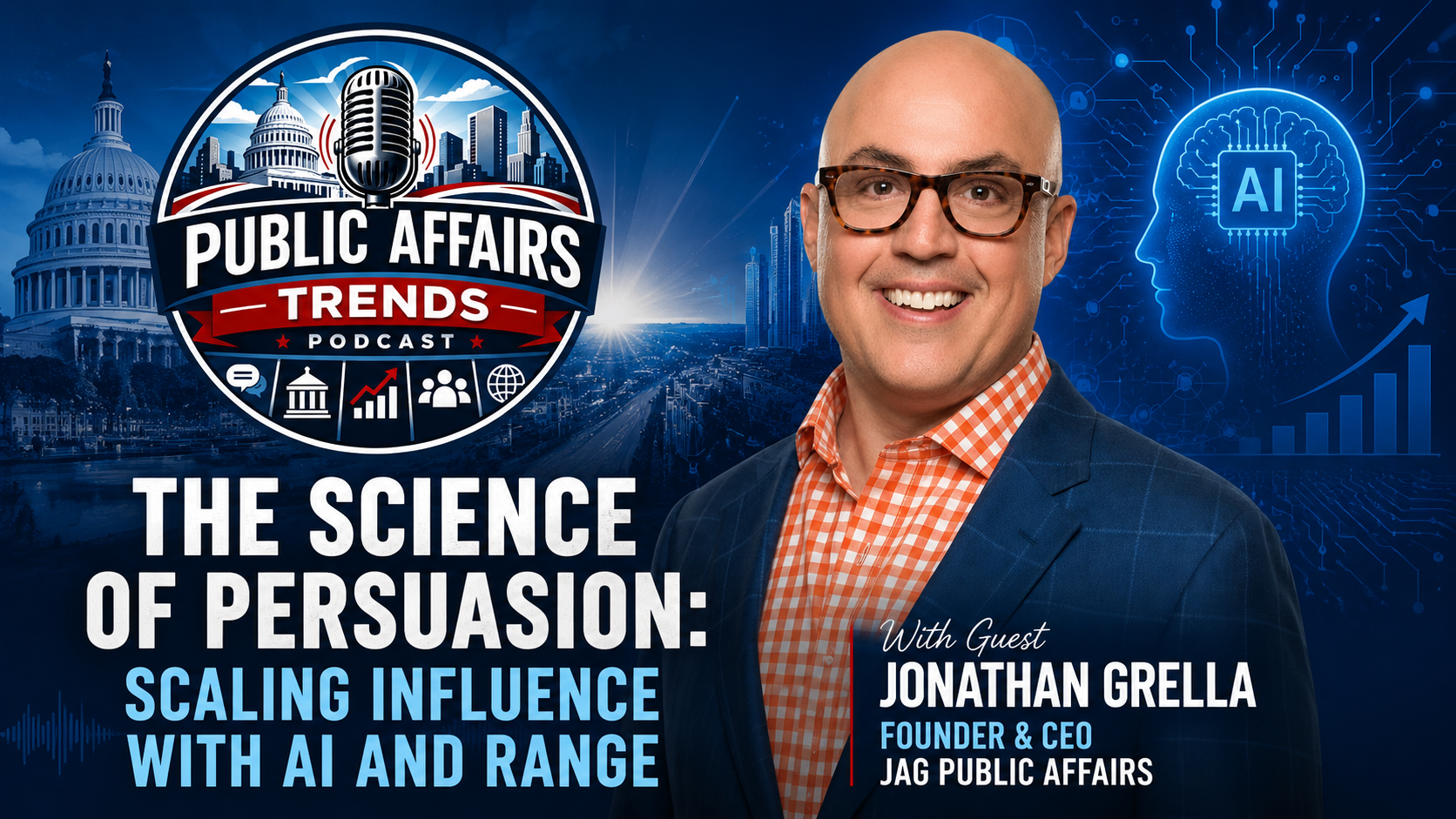
[00:07] Neil Hughes: From fax machines on the campaign trail to AI helping shape communications in seconds, public affairs has changed almost beyond recognition. But has the art of persuasion really changed with it? Welcome back to the Public Affair Trends Podcast, where we examine the ideas, technologies, and strategies that are changing communications, advocacy, media, polling, and stakeholder engagement. My guest today is Jonathan Greller, and he's the founder and president of JAG Public Affairs. And Jonathan brings with him 30 years of experience across Capitol Hill, corporate communications, professional sports, trade associations, crisis communications, and reputation management. Yeah, I think it's safe to say this is not his first rodeo. So today we'll talk about why public affairs is ultimately a business of persuasion and how AI is helping communicators work at speed and scale without losing authenticity. And we'll also discuss why producing more content doesn't necessarily make you more influential. And we'll also get into crisis communications, rapid response, reputation management, and why sometimes the smartest communications decision is knowing when to say less. So let's get into it. So thank you for joining me on the show today. Can you tell everyone listening a little about who you are and what you do?
[01:43] Jonathan Grella: I'm Jonathan Grella, and I'm a 30-year communications, PR, and strategy professional based in Washington, DC. I've worked in politics and sports and business all this time. And really happy to be with you today.
[01:58] Neil Hughes: And I'm glad you've took time to sit down with me because, I mean, 30 years experience spanning politics, public affairs, professional sports, trade associations.
[02:09] Jonathan Grella: It'll age you.
[02:10] Neil Hughes: And corporate communication. I mean, you must have seen so many trends and technology trends along the way. But before we talk about the tech side of things, how has that breadth of experience shaped the way you advise clients today?
[02:24] Jonathan Grella: I think the book Range is a must-read. And I've been searching for the right words as a comms professional to make the case for my having been a— what I guess you could say a mile wide and an inch deep, but like not over 30 years to get more than an inch, I guess. And once I realized that versatility and range are about pattern recognition, And then pattern utilization. And if somebody says to you, hey, why should I hire you as a consultant? We focus on biotech. What do you— what could you possibly know about biotech? And while I have done biotech, I could tell them that I've done 7 or 8 different things. The same thing with like language. Like if I found out that you spoke 3 or 4 different languages, that I've— I'd have great confidence that you could pick up number 5 and 6.
[03:17] Neil Hughes: Yeah.
[03:17] Jonathan Grella: So I think, I think, um, I'm a big believer in a breadth of experience and, and, um, in the confidence to know that you could take your tools and your skills and apply them to different fields and conquer new frontiers.
[03:32] Neil Hughes: Completely agree with you. And as I said a moment ago about technology, so much has changed there. I mean, what if we just quickly look at an overview of 30 years? We've got the rise of mainstream internet.
[03:44] Jonathan Grella: I didn't have the internet during grad school or college, Neal, and I didn't have my first email address until grad school. And I mean, it's unbelievable what's happened since.
[03:55] Neil Hughes: Yeah.
[03:56] Jonathan Grella: I was well into my, like, early in my career, it was fax machines and you didn't open your email account more than a couple of times a day. And like, there'd be like a few emails in there and I was blasting out fax machines, like, you know, on the campaign trail, like a true pro. And then like, it wasn't until years later that even like, Twitter, you know, came to pass and such, right? So a ton has changed. And then we'll get to AI too. But like, wow, wow, wow, we've seen a lot.
[04:28] Neil Hughes: Yeah, so much. So sometimes wish you could go back to those old days of US Robotics modem connecting, you know.
[04:36] Jonathan Grella: And then, but of course, Video Professor.
[04:39] Neil Hughes: Yeah. I mean, from there it was mobile, digital disruption, cloud, now AI and AI agents. When you look back at the change and you've been a big part of it throughout there, How has public affairs changed in that time?
[04:53] Jonathan Grella: I mean, massively, right? Like, the speed alone, Neil, and the fact that, like, we're, like, taking in so much, digesting it, and kind of, like, dispensing with it so very quickly now. And what you need to do to break through and persuade and stick and be resilient and survive storms and reputational challenges— I mean, a million different things and ways to slice and dice it. And I think that the real next frontier, you know, and then I'm sort of like leading toward this like AI transformation and the AI arms race has kind of come to Washington, which, you know, was inevitable. And how can you, you know, scale your influence? How can you institutionalize your message? how can your influence and like message, your narrative compound over time and like the insane speed and efficiency that that will bring to bear. So a lot there, but it's amazing how folks who were committed to being cutting edge, like at a certain point, I guess either got tired or whatever else, but like what choice do you have, especially when you have to like, source your own business and clients like I do. Like, if I don't hunt and succeed, then I don't eat, right? So you have to learn new tricks all the time. And so you have to continue to keep that growth mindset. Yeah.
[06:32] Neil Hughes: And aside from the technology, you mentioned the word persuade there. And when I was doing a little research on you, I was reading how you often talk about persuasion rather than just communications when talking about the industry. So what is the difference here? Why does that matter?
[06:47] Jonathan Grella: So persuasion is like a behavioral science, right? Think of it like that way. Let's say we are psychologists. We are specialists, right? And then like for a long time, I think, you know, there were comms people who were like, you know, this isn't rocket science and it sold it short. And then there are other people who tried to turn it into like an actual science and that was probably overselling it. But like, look, We're in the business of persuasion, just like trial lawyers would be, just like salespeople would be. We're trying to change hearts and minds, and it has real bottom-line consequences, be they political, business, you name it, public opinion. And so the light bulb went on, Neil, when in the aftermath of 2016, I was like so many people, particularly political and comms professionals and political professionals who were trying to make sense of the 2016 election outcome. And like, what did I miss? Like, what didn't I get? You know, and, you know, you're just, geez, man, like, you know, a lot of us really kind of missed, missed what was going on, right? And shame on us. And you could be pissed at it, or you could say, like, never again. Like, I need to get underneath, underneath this and understand it. So read Scott Adams' Win Bigly. It helped me understand Trump, the 2016 election, his unconventional style. And, you know, think of him as like a baseball knuckleballer or an unconventional guy and try to make it as sort of clinical as possible. possible. And then underneath that, Adams gets into the science of persuasion, Dr. Robert Cialdini and the book Influence. And of course, I had to go read that and subsequent books and, and how people essentially can weaponize or utilize language and stuff like, heck, anybody who's doing polling and focus groups are trying to optimize language and put their best foot forward. And comms professionals are doing it with a lot of times guesswork or instincts, right? Or client preferences. But like, you can actually like learn persuasion techniques, and I have. And then the exciting part of that, it, you know, bringing it into the present is that you could then bake persuasion techniques into your AI and into your client work. And so you make this maximally persuasive and like, that's unbelievably powerful. So yeah, I'm, I'm very passionate about persuasion and, and continue to be a lifelong learner about how to get even more impactful and effective with delivering messages.
[09:18] Neil Hughes: And as you said there, AI is transforming communications. And I'm curious, in your world, how are you using to help clients work smarter while also maintaining authenticity and trust? How are you helping them here?
[09:32] Jonathan Grella: Yeah, I mean, part of it is an educational thing and like, and getting them comfortable, like wading into the water, like dipping a toe in, right? And there's a lot There's a lot, you know, what, what has broken through, particularly people of, of our age and generation, is the fear side and the downside. And what if my client information finds its way out there? And what if there's a hallucination? And, and like all of the fear stories, and it's the same few ones. And it's amazing for the, you know, hundreds of highly impressive people that I would have, you know, coffee or beers or lunch with or, you know, text conversations. And they know that I'm into this, so they, they bring their, you know, hopes and and Dreams to me, and they're all lamenting the same, you know, kind of urban legends and stuff. I'm not saying urban legends like they're untrue, but the same 3 or 4 tropes or whatever. And you're like, guys, like, here's the thing. If you're not doing, let's say, something with like a lot of numbers, then like I wouldn't worry about hallucinations as much. And by the way, when do we ever relinquish our responsibility to review our work? We don't just like, put something into chat and then just like no-look pass, send it off to the client. Like, it's always your obligation to review everything. And then people get very paranoid. So you're really trying to break down these barriers and say, listen, there is speed, there's efficiency. And if you allow me— and then I am with a lot of clients, it's like sort of trusted confidant or advisor, and you feel like a running mate with them or a wingman. We are kind of jogging with them through their workday each day, and with the help of this technology, are able to crank what they need in real time. So they get a text or a visit from the boss and they say, I need this or that. And they say, hey, you know, it's almost like watching, you know, The Bear where like they order the kitchen and you go cook it up. And, you know, I worked at a lot of restaurants myself, so I really, that really, I really respond to that. And you just try to turn stuff around as quickly as possible, turn the tables over as quickly as possible. And once you get them to understand that, You give me your notes. I've always been able to help you put your best foot forward. Now this machine can do it at speed, at scale, it'll remember your preferences, it'll compound, and it'll just get better and tighter and more momentum over time. So if you think about a client relationship that obviously hopefully lasts years and years, right? Let's say we work together for a year and a year of back and forth and a year of feedback and, and all of this background and stuff have fed into it. Like, how, how much knowledge and how much, how much power will it have banked and compounded over that time? And then like, you're the beneficiary of that. So then in the subsequent years, you're just reaping the rewards and the windfall of this, this machine getting to know your comms and your message, your CEO specifically versus that executive or whatever. And you, and obviously you can be as specific as you want. So there are a million different manifestations and applications for it. But as a one-man band who, you know, who advises clients and kind of, it's like very intensive and, you know, senior-level pro to senior-level pro, that, that this has been an unbelievable force multiplier.
[13:03] Neil Hughes: And I'm curious on your viewpoint here because social media famously gave executives that direct route to their audience. AI now makes it possible to produce more content than ever before. So do you think leaders are in danger of possibly communicating too much? And how do you make sure visibility actually strengthens their reputation rather than becoming just too noisy or a part of that noise out there? Is this something you're very aware of too?
[13:28] Jonathan Grella: It's a great question, right? There's so much.
[13:31] Neil Hughes: Yeah.
[13:31] Jonathan Grella: There's— everybody always wants more and thinks that the answer is always a little bit more. And, and, you know, and, and, you know, as we get older, we learn, you know, the life that sometimes less is more, and that there needs to be restraint, and that the— some of the, uh, beauty in life is in the contrast. And sometimes you have to, you have to, like, you know, downshift to, to make the, um, upshift more meaningful. So Yeah, you can, you can crank a lot of stuff. I don't think that the stuff that— the ability to produce a ton of material and content in words and pages, I think of mainly as helping get you better. And as I get more mature and, you know, take, you know, try to get ever more like accountable and, you know, read books about like, you know, about extreme ownership and such that you, you just say like, there's nowhere when you're solo for the work to hide, right? So I've gotta find a way to be on top of everything, to take on client work as soon as it comes in. Because if I get slammed and like 3 clients need something at once, like I can get buried pretty quickly and then my business model gets exposed. So like, I've gotta, I've gotta be urgent and efficient and like, it's really, It's a very interesting kind of exercise to kind of attack each day is like, how do I get myself a little bit more efficient?
[14:58] Neil Hughes: One of the reasons I wanted to ask that is I think we're all operating in an environment now where as an organization or as an individual, we can respond to a controversy within minutes, but that level of speed can also make a bad situation even worse. And you're someone that's managed communications in high-pressure situations. What are the keys to effective crisis communications?
[15:21] Jonathan Grella: Yeah.
[15:22] Neil Hughes: What mistakes do you see them making most?
[15:24] Jonathan Grella: Great question. And so I'm a big believer in rapid response in that if your reputation is being maligned and so many people's are these days and organizations, and there's obviously a lot of paid efforts that are out there that are passed off as sort of being authentic, that are intended to malign a brand or organization, candidate, you name it. figure you have to be urgent in correcting the record. You have to be clear and you have to be dogged about fighting for your reputation. And just like you would, I saw the movie The Fugitive for the umpteenth time last week. And you think about the awful feeling, like if you were wrongly charged with something, like you wanna shout it from the rooftops, right? I didn't kill my wife.
[16:10] Neil Hughes: Yeah.
[16:11] Jonathan Grella: And so If someone's maligning your reputation, like, you got to fight like hell. And so is saying— the danger I find a lot, a lot of times is everybody just wants to like unburden themselves and like, just like, you know, like, here's my chance to tell you everything I think about everything. And like, you know, then they explode and you're like, actually, like, if we're talking about an earned media situation or social media situation, you might have a couple sentences. Like, so let's— like, how can we make a maximally impactful couple of sentences so that people's takeaway is unmistakable and intentional, right? Like, we don't want this to be a buffet. We want this to be a very deliberate and intentional plated dinner. So I do believe in responding to stuff urgently, but there is unfortunately, you know, meaningful stuff gets washed out or doesn't get enough attention. And then once it's already been washed out, gets, you know, kind of treated as leftovers, like from the media and other folks. You're like, you know, there was a report that was released last week that was super important. And the takeaway at the moment was like, not exactly like it kind of missed the point. Like, I'm just circling back to like, oh, that was released all week. We don't have any use for it anymore. You're like, ugh. So like the shelf life of things is so limited and the attention span is so awful. But like, we've gotta play by the rules that exist today. And that's, that's what I'm saying about like adapting your speed and adapting to the scoring system as it as it actually is.
[17:42] Neil Hughes: And if, let's say, a CEO or even Dr. Richard Kimball— so you watched that recently— called you tomorrow and said, I think I've got a bit of a reputation problem on my hands here, what would you do or look at to determine whether they genuinely have a communications problem or whether communications is simply exposing a deeper business problem? But how would you approach something like that?
[18:05] Jonathan Grella: Yeah, you evaluate them. And in many cases, just being a news junkie, you're aware of a lot of people's reputation. And then they, if they come through referrals, you'll hear from, let's say a lot of the clients that I would get would be sourced by lobbyist friends of mine and friends of mine and trade association executives or PR professionals. And so you'll, you'll find out whatever from, from referrals about people's reputations. But now I, you know, I'm just using AI, right? So I'll go to several tools that, you know, and And ask them. And there's one tool that constantly frustrates me in terms of having the lifeguard whistle out and telling me that my questions are either too weaponized for persuasion or too partisan or too edgy. And I'm like, this is where I live. This is my career, man. I'm paying you hundreds of dollars a month and you're telling me that I'm playing too close to the line. I'm like, I know where the freaking lines are, dude. And like, I've had times too where I, where like the AI tool— I don't get off track— but the AI tool will like say to me, like, you'll talk about a political, like, giving strategy for like a client or whatever. And like, it's like a little bit outside of like my wheelhouse, but like I could advise on like, on like how to give to, to build relationships and stuff. And, and like, it's like, well, you should talk to a lawyer. And you know, you know, you should not, you should not link official activity to political giving. I'm like, no shit, Sherlock. Like, And I wrote back. I actually like like got in an argument. I was like, "I did talk to my lawyer for your information, and his name is Phil." Here's his link. So anyway, so you'll you'll research people's reputations on you know on AI. And actually, that's like a new thing. I was even listening to a pod about this week was instead of like looking at like search engine optimization, like put in a brand on on you know in in one of the in. Grok or Chat and Claude and ask it, ask it, what do people say or what do people think about it? It's very interesting. You'll get different answers, of course. So, so I assess people where they stand with their brands and look, you have to have this very healthy attitude that like if I'm going to make a living or where I've kind of positioned or parked myself, you know, you can't lament people's problems too very much because like I wouldn't have had many of the opportunities opportunities I've had in my career if people weren't up against the wall, right? Or, you know, if there were an adverse situation. So, you know, it's like a high-leverage relief pitcher in baseball, or you name it, somebody who's counted on, counted on to deliver in the clutch. Uh, you can't be too mad when, when business is good. Um, so anyhow, so that's, that's how I assess where people stand. Uh, you have to do a lot of listening. And a lot of times you're really— you're also doing a lot of like reading between the lines and like assessment of like kind of like what— it's almost like putting them on the couch, right? Like you're kind of like analyzing them. Like, are they— they seem super sensitive, they seem triggered by this, they have the chip on their shoulder about this or that. And, and you try to help them. You're not like judging them as much as you're reading them and saying like, how can I build a client relationship that's constructive, that's built to last, and doesn't begin like with this like recipe for resentment where, you know, we kind of don't get each other, we don't take the time to get aligned, they have outsized expectations, they think they're going to be in the Wall Street Journal or, you know, in, in some like 30 Under 30 list, you know, you know, without, without proving a thing, you name it, right? And, um, and so I'm now at this kind of stage of my career in consultancy where like Alignment is like everything. And like, you just gotta like put your time into that. And like, you know, you could spin your wheels and I do and I have like in producing more and more stuff and like being like a sort of prolific, like a scorer. And but like, I don't know that that gets you anywhere. Like, you also have to like, clients need to feel heard and you need to like, you need to address like what they really, what they're really getting at, right?
[22:18] Neil Hughes: Yeah.
[22:19] Jonathan Grella: And, you know, sometimes if a client says like, I'm thinking about going on X and responding myself, that's not what they're asking you to do. There's maybe what they're really saying is, I'm tired of being attacked. Is nobody else— is the cavalry not coming? Right? Like, that's— I mean, like, read between the lines. That's what they're really saying, right? Look, I've been married for almost 20 years now, so I understand, like, And I have, you know, 2 kids who are teenagers now, and like, you have to read between the lines a lot. And what people say and what they mean are 2 different things sometimes. So like, you really have to make these professional relationships work. You kind of have to do more than just like deliver a crisp press release or soundbite.
[23:01] Neil Hughes: 100% with you. And for people that are listening and hearing about JAG Public Affairs and yourself for the very first time, explain a little why organizations bring you in and what they gain from working from you so they understand that ROI and how they can work with you, etc.?
[23:18] Jonathan Grella: Yeah, thanks. So, first of all, my website is jag.ninja. So, my initials are J-A-G, Jonathan Adam Garella. So, jag. And they had all these suffixes that I got to choose from. I couldn't pick .com, but I was pleased to see that ninja was available as a suffix, as was pizza. And I didn't want to lean too much in the Italian stereotype or confuse people into what business I was in. So I picked Ninja because it's like close enough. I thought it was pretty cool. But I'm like, you know, over 50 dad now. So like there's very little that I do would be, you know, not viewed Dr. Rick territory by my pained teenagers. Anyhow, so I am a— a long time ago was a— was an amateur wrestler, like in high school. And, and so I think of like in terms of like weight classes, right? And like not every client or people that have a reputational challenge or a need in Washington, a public policy objective, crisis, you name it, can afford some of the PR firms that I've worked for, my friends have worked for, etc. And they need senior counsel. They need the— they need not a kid, no offense, but like they need like a trusted senior person with no interference who can deliver like in the clutch. and they don't have all the money to pay the big firms. I, as, as someone who likes to call my own plays, prefer to work like as a consultant, prefer to work like alone, meaning like as a sole proprietor. And so there's no interference and folks, my clients just get me. So you end up gravitating toward a certain sort of weight class of client where they're like startups or lean and mean organizations, or at the very least, a singular executive, a trade association executive. It could be from a big organization, but like one person who I'm again, like their kind of wingman or like their kind of like comms and strategy consigliere. So you would have to kind of fit into that, into like one of those zones to be like an ideal fit. Could be a coalition, a think tank, a company, you name it, startup. But like, but there are— but if you want that senior counsel, And kind of a more of a Moneyball approach that this is how you this is how you get that quality thirty-year counsel and somebody who's kind of seen it all across politics sports and business and and so that's that's how I end up with the clients that I do so thank you for asking Neil no problem at all and we have covered so much in a short thirty minutes together today we've covered technology its role in public affairs messaging advocacy crisis communications and how you're helping clients communicate with clarity, credibility, and impact.
[26:08] Neil Hughes: It's great to hear all that, the journey that you've been on as well. I think that really brought it all to life. So I will add a link to the website there, encourage people to check you out. But more than anything, thank you for sharing your story with me today.
[26:20] Jonathan Grella: It's been really, really fun, Neil. And sometimes it takes occasions like this to reflect on, you know, a career as long as mine and And a lot of these experiences from, you know, my first day on Capitol Hill was when the Lewinsky scandal broke. I worked on under the Capitol dome on 9/11. And, you know, I've seen a lot of stuff from, you know, pro sports and the war room and the locker room and all that kind of stuff. And it's been an awesome, really fun ride. So thanks for allowing me to relive it a little bit. And hopefully it informs other folks' journeys. So thanks for doing what you do.
[27:01] Neil Hughes: 30 years can take you from fax machines to social media to generative AI and agentic AI. But Jonathan's experience suggests one thing hasn't changed. Communications only matter if it persuades somebody. AI can help public affairs professionals research faster, understand their audiences, refine their messaging, remember preferences, and respond at a pace that would have been unimaginable earlier in Jonathan's career. But more speed and more content can also create more noise. But I particularly liked his point about restraint. When organizations face criticism or a reputational crisis, the temptation is often to explain everything. And Jonathan's advice is almost the opposite. Respond quickly, yes, Fight for your reputation, but understand the few sentences that people actually need to remember. And beneath all that technology, there's a very important lesson here. Listen carefully enough to understand what your clients, stakeholders, and audiences really mean rather than simply what they say. So a big thank you to Jonathan Grellier, founder and president of JAG Public Affairs, for joining me today on the Public Affairs Trends Podcast. Thanks for listening. I'll speak with you again real soon. Bye for now.