Show full transcriptHide transcript
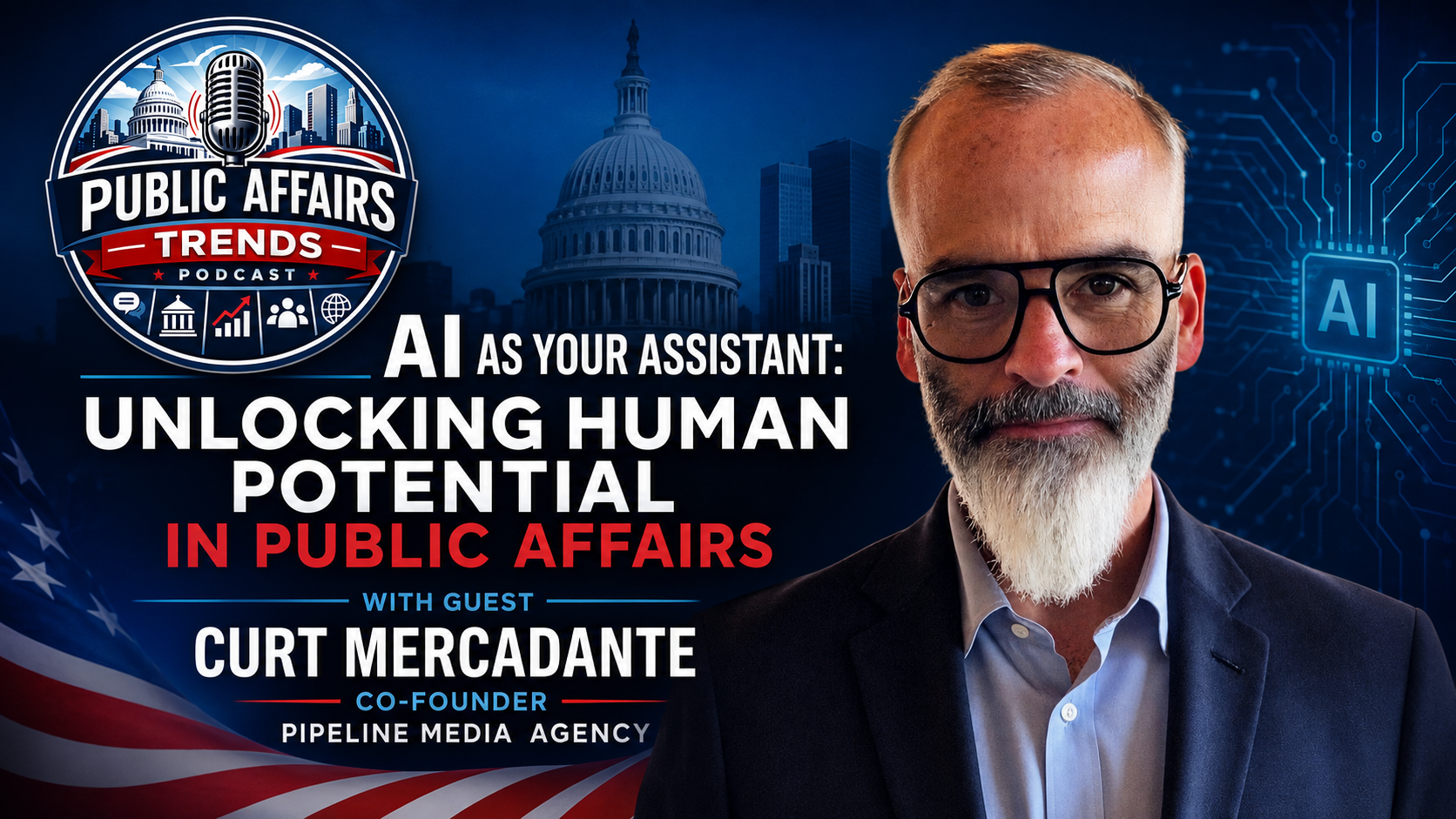
[00:03] Neil Hughes: What if AI's biggest value isn't replacing people, but giving us more time to do the things that only humans can do? Now, in public affairs, influence still depends on relationships, judgment, and conversations between people. But research, content creation, audience targeting, and countless hours of repetitive work can now be completed in a fraction of the time. So today I'm going to be speaking with Curt Mercadante. He's the co-founder of Pipeline Media Agency, and he's going to join me and discuss why we need to remain the architects while AI plays the assistant, and how almost anyone can now build their own technology without knowing how to code. And we'll also discuss the falling cost of content creation and how it's making distribution, ownership, and reaching the right audience more important than ever. But enough from me. Let me introduce you to Kurt right now. So thank you for joining me today on the podcast. Can you tell everyone listening a little about who you are and what you do?
[01:17] Curt Mercadante: Yeah. Hi, Neil. Thanks so much. My name is Kurt Mercadante. And I'm a co-founder of Pipeline Media Agency. What we do is we get our clients guaranteed media coverage. We don't focus on the legacy media. We focus on the decentralized media that really has revolutionized the industry. Then we take that news coverage and we promote it directly to your target audience. So instead of spray and pray, it's hitting the people who need to be hit to see your message. Specifically, that's what I do. I have 30 years of experience, public relations, public affairs, political campaigns, worked in some trade associations, took some time off to do some business and strategy coaching, but now I'm back doing this.
[02:02] Neil Hughes: Well, thank you for sitting down with me today. I think we can both agree, and everyone listening, that AI seems to be everywhere right now. There is a lot of noise that surrounds it. And on this show, I always try and get people thinking a little bit differently about the areas that AI impacts and very often areas that you don't associate with technology. And I would imagine that public affairs is possibly one of those areas too. But how do you see it changing the day-to-day work of public affairs professionals? Because we've seen all the shiny keynotes and the big promises and everything in our news feeds, but what are you seeing on the ground here?
[02:38] Curt Mercadante: Yeah, I think, you know, there is especially in public affairs or if you're in sales, etc., right there, the power of the face-to-face, whether that's face-to-face on a Zoom call or face-to-face in reality in someone's office or on a phone call, is of the utmost importance. But how can you free yourself up to do more of that and less of the busywork and the strategy and the research? And I think that's where AI comes into play. You know, the ability to build targeted lists. You know, we talked about what we do in terms of, of taking media coverage and delivering it specifically to targeted audiences. You know, there's a lot of, you know, software as a service out there built around kind of cultivated lists. Well, a lot of that's going to go away now because you can go into Claude, you can go into ChatGPT, and you can build very targeted lists that were previously proprietary in like 30 seconds, right? Whether those are email lists, contact lists, etc., you name it. You know, the cost of producing content is coming way down to almost free. I think so. The way I like to— and this isn't just for public affairs, this is for any industry, this is for anything. And I try to teach my kids this, by the way. I just, I built them, you know, here in the US, it's the 250th anniversary of the United States, and I built them an app. There's an app called Lovable, and it's an LLM to build apps. And between ChatGPT and Lovable, I used it to build a 40-day lesson It was complete with daily quizzes and it was daily lessons, 40 days to 250 on the history of the United States. And so we were talking about it. I said, listen, here's the deal. I couldn't just tell AI to build this app. I couldn't just say, build this in 40 days on the history of the United States.
[04:26] Neil Hughes: Yeah.
[04:26] Curt Mercadante: You'd get some stuff maybe I wouldn't agree with. You'd get some stuff that maybe was out of order, whatever it was, right? So you've, the key is you gotta know what you're talking about first. So I always, I always point back to, you know, my kids and I love Marvel movies and the Avengers. And, you know, there's Tony Stark, right? And there's Tony Stark who famously has Jarvis, who is his AI assistant. The thing about Jarvis is Jarvis is really advanced, more advanced than any LLM we have, more advanced than any AI, at least that we know of in existence. Guess what? Through all those movies, even when Jarvis becomes a human or sort of a human, a living being named Vision, Tony is still in charge. Tony was the brain. Tony was the strategist. Tony was the architect. Jarvis, the AI, was the assistant. It was an extension of who he was. And I think the important thing to realize, and where I have seen people go really wrong, is where they try to substitute AI for their brain. Instead of me going into ChatGPT and saying, build a, a 40-day lesson plan on the United States, I had to outline it out first. I had to be an architect for the building to ensure that the building was gonna be on a firm foundation, looked right, and was exactly right. And then it was an ongoing conversation. Now, previously it might've taken me a month to build that plan. It took me about 2 hours. And so yet you have to remain the architect and use AI as an assistant to accomplish your tools. Instead of having AI be the assistant where you can just sit back, put your feet on the desk and say, AI is gonna do all my work.
[06:06] Neil Hughes: And I think you will have set off a few light bulb moments there. So for people listening to our conversation, they're hearing Lovable mentioned for the first time. It can help you turn your ideas or help almost anyone turn their ideas into a full web app in minutes with its AI builder. But what's your experience has been with Lovable and how easy was it to get up and running for anyone listening thinking, I might check this out after the podcast?
[06:31] Curt Mercadante: Yeah, you know, Lovable is great. I mean, and it, like any LLM, sometimes I get frustrated. It's funny, my wife will come in, I'm frustrated, I'm having an argument. She's like, who are you arguing with? I'm like, AI, you know? She's like, what? And it's funny, I'll say, why did you do that? I asked for this 3 times. And I said to my wife recently, in college, I had a class my freshman year called Principles of Reasoning. I wasn't a good math person. Right? So I took Principles of Reasoning, and Principles of Reasoning is kind of if this, then that, right? That's what it is.
[07:02] Neil Hughes: Yeah.
[07:02] Curt Mercadante: And I wondered, when am I ever gonna use this? Now is the moment when I'm using this. To be an architect, you have to look at it and say, if this happens, then that happens. If I put this load on this column, it's going to collapse. I have to know that to build it. And so to use Lovable, that's what you have to do. So I actually, I'll use ChatGPT, and I'll have a whole discussion with ChatGPT to give me a prompt to put in Lovable, right? And so it's a back and forth process. And so you can use language to build it, but again, you gotta really know what it's like. So what have I built on Lovable? I built, you know, I used a variety over the years of productivity management, you know, paid software as a service, you know, productivity suites. And I didn't like any of them because some of them had a little bit of what I wanted, And so it's like, it's like the streaming wars, right? Like nothing has all the channels I want. So then I gotta pay 3. So I just decided to build one with everything I want. I call it Atlas and I have my to-do in there. I rebuilt my own version of Google Docs in there. My calendar's in there and I built it on Lovable and it's incredible and has a voice assistant that I talk to all the time. I built that all through Lovable and you know, you build in these pieces, you gotta be patient. You got to be willing to do the if this, then that reasoning to be a true architect. And if you have those things and you're patient and you're willing to go back and optimize on a regular basis, you know, every day I make a list of this went wrong today on this app and then I go in and fix it. You can be really successful with it. Unfortunately, I think, you know, over the past several decades there have been studies and a lot written about The declining attention span of humans. You know, we're, we're, I think we're down to a goldfish. I think it's like 8 seconds. It's interesting that this is the moment when we need a better attention span. You'd think, so you'd think it's less, right? With AI, you need a smaller attention span. You actually need a, a, a longer attention span to be able to have that discussion with AI. And if you use AI as that, you have a discussion, you have a back and forth. like it's a team member, and you have the patience to build, because the AI is not gonna call in sick, by the way. The AI is not gonna claim that they have a mental health day, right? The AI is not gonna come in late to work. And so you can have that discussion on an ongoing basis. But it's funny how technology has withered away our attention spans. Now's the time when you actually need it.
[09:38] Neil Hughes: It's such a good point. And I think many organizations are experimenting with AI right now, but I don't know if you saw this, but I think it was last year or the year before, year before, an MIT study stated that 95% of companies were failing to get any return on investment from their AI projects. And I mean, you mentioned a few moments ago around what you think some are going wrong, outsourcing critical thinking, for example. But where do you think so many are getting this wrong?
[10:06] Curt Mercadante: I think that a lot of people, a couple ways, I know a lot of people who just use AI like they used Google. Yeah, they ask a question, it gives them an answer, and then they take that and run with it. You know what? What's the bad— live in Phoenix, Arizona. You know, what's the best barber near me? You know, whatever it is, they leave it at that. You know, there, there are automations that you can set up. Let's say, let's say you're in public affairs and you're following and you're tracking a certain issue and you could just set up an automation in Claude or ChatGPT that every morning at 6 a.m. send me a rundown of news on these 4 issues. And it will, and you can go deep on it. I mean, again, you can build and craft whatever you want AI to deliver you at any time. And so a lot of people don't have the patience to sit and really design that out. And so I think people use it on the surface, I think there are people who don't use their brains and they just want AI to replace it. And when AI gives them the wrong answer, they throw up their hands and say, see, this is a hoax. And they walk away. You know, it's, I'm going to go back to Tony Stark, but it's like, you know, over the Marvel, the Avengers movies, you know, it goes from something that takes, you know, 40 seconds to the Iron Man suit to build around him to he just has the thought and nanoparticles just automatically build this kind of this liquid metal. It's not liquid metal, but around him. I look at AI as like that. Like I wake up and I'm like, what can I build today? What problems am I having today? What, you know, what blockages am I having in any part of my workflow? And if you, if you take a half hour and you map it out and you reverse engineer, from the solution you want and you bring it backward and you can have a discussion with AI to do that, you can clear just about any roadblock, any blockage. And I think when people are using it wrong, they're using it on the surface, they're substituting it for their brain instead of actually using their brain to use that as an assistant and keep themselves as the architect. Or they don't, they just don't have the patience to sit and interact with the AI. Now, this, this may sound very simple to people who are like building AI and developers, But I'm talking about public affairs professionals who are not trained in technology at all, right? And, and so from a public affairs standpoint, from research to list building to drafting content, I mean, all you have to do is take one quote. You can build a press release immediately out of it, you know, a letter to someone. Now you got to look at it. You got to make sure it's okay. You got to fact-check it. But that editing can take you minutes, whereas the crafting of that content might have taken you a half hour before. And so, and by the way, it'll probably be more accurate and more well-written, you know? And Neil, I know you and I are big on like LinkedIn content, producing content. AI can be fantastic, but I've seen people, and you've asked where people go wrong, they use it to craft the content from A to Z without declaring or telling AI, what they want the point of the story to be or the point of the article. And so AI gives them kind of crap. And that's, again, you have to be the architect and you gotta look at it at the end, right? You gotta fact check it. I mean, AI will hallucinate. I remember one time I, it was, there was a political figure who had given a couple speeches. I said, pull me quotes from these 2 speeches. And it gave me a bunch of John Lennon quotes. I'm like, wait a second. I think you're having a moment here. I think you're hallucinating, maybe like John Lennon used to, but you're hallucinating. And so, yeah, those are just a few ways where I see people go wrong.
[13:59] Neil Hughes: Yeah, I think so much has changed and so much hasn't. And I think the old adage of garbage in, garbage out is stronger than ever. And your passion for unlocking business value by leveraging AI really shines in our conversation today. And I'm curious, as someone that spent years helping organizations create and distribute content, how are you seeing AI changing the way that your public affairs teams are thinking about content today? And if there's anybody listening in the industry that are maybe looking to follow in your footsteps, what should they be thinking about?
[14:32] Curt Mercadante: Yeah, I think creating content at scale is important, right? And that not only helps when you're distributing it, and we could talk about distribution as well, because I think that is at a premium now that the cost of content's going down. When you produce content at scale, instead of just doing one blog post, you know, you, you, you produce podcasts instead of doing one blog post, produce 50. Take every quote from that podcast and build it around. Why is that important? Why is scale important? Because guess what? LLMs and AI search is fast replacing SEO. I mean, I remember a couple months ago, like search was, regular search was down like 30%. I'm sure it's more now. So what does LLMs, what do the LLMs like, the large language models? So ChatGPT, Claude, Grok, et cetera. What does it love? It's an answer engine. It's a solution engine, right? And so it wants to look for content that provides a solution or an answer to the questions you're asking. And so the interesting thing I tell people is, you know, we're headed into territory here where you can have a really crappy website. But still rank above everyone else in the LLMs. Where it used to be SEO was about ranking your website. Now it's about ranking solutions-based content. And the more you can do that at scale, produce Q&As, produce blog posts, produce press releases, you keep doing that and doing that and doing that at scale. And the ability to do that at scale where you used to have to hire someone to do it, hey, produce me 20 press releases and you pay them a bunch of money. Now you can do it in 30 seconds. Now you gotta check it. You gotta make sure you gotta be the architect. You gotta, you gotta set up the right prompts, make sure the content is right. I think that and the cost of doing that has come to zero. And if you're not taking advantage of that, you have to. And, and that's gonna be super important with content. And, you know, public affairs is about influence, not about manipulation. It's about influence and using content to influence key stakeholders. whether that's in business, whether that's on Capitol Hill, whether that's in states, cities, wherever, is super important. And content is the key, is the foundation to do that.
[16:42] Neil Hughes: Yeah, I completely agree. And I think the big message for anyone listening, I would suggest, is, is maybe rethinking search visibility. When you're searching for any form of content, are you going to a website or are you doing it within an AI window there? And as a result of that, generative engine optimization or GEO, which is leveraging earned media, that is rapidly becoming the next layer of search strategy for certainly something to look up there. And you mentioned distribute— distribution a moment ago, and one of your areas of expertise has always been content distribution. So why is distribution just as important as creating that great content?
[17:21] Curt Mercadante: Yeah. So the cost of generating content is going to almost zero. Yeah, right. I mean, depending on how much you want to do in the quality and all that, certainly, and you want people to check it, etc. But compared to what it used to be, distribution is becoming incredibly important because how we consume content has been fast changing. You know, it used to be the same. We all got our news from the same 4 TV stations. Now it's like, which of the 100 cable news stations are you going to get your news from? Right?
[17:51] Neil Hughes: Yeah.
[17:51] Curt Mercadante: You look at how podcasts has revolutionized elections just in the past 5 years. Then you look at social media, right? And, you know, Facebook changes the way in what it calls political content every year or 2. I know someone who's actually going to be a guest on this podcast soon who said, you know, the problem was every time Mark Zuckerberg got called before Congress, they tightened up your ability to run ads on Facebook.
[18:18] Neil Hughes: Yeah.
[18:19] Curt Mercadante: And so it affected small business owners as well. And you also have to realize these— all the social media, you know, you're renting space. Actually, it's free. You're not even renting space. You're getting space for free. And so everyone can complain, well, LinkedIn, I had a post, Neal, 2 years ago, and I was threatened to be banned from LinkedIn.
[18:38] Neil Hughes: Wow.
[18:39] Curt Mercadante: Post was a picture of meat on the grill. Yeah. And they banned it. Now, I don't know why they banned it. And someone said, well, an algorithm might have thought that was like a picture of war and someone bleeding. And someone said, well, it might have been some vegan didn't like your picture. Whatever it was doesn't matter. It, it showed me that I don't own this platform.
[19:00] Neil Hughes: Yeah.
[19:01] Curt Mercadante: It's their platform. I get there for free and I put my content there. Well, now with the cost of content coming down, how can I build my own distribution engine? I know someone who is in the business of buying up mailhouses because people saw them as not good investments, mailhouses where you'd send out direct mail, et cetera. And so, no one wants to buy these and they're going away. And he really is doubling down at buying these for a song saying, I think mail's moment is coming back because people are getting so inundated online, right? You, over the last 5 or 6 years in politics, all of a sudden the growth of text messaging. And now to keep up with it, Google and Apple are coming up with spam inboxes on text messaging. So where's that going to go? I see people going back to email. Well, what happens when that happens? Are they going to go back to text? Where are they going to go? And so, you know, offline, you and I were talking about the fact that I'm going to look at buying, you know, uh, regular good old-fashioned radio stations. You know, if you can build your distribution engines and diversify, don't just go all in on Facebook or LinkedIn because they can take that away from you in a heartbeat. Build your email lists, build your text lists, build your opt-in lists. You know, if you can get on local radio, you know, make sure you're putting out plenty of content so that people are finding it on the LLMs. Diversify because the world is diversifying. You know, I still know some public affairs and PR folks who are 100% set on getting what I call brand legacy mastheads. Are you in the Washington Post? No, but who's reading the Washington Post? The people who are paying for the paywall? Are you counting the Russian bots, the Chinese bots, et cetera? Well, no, I don't know, right? That's all about distribution. Don't rely on other people, on rented platforms only. And with AI now, you can bring the content down to free. You can scale it out. How are you going to distribute it? I say diversify email, text. Yes, social media. Can you get on local radio? Start putting your stuff on EIN Presswire, you know, get your press releases out there, you know, flood the zone with content, distribute, build your own list as much as possible. You know, with AI, we talked about Lovable.
[21:10] Neil Hughes: Yeah.
[21:11] Curt Mercadante: I'm so sick of email distribution software, you know, because they overcharge you, they have limits, etc., etc. I'm building my own email system right now on Lovable because I want to own my own platforms in this AI era. And with AI, I can constantly optimize it by going in, writing a few sentences. I don't have to— I don't know code. I'm not a tech guy. And making it better and optimizing and fixing it. If you take advantage of that, that's how you can make yourself resilient as a public affairs professional for you, your agency, and your clients in this AI era.
[21:45] Neil Hughes: Yeah, I would echo everything you said there. And I think existing in or building an audience on somebody else's playground and being at the mercy of their rules, their algorithm, introducing pay-to-play at any stage should never be a primary strategy. So if you were advising a public affairs team that could be listening to our conversation today, they're just at the beginning, they want to use AI, what are the first 3 things you'd tell them to do to get up and running?
[22:13] Curt Mercadante: Number one, make a list of all your challenges in the day. What's wasting time? What's taking too much time? What are your blockages? You know, what is, what's taking your eye off the ball? Maybe it's research, making lists. Maybe it's making press releases. Maybe it's outreach, whatever it is, make that list. Set that as your target and say, okay, these are our challenges. These are the things that are the problem. What would life look like if these problems went away, right? Well, we'd have an extra 2 or 3 hours. You know, maybe we could— those 3 new people we hired, instead of them having busy work, we could really get them on a track for growth to really help grow revenue. And then they can grow and do the things that they want to do, do more fun work rather than just busy work. Right. And then what you do is you set that solution. You got to reverse engineer. I wrote a book, gosh, 7, 8 years ago, and it was more of a lifestyle book, right? It was about how to live a certain life, but a big part of it was reverse engineering. And it was set that outcome and then reverse engineer to now. What most people do, they do this in life with any goal, but they also do it with AI. They start here and they try to move forward. Well, that's like throwing spaghetti against the wall to see what sticks, right? With AI, reverse engineering is so important. I have this challenge. Okay, great. Well, how do I fix this challenge? How do I really want it to look? Well, here's what I want it to look like, then reverse engineer. When you reverse engineer, you're building that building, you're creating, designing that building in reverse. That's prompt engineering. You take that prompt and you put it into AI. AI can help you build it. And, and so I, you know, it's make a list of your problems, right? What, you know, I, it's, it's Elon Musk. There's a famous story when he wanted to start building rockets. He ran into all the rocket experts and they, oh, you can't do it. That's going to be $20, $30 million a rocket. And he's like, that doesn't sound right. So he went and looked at all the components of a rocket and said, well, it only costs this. And then if I hire some smart people to put it together, it only costs this. I think he ended up building it for like $2 or $3 million or something like that. My numbers might be off, but the percentage of difference were not off. And that's first principles reasoning. It's the same thing. You start with the problem. Here's what it's like. You reverse engineer, and then by doing that, you build the path forward, the straightest, simplest, you know, most efficient way to get where you want to go. I think that's the way to use AI because in doing so, you, you know, Steve Jobs always said you can't plot the path going forward. You can only do it looking backward.
[24:50] Neil Hughes: Yeah.
[24:50] Curt Mercadante: Well, you can kind of, you can kind of do a reality distortion feel like Steve Jobs used to do by imagining you're in the future and Plotting it backward. You could do that with any task, any problem, any blockage that you have. And by doing that, it keeps you on the straight and narrow and ensures you're using your brain and ensures you're in control of the AI and you're solving real problems that can save time and money for your agency.
[25:11] Neil Hughes: Wow, a lot of actionable takeaways and pure gold there. I think that's a powerful moment to end on. But for everyone listening that goes away, completes those 3 tasks, and then thinks, I need to speak with Kurt again now. Where can anyone find more information on anything we talked about today and keep up to speed with what you're doing? Where would you like me to point everyone?
[25:31] Curt Mercadante: Yeah, follow me on LinkedIn, Kurt Mercadante, M-E-R-C-A-D-A-N-T-E. I'm posting regular content on a lot of these topics there. You can also email me at kurt@plmediaagency.com. Happy to answer any of your questions.
[25:48] Neil Hughes: Well, we covered so much there around how AI is transforming public affairs in everything from content creation to influence. A lot of big takeaways. I encourage people to check out the links that will be in the show notes there. But more than anything, thank you for sitting down with me and talking about this in a language everyone can understand. Pleasure as always.
[26:06] Curt Mercadante: Neil, it has been my pleasure. Thank you so much.